
Startups & Business News
Operational Excellence Scales Through Leadership and Intelligence
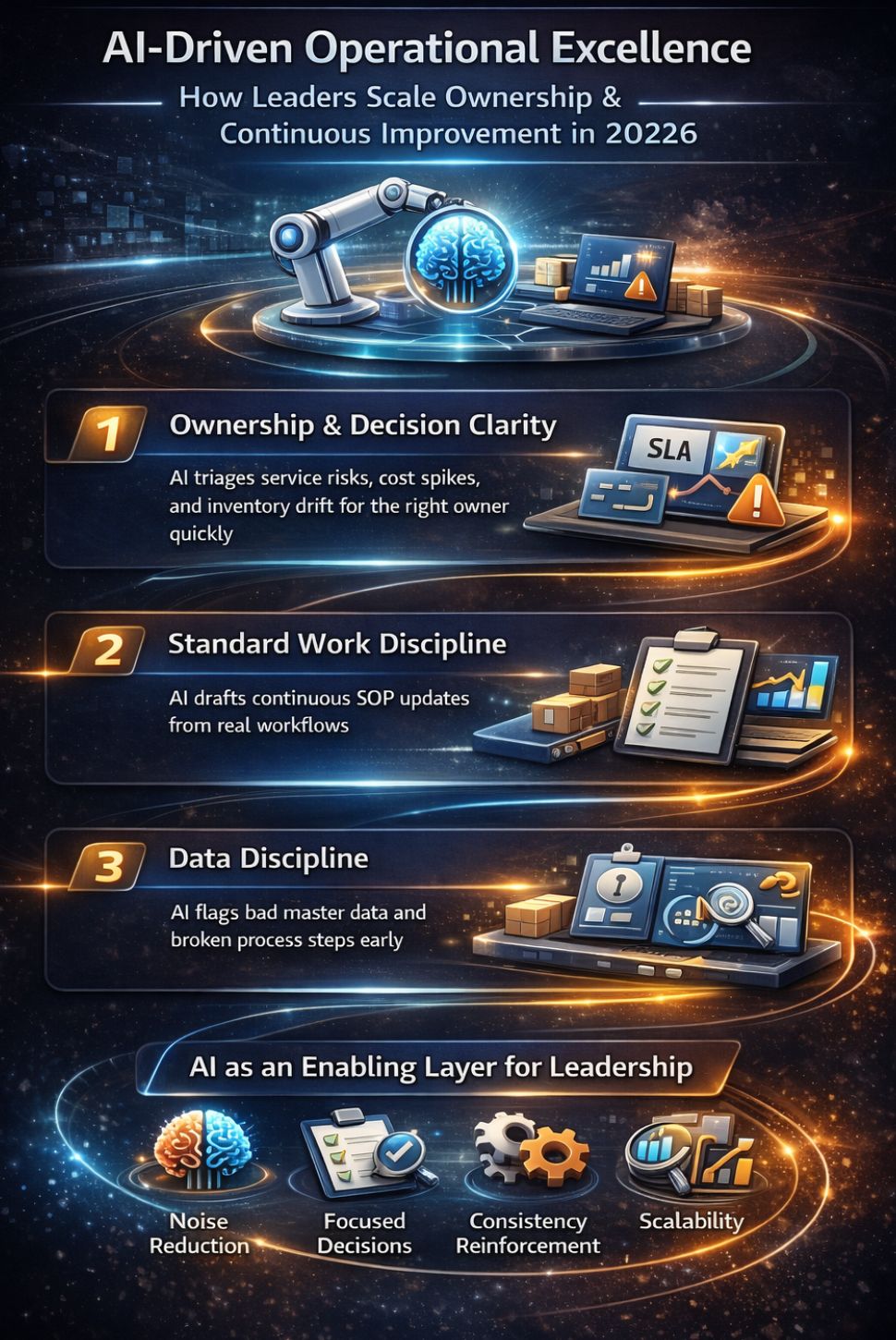
At its core, operational excellence remains rooted in leadership behaviors and operating discipline. AI enhances these foundations by improving speed, clarity, and signal quality across the system.
1️⃣ AI-Enabled Ownership and Decision Clarity
- Triage and prioritization of operational exceptions (service risk, cost spikes, inventory drift)
- Routing issues to the appropriate decision owner based on impact and urgency
- Reducing manual escalation and ambiguity across functions
Embedding Discipline Through AI-Supported Standard Work
2️⃣ AI-Maintained Standard Work and SOPs
- Analyzing workflow data from tickets, scans, and system logs
- Drafting and updating SOPs based on real operational behavior
- Highlighting deviations from expected process flow
Data Discipline as a Foundation for Performance
3️⃣ AI-Driven Data Discipline and Process Integrity
- Detecting master data issues such as incorrect units, lead times, or item attributes
- Flagging missing scans, broken handoffs, and process gaps
- Identifying upstream data quality issues before they create downstream waste
Continuous Improvement Guided by Signal, Not Noise
4️⃣ AI-Informed Continuous Improvement and Kaizen Targeting
- Surfacing recurring defect patterns and delay drivers
- Identifying rework loops and chronic failure points
- Prioritizing improvement opportunities based on frequency and impact
AI as an Enabling Layer for Operational Excellence
- Reduces operational noise
- Improves visibility into true performance drivers
- Reinforces consistency across teams and sites
- Scales leadership intent across complex systems
Final Thoughts

Carlos Salazar
Senior Contributor
Carlos Salazar is an Executive Supply Chain Leader with 20 years of experience spanning international business, engineering, and operations. Certified in PMP, Lean Six Sigma, and advanced artificial intelligence (AI) for supply chain leadership, Carlos combines disciplined execution with innovation to build resilient, end-to-end supply chain solutions.
Discover the companies and startups shaping tomorrow — explore the future of technology today.
Most Popular
Trending Companies
Latest Articles
futureTEKnow is focused on identifying and promoting creators, disruptors and innovators, and serving as a vital resource for those interested in the latest advancements in technology.
© 2026 All Rights Reserved.