
Startups & Business News
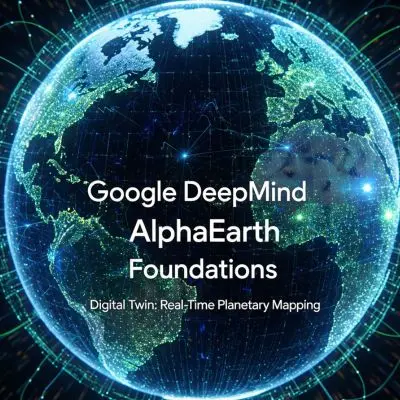
The Dawn of a Real-Time, Global Map
Earth’s surface changes by the minute—forests razed, cities built, rivers shifted. Yet for decades, synthesizing such conditions into a unified digital map was a monumental struggle. Now, AlphaEarth Foundations, Google DeepMind’s new “virtual satellite,” is promising to liberate environmental intelligence at scale.
Instead of relying on isolated snapshots from periodic satellite passes, AlphaEarth Foundations fuses data from diverse sources: satellite optics, radar, 3D lidar, and climate models. It then condenses this torrent of information into 64-dimensional “embeddings”—digital summaries that efficiently represent every 10×10 meter patch of Earth. This not only preserves fine-grained surface detail but does so with a 16-fold reduction in storage demand.
Breaking Through Satellite Barriers
Clouds, darkness, and data overload traditionally limited satellite monitoring. AlphaEarth Foundations addresses these shortfalls: acting as a virtual satellite, it can fill in gaps where satellites can’t see, building time-continuous maps. In practice, this means unfaltering monitoring—whether in perpetually cloudy Ecuadorian valleys or the sunless Antarctic.
The system’s innovative “Space Time Precision” (STP) architecture learns not just from single images but from sequences spanning years and modalities, allowing for precise environmental assessments over arbitrary timeframes, even when direct observations are missing.
Transforming Environmental Decision-Making
AlphaEarth’s real-world applications have already begun to reshape science and policy:
MapBiomas is harnessing the model to monitor deforestation and agricultural shifts across the Amazon basin, achieving accurate maps despite daunting cloud cover.
The Global Ecosystems Atlas is applying AlphaEarth’s data to classify rare or previously unmapped ecosystems—from coastal shrublands to hyper-arid deserts—bolstering conservation planning.
Public agencies and NGOs leverage these detailed embeddings to support disaster response, urban development, and conservation, confident in the technology’s 24% improvement in accuracy versus previous methods.
Researchers no longer rely on a single satellite’s trajectory. Instead, with AlphaEarth’s persistent digital twin, they track every patch of the planet—continuously and cohesively.
A Model for the Future of Monitoring
AlphaEarth Foundations is available as part of Google Earth AI’s broader suite—which also powers real-time flood and wildfire alerts in platforms like Search and Maps. By openly providing massive annual datasets (over 1.4 trillion spatial embeddings per year from 2017 onward), Google is unlocking planetary-scale environmental intelligence for communities, researchers, and policymakers everywhere.
As the technology matures, it’s poised to become the foundation for everything from agricultural risk assessment to ecosystem conservation and resilient urban growth. The leap is more than technical— it’s a shift toward an always-on, AI-driven view of Earth’s pulse.
The planet now has a digital twin. With AlphaEarth, understanding and protecting our changing world just got a brilliant new set of eyes.

futureTEKnow
Editorial Team
Discover the companies and startups shaping tomorrow — explore the future of technology today.
Most Popular
Trending Companies
Latest Articles
futureTEKnow is focused on identifying and promoting creators, disruptors and innovators, and serving as a vital resource for those interested in the latest advancements in technology.
© 2026 All Rights Reserved.