
Startups & Business News
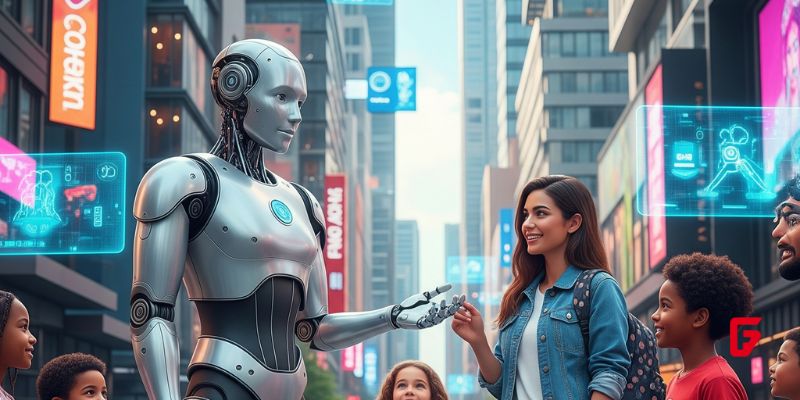
The world of artificial intelligence is on the verge of a seismic shift. For years, we’ve marveled at AI’s ability to read, write, talk, and create digital art. But a new frontier is emerging: AI is gaining physical abilities, blurring the lines between mobile devices and robots, and transforming how we interact with the physical world.
“AI is all around us. AI listens to you. AI sees your face and body. AI knows where you are right now… But AI rarely ever actually moves.”
This evolution is more than a technological upgrade—it’s the dawn of embodied AI. Think of machines that not only process data but also perceive, learn, navigate, and manipulate three-dimensional space. From autonomous vehicles to humanoid robots, embodied AI is set to revolutionize industries and create markets on a scale we’ve never seen before
The Physical Economy: Where Atoms Meet AI
Historically, AI has dominated the knowledge economy—the realm of bits and bytes. It’s disrupted jobs in writing, accounting, legal services, and more. But as digital data becomes universally accessible and compute power levels the playing field, the real differentiation will come from conquering the physical economy. This is where AI interacts with atoms and photons, not just information.
Vision data is the new oil. Just as a bluefin tuna is worthless to someone without the tools to catch it, the world’s visual data is only valuable to those who can collect and process it at scale. Companies that master real-time data collection and interpretation will have a decisive edge in the next wave of AI advancement.
Learning from Nature: The Genius of Simplicity
Biology offers powerful lessons. Consider the fruit fly—its brain is tiny, yet its compound eyes act as sophisticated computers, processing visual data with incredible efficiency. Tech giants don’t have millions of years to evolve like nature, so they rely on simulation—hyper-realistic digital twins that allow robots to “dream” and learn at an accelerated pace. This narrows the gap between simulated and real-world performance, making AI-powered machines more capable every day.
The Data Advantage: Why Real-Time Matters
The most valuable data for training AI models isn’t from the past—it’s the last five minutes, and even more so, the next five. Real-time, context-rich data fuels better predictions and smarter machines. This is why companies like Tesla and Waymo are investing heavily in data collection through their fleets and devices, turning every user interaction into a training opportunity for their AI systems.
Tech Giants and the Embodied AI Race
Waymo is rapidly expanding its autonomous fleet, aiming to transform urban mobility.
Meta is leveraging wearable devices to gather real-world data, training humanoid avatars in simulation.
Amazon is automating its fulfillment centers, reducing the human-to-robot ratio and eyeing robotics as a standalone business.
Apple is poised to integrate its software, hardware, and sensor expertise into the car of the future, turning vehicles into immersive, data-rich environments.
Tesla stands out with its vertically integrated approach, combining data, robotics, energy, AI, manufacturing, and even space-based communications to build a formidable AI ecosystem.
The Stakes: Markets Beyond Imagination
According to recent research from MarketsandMarkets, the worldwide embodied AI market is expected to expand from $4.44 billion in 2025 to $23.06 billion by 2030, reflecting a compound annual growth rate of 39%. As AI takes on more physical tasks, from transportation to logistics and beyond, the economic impact will be profound. This is not about getting people to spend more time on devices; it’s about automating the physical world and unlocking trillions in value.
The Future: Safer, Smarter, and More Connected
With autonomous vehicles, flying cars, and robotic swarms on the horizon, the way we move, work, and live is set for radical change. The companies that can collect, process, and act on real-world data at scale will shape the next era of innovation. As AI gets physical, the boundaries between the digital and physical worlds will continue to blur, ushering in a new age of intelligent machines.

futureTEKnow
Editorial Team
Discover the companies and startups shaping tomorrow — explore the future of technology today.
Most Popular
Trending Companies
Latest Articles
futureTEKnow is focused on identifying and promoting creators, disruptors and innovators, and serving as a vital resource for those interested in the latest advancements in technology.
© 2026 All Rights Reserved.