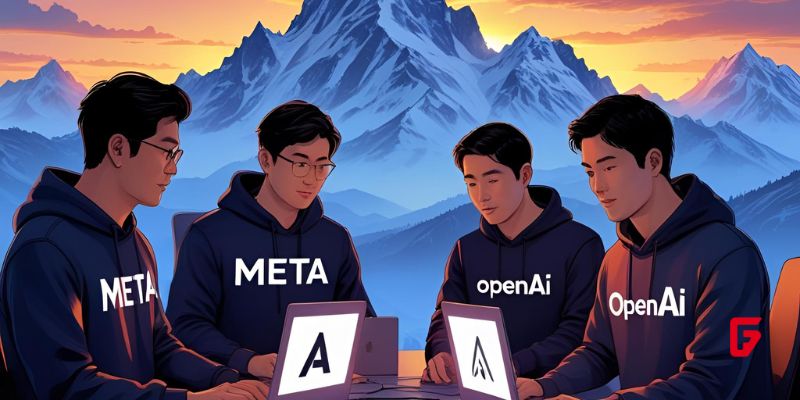
What just happened in the AI talent wars?
If you’ve been tracking the AI industry, you’ve probably noticed the headlines: Meta just pulled off a major coup by hiring four top researchers from OpenAI, including the entire founding team of OpenAI’s Zurich office and a key architect behind the company’s advanced reasoning model, o1. This isn’t just a routine job change—it’s a strategic move that could reshape the future of artificial general intelligence (AGI).
Who are the researchers Meta hired from OpenAI?
Meta’s new recruits are some of the most influential minds in AI. Lucas Beyer, Alexander Kolesnikov, and Xiaohua Zhai—the trio responsible for building OpenAI’s Zurich presence from scratch—are now headed to Meta. Trapit Bansal, a core contributor to OpenAI’s o1 reasoning model, is joining them. These hires signal Meta’s serious ambitions in superintelligence research.
Why is Meta aggressively hiring AI talent now?
Mark Zuckerberg is making a full-throttle push toward AGI, investing billions and even personally reaching out to researchers. The recent $15 billion investment in Scale AI and the appointment of Alexandr Wang to lead Meta’s AGI unit underscore how much the company is betting on artificial intelligence. The goal? To build superintelligence on Meta’s own terms and to compete directly with OpenAI and other tech giants.
How does this impact OpenAI and the broader AI ecosystem?
OpenAI is facing a brain drain at a critical moment. With legal battles, public debates over privacy, and growing tensions with partners like Microsoft, losing key researchers is a significant setback. OpenAI’s CEO Sam Altman insists that the company’s “best people” aren’t leaving, but the loss of the Zurich crew and a top o1 architect is hard to ignore.
What other AI developments are happening alongside this talent shift?
While Meta is making waves with its talent grab, the AI landscape is buzzing with other innovations. DeepMind just launched AlphaGenome, a genomics model that can simulate disease mutations across a million base pairs—far beyond what legacy tools could handle. Meanwhile, Reid Hoffman has invested $12 million in Sanmai Technologies, a startup building an AI-powered helmet that uses ultrasound to treat anxiety at home.
How are companies like Meta and OpenAI managing AI risk and governance?
The battle for AI supremacy isn’t just about talent and technology—it’s also about trust and governance. Both companies are investing in risk management frameworks, but the competition is fierce. OpenAI is doubling down on privacy and user control, while Meta is building its own vision for AI ethics and superintelligence.
What does this mean for startups and the tech community?
For startups, the message is clear: the race for AI talent and innovation is intensifying. Companies that want to attract top minds need to offer more than just competitive salaries—they need compelling missions, strong ecosystems, and a commitment to ethical AI. The best teams will be those that balance ambition with responsibility, and that can adapt quickly to the shifting landscape.
How can organizations stay ahead in the AI talent game?
To attract and retain top AI researchers, companies should focus on building collaborative, mission-driven environments. This means investing in cutting-edge projects, fostering cross-disciplinary teams, and creating cultures that value both innovation and ethical responsibility. The organizations that succeed will be those that can offer researchers the chance to work on meaningful problems with real-world impact.