Kiku Secures €4 Million to Revolutionize Frontline Hiring with Conversational AI

Kiku just secured €4M to disrupt frontline hiring. Its conversational AI streamlines recruitment, improves candidate experience, and reduces hiring time for high-volume employers.
China’s Robotaxi Boom: A Glimpse Into a $44.5 Billion Future
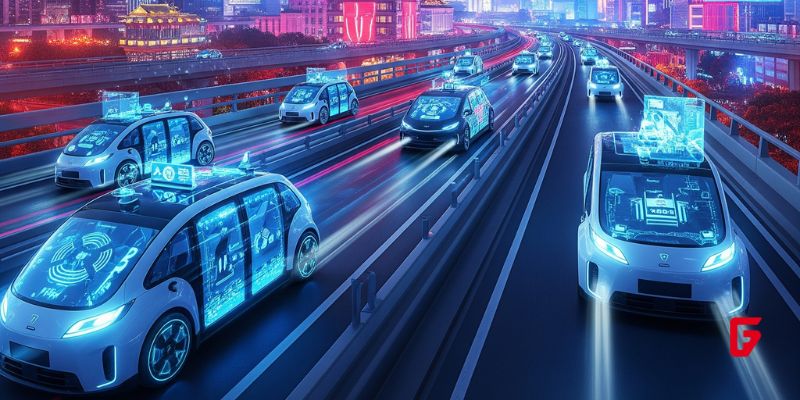
China’s robotaxi market is accelerating towards a $44.5 billion valuation by 2035. Explore the drivers, challenges, and future of autonomous ride-hailing in China.
Warehouse Automation – futureTEKnow Glossary

Warehouse automation involves the use of technology—including robotics, automated storage and retrieval systems (AS/RS), and warehouse management software—to perform warehouse tasks traditionally done manually. By integrating solutions such as autonomous mobile robots, conveyor systems, and digital picking systems, warehouse automation boosts operational efficiency, enhances inventory accuracy, reduces labor costs, and optimizes order fulfillment processes. Modern automated warehouses leverage artificial intelligence, IoT devices, and data-driven systems to manage everything from inventory movement and tracking to real-time order processing, transforming supply chain operations and supporting scalable business growth
Virtual Reality (VR) – futureTEKnow Glossary

Virtual Reality (VR) is a cutting-edge technology that immerses users in a fully simulated, computer-generated 3D environment, allowing them to interact with digital surroundings in real time using specialized devices like headsets and motion controllers. VR delivers a believable, interactive experience that can simulate real or imaginary worlds for applications in gaming, education, training, healthcare, and business. Unlike augmented reality, which overlays digital elements onto the real world, VR places the user entirely inside an artificial environment, making them feel as if they are truly present in a different place or reality.
Sovereign AI Infrastructure – futureTEKnow Glossary

Sovereign AI Infrastructure refers to the complete stack of hardware and software systems that enable governments, organizations, or nations to maintain full control over their artificial intelligence capabilities, data, and workflows. This infrastructure ensures compliance with national regulations by supporting data localization, secure multi-tenancy, real-time metadata management, and policy-based governance. Designed to operate independently from foreign cloud providers, sovereign AI infrastructure empowers users to scale, secure, and manage their AI systems—preserving digital autonomy, data privacy, and operational transparency across local, cloud, and edge environments
Robotaxi – futureTEKnow Glossary

A robotaxi is an autonomous, self-driving vehicle that provides on-demand ride-hailing services without a human driver, typically booked through an app. Using advanced sensors, artificial intelligence, cameras, radar, and LiDAR technology, robotaxis safely navigate city streets, transporting passengers to their destinations efficiently. These electric or hybrid vehicles are poised to transform urban transportation by reducing traffic congestion, lowering emissions, and offering an affordable alternative to traditional taxis and personal cars. Major cities worldwide are testing and deploying robotaxis, signaling a significant shift towards automated, sustainable, and accessible public mobility
Robotics Automation – futureTEKnow Glossary
Robotics Automation refers to the integration of programmable, computer-driven machines—robots—into processes to perform tasks autonomously or semi-autonomously, reducing or eliminating the need for human intervention. This interdisciplinary field merges engineering, computer science, and emerging technologies to design, build, and operate robots that carry out repetitive, hazardous, or precise functions across industries like manufacturing, healthcare, and logistics. Robotics automation increases efficiency, consistency, and safety while lowering costs and improving scalability, playing a crucial role in modern industrial and business operations
Reusable Rocket Technology – futureTEKnow Glossary
Reusable Rocket Technology enables rockets to launch, return to Earth, and be refurbished for future flights. By revolutionizing space travel, this innovation reduces launch costs, increases flight frequency, and enhances sustainability for commercial, scientific, and government missions. Companies like SpaceX have demonstrated the practical success of reusable rockets, making space access more affordable and accelerating advancements in aerospace technology. Discover how reusable rocket technology is shaping the future of space exploration and sustainable transport beyond our planet.
Large Language Models (LLMs) – futureTEKnow Glossary

A Large Language Model (LLM) is an advanced artificial intelligence system trained on massive datasets to comprehend, generate, and analyze human language at scale. Leveraging transformer-based deep learning architectures, LLMs power a broad range of natural language processing (NLP) tasks—such as text generation, summarization, translation, and question answering—across diverse industries including healthcare, finance, and customer support. These foundation models can interpret context, produce humanlike responses, and automate complex content creation, making LLMs a core driver of generative AI innovation for businesses aiming to harness the full potential of natural language understanding and generation
High-Performance Computing (HPC) – futureTEKnow Glossary

High-Performance Computing (HPC) enables the rapid processing of vast amounts of data and complex calculations by combining the power of multiple, interconnected computers—often called clusters—to achieve performance levels far beyond typical workstations or servers. HPC solutions utilize parallel processing, high-speed networks, and significant memory resources to handle compute-intensive applications in areas like scientific research, engineering simulations, artificial intelligence, weather forecasting, and big data analytics. Whether deployed on-premises, in the cloud, or as hybrids, HPC drives innovation by accelerating computational workflows, making it essential for organizations tackling advanced data and simulation challenges