By futureTEKnow | Editorial Team
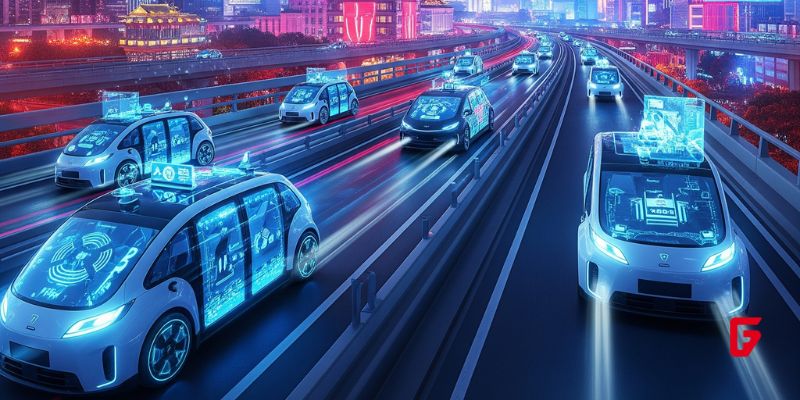
China’s robotaxi market is on track to transform urban mobility—and the numbers are staggering. By 2035, this sector is projected to reach $44.5 billion, marking a nearly 900-fold increase from current levels. This places China ahead of the US, whose robotaxi industry is expected to climb to $36.5 billion over the same period.
Mature supply chains: China’s well-established electric vehicle and autonomous tech supply chains are driving down hardware costs, accelerating robotaxi adoption and making rides more affordable by the year.
Industry leadership: Homegrown giants like Baidu, Pony.ai, and WeRide are at the forefront, rapidly expanding fleets and pushing autonomous technology closer to mainstream deployment.
Government backing: Strong policy support and growing investment in digital infrastructure are clearing regulatory roadblocks and nurturing innovation across key metro areas.
| Metric | China | United States |
|---|---|---|
| Market Size in 2025 | $52 million | $314 million |
| Projected Market Size in 2035 | $44.5 billion | $36.5 billion |
| Compound Annual Growth Rate (CAGR) 2025-2035 | 96% | 61% |
| Growth Factor (2025-2035) | ~900-fold increase | — |
| Main Industry Players | Baidu, Pony.ai, WeRide | Tesla, Waymo |
| Growth Drivers | Supply chain maturity, declining hardware costs | Manufacturing integration, vision-based tech, regulatory readiness |
| Key Challenges | Regulatory differences, R&D costs, social concerns (jobs, safety, privacy) | Regulatory approval, production scalability, cost reduction |
Source: TrendForce
China’s looming labor crunch—an aging driver workforce with nearly 4 million expected to retire by 2035—creates an urgent demand for alternatives. Robotaxis are uniquely poised to fill this gap, especially as cities like Shenzhen and Hangzhou already grapple with driver shortages. As vehicle and system costs fall, robotaxi operators can pass savings on to riders, further accelerating public acceptance.
Compound Annual Growth Rate (CAGR): 96% between 2025 and 2035—an almost unheard-of pace in transportation tech.
Fleet expansion: Experts predict the number of autonomous vehicles could reach hundreds of thousands by 2035, covering not just major metros like Beijing and Shanghai, but also expanding into tier-2 cities.
Despite its momentum, the robotaxi revolution still faces several major hurdles:
Complex regulations: Differences between local and international standards can slow fleet deployments and market entry for new players.
Tech and R&D costs: Advanced autonomous systems demand significant investment, leading to uncertain payback periods for operators.
Social impact: Concerns around job displacement, passenger safety, and data privacy remain high on the public agenda.
If projections hold, by 2035 robotaxis could make up a quarter of China’s shared mobility market. Expect new business models: seamless AI ride hailing, autonomous fleet-as-a-service, and partnerships between tech giants and traditional automakers.
China is not just building a market—it’s redefining what urban mobility can be, and the global auto industry is taking notice.

AWS frontier agents introduce a new era of autonomous AI coders that can build, secure, and run applications for days at a time, acting like virtual teammates across dev, security, and DevOps while engineers retain final control over production changes.

Explore the cutting-edge ways AI is enhancing Lean Six Sigma, from real-time process insights to predictive controls, ushering in a new era of operational excellence and efficiency.

Facing supply chain challenges in 2025? High-performing teams leverage AI for risk management, demand forecasting, supplier analytics, and end-to-end visibility to ensure business continuity and resilience.

Craft an AI-powered supply chain Center of Excellence that unifies control tower visibility, analytics, and inventory optimization into one strategic hub. Explore this blueprint to learn how a modern supply chain CoE drives resilience, smarter decisions, and operational excellence in the age of AI.

Supply chain leadership is being redefined by AI, intelligent automation, and agentic decision-making, demanding leaders who can engineer end-to-end intelligence rather than simply manage workflows. This article explores how next-generation supply chain leaders will combine data, algorithms, and human judgment to build resilient, adaptive, and high-performing global operations.

Bridgit Mendler’s Northwood Space is pioneering mass-produced ground stations, enabling scalable, high-speed connectivity for the new era of satellite networks and megaconstellations.

SpaceX aims to nearly double launches from Vandenberg in 2025, facing support from federal agencies but strong objections from the state and local communities.

Traditional Medicare will pilot AI-assisted prior authorization in 2026 across six states, focusing on high-risk outpatient services. Clinicians retain final say, but incentives and access concerns loom as CMS tests fraud reduction and “gold card” exemptions. Here’s what providers and patients should know.

OpenArt’s new “one-click story” compresses scripting, visuals, and edits into ready-to-post short videos—fueling viral growth and a fresh IP debate. We break down how it works, adoption signals, what’s next (multi-character, mobile), and practical guardrails creators and brands should follow to stay original and compliant.

OpenAI’s o3 swept the Kaggle AI chess tournament, defeating xAI’s Grok 4–0. The victory fueled the intense rivalry between Altman and Musk, reshaping AI benchmarks.

NASA and Google’s AI-powered Crew Medical Officer Digital Assistant enables autonomous diagnoses for astronauts on Mars missions, redefining remote healthcare for space and Earth.

Pinterest’s CEO confirms that fully agentic AI shopping is years away, as the platform invests in AI-powered tools to enhance discovery, inspiration, and personalized shopping experiences for millions.
To provide the best experiences, we use technologies like cookies to store and/or access device information. Consenting to these technologies will allow us to process data such as browsing behavior or unique IDs on this site. Thanks for visiting futureTEKnow.