
Startups & Business News
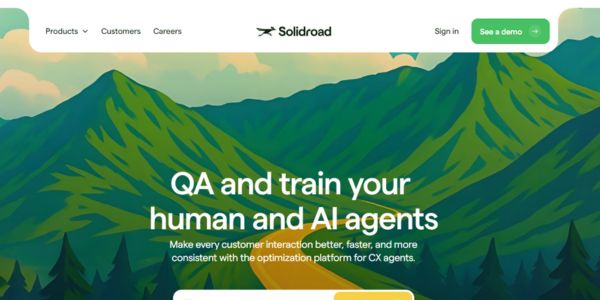
When customer support leaders talk about AI, they usually mean chatbots and virtual agents. The harder problem sits in the background: how to ensure quality when both humans and models handle millions of conversations across channels. Solidroad, an AI-native quality assurance and training platform, just raised a $25 million Series A round to make that problem its core business.
The San Francisco and Dublin–based startup automatically evaluates every interaction a company has with its customers, whether handled by human agents or AI systems, and turns those conversations into a continuous feedback loop for operations and training. The fresh funding, led by global investment firm Hedosophia with participation from First Round Capital, Y Combinator, and Sony Innovation Fund, brings Solidroad’s total capital raised to more than $30 million and signals how quickly quality assurance is becoming strategic in AI-powered customer operations.
Why quality assurance is the next AI battleground
Most contact centers still rely on manual sampling to monitor performance. A team lead listens to a small subset of calls or reads a handful of chat transcripts, then scores them against a rubric. Industry estimates suggest this often covers just 1–3% of total volume, which makes it difficult to spot systemic issues, coaching needs, or model failure modes with any statistical confidence.
As companies roll out AI agents alongside human teams, this gap becomes riskier. A bad answer from a chatbot can spread faster than a bad answer from a single agent, especially when models operate 24/7 at scale. At the same time, leadership teams are under pressure to improve customer satisfaction, reduce handle times, and prove that new AI investments actually move those metrics. That combination explains why investors are now backing infrastructure that can continuously score and explain what is happening in every customer interaction, not just a sample.
Solidroad positions itself as that layer. Instead of treating QA as a compliance checkbox, it aims to make quality measurement a real-time system that informs product decisions, operational changes, and training programs across human and AI support.
Inside Solidroad’s AI-native QA platform
Solidroad’s platform plugs into the channels that support teams already use—voice, chat, email, and increasingly AI agents—and automatically evaluates 100% of interactions against a company’s quality criteria. Under the hood, this means using AI models to understand context, intent, and outcomes, then translating that into scores and structured insights.
Instead of a spreadsheet with a handful of manually scored tickets, teams get dashboards that reveal patterns: where agents struggle with a particular type of query, which workflows generate repeat contacts, or where an AI agent consistently misses policy constraints. The system surfaces risk, identifies skill gaps, and can trigger personalized coaching in real time, closing the loop between measurement and improvement.
This approach also extends to AI oversight. As enterprises deploy generative AI into their support stack, they need evidence that responses are accurate, compliant, and aligned with brand tone. Solidroad evaluates AI-generated conversations alongside human ones, creating a single source of truth for quality across all support channels.
From QA to training: closing the loop
One of Solidroad’s core claims is that QA should not stop at scoring. By linking quality data directly to training content and workflows, the platform aims to make coaching more targeted and measurable. If multiple agents repeatedly mishandle a certain issue type, leaders can see that pattern and trigger specific training modules rather than generic refreshers.
Customers cited in public materials include Oura, Ryanair, ActiveCampaign, and Crypto.com, all high-volume, customer-centric brands with complex support needs. According to the company, one customer improved its go-live customer satisfaction score by three percentage points after deploying Solidroad, with overall scores now above 90%. At large outsourced contact centers such as PartnerHero and Tech Mahindra, onboarding times for new agents reportedly fell by half once performance insights fed directly into training.
For operators, this moves QA from an after-the-fact audit to a continuous learning loop. For AI teams, it offers a feedback channel to refine prompts, escalation rules, and model guardrails based on real-world performance rather than synthetic benchmarks.
The funding round and investor thesis
The $25 million Series A is led by Hedosophia, a global investment firm known for backing high-growth technology companies, with participation from First Round Capital, Y Combinator, and Sony Innovation Fund. The round follows an earlier seed led by First Round Capital in mid-2025, bringing Solidroad’s total raised to more than $30 million and giving it capital to scale in both North America and Europe.
In a public post, Sony Innovation Fund described customer support as undergoing a “fundamental shift,” positioning Solidroad as part of the AI-first infrastructure that will power that transition by converting customer interactions into actionable insights and scalable training. That framing aligns with a broader investor narrative: as AI moves from pilots to production, companies will need tooling that monitors and improves AI performance in the wild, especially in customer-facing roles where trust is on the line.
Hedosophia’s involvement also signals that this is not just a tooling bet but an operational one. QA sits at the intersection of cost, risk, and user experience, and any platform that can move all three in the right direction has a clear path into enterprise budgets.
Go-to-market: support-heavy industries as early adopters
Solidroad’s early customer list suggests a focus on sectors where support is high volume, revenue-critical, and already undergoing digital transformation. Airlines like Ryanair, fintech platforms like Crypto.com, and subscription businesses like Oura all face heavy inbound volumes and tight margins. In these environments, small percentage improvements in customer satisfaction, first contact resolution, or onboarding speed translate directly into revenue and retention.
By promising to review every interaction instead of a tiny sample, the platform offers operators visibility that has historically been missing from their dashboards. That visibility can inform everything from staffing decisions to upstream product fixes. For example, if a new feature launch generates a spike in tickets with low quality scores, product and support teams can see the pattern quickly and respond with better in-app guidance or targeted campaigns.
Internationally distributed teams also stand to benefit. With offices in San Francisco and Dublin, Solidroad is positioning itself to serve both U.S. and European customers, where language diversity, regulatory requirements, and different expectations around support quality can complicate scaling.
What this means for founders and operators
For founders building AI products in customer operations, Solidroad’s trajectory highlights a few themes. First, AI success is increasingly measured not only by automation rates, but by the quality of outcomes and the ability to explain them. Platforms that measure and improve those outcomes across both humans and AI systems are likely to become standard in mature stacks.
Second, there is room for vertical and workflow-specific infrastructure in the AI era. Rather than offering general-purpose observability, Solidroad is betting on deeply understanding the metrics, playbooks, and constraints of customer support and building tools tuned to that environment. That focus may help it stay differentiated as more generic analytics tools and LLM observability platforms enter the market.
Finally, for investors, this round is another signal that AI-native “picks and shovels” around quality, governance, and training are moving from nice-to-have to must-have in enterprise deployments. As more companies hand over parts of their customer experience to AI, they will need platforms capable of evaluating 100% of interactions and turning that data into operational changes. Solidroad is one of the early companies to raise significant capital around that thesis; how it executes from here will be watched closely by the broader ecosystem.

Elena Rossi is a Senior Staff Writer at futureTEKnow, covering AI, foundation models, autonomous agents, and the infrastructure powering the next wave of intelligent applications.
Discover the companies and startups shaping tomorrow — explore the future of technology today.
Most Popular
Trending Companies
Latest Articles
futureTEKnow is focused on identifying and promoting creators, disruptors and innovators, and serving as a vital resource for those interested in the latest advancements in technology.
© 2026 All Rights Reserved.