
Startups & Business News
London AI startup Lua wants to give every business its own AI workforce with $5.8M seed round
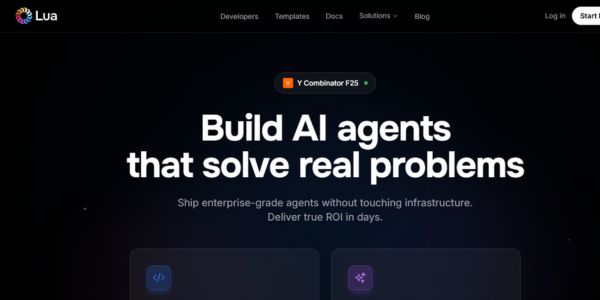
AI agents are finally moving from demos to the day-to-day stack of real companies—and a London startup wants to make them feel less like science projects and more like hiring a new team. Lua, an operating system for humans and AI agents working side by side, has raised a $5.8 million seed round to help any business, technical or not, stand up its own AI “workforce” in hours instead of months.
The company is betting that the next wave of enterprise AI won’t be about one chatbot per workflow, but about orchestrating fleets of specialized agents that coordinate with employees, tools, and data sources like a real organization. For founders and investors, the question is no longer whether agents will matter, but who will own the layer that makes them dependable, governable, and ROI-positive inside existing businesses.
Who is backing Lua and why now
Lua’s $5.8 million seed round is led by Norrsken22, an Africa-focused tech growth fund, with participation from Flourish Ventures, Y Combinator, Phosphor Capital, 20VC, and other backers. Angels include founders and operators from companies such as Privy, Opendoor, and Nuiee Travel, signaling that the cap table blends AI-native investors with operators who have wrestled with automation in production environments.
The fresh capital will go toward expanding Lua’s developer community and a global network of implementation partners who can bring its platform into mid-market and enterprise accounts. That partner-centric approach suggests Lua is not only targeting early adopters, but also systems integrators and boutique consultancies that are looking to standardize how they build agentic workflows for clients.
From single agents to AI “workforces”
Many companies’ first contact with AI agents is a single assistant—say, for support triage or lead qualification—bolted onto existing tools. Lua’s core thesis is that this one-off model leaves too much value on the table and creates a maintenance problem: each agent is a snowflake with its own stack, prompts, and integrations.
Instead, Lua frames agents as a workforce that should be hired, onboarded, and managed collectively. Its platform lets teams design networks of agents that collaborate with humans and with each other, handle handoffs, and plug into existing systems across channels. In practice, that means a customer success agent can escalate to a billing agent, loop in a human account manager, and update a CRM, all under a shared orchestration layer.
Lua also positions itself as an “HR system for non-human employees,” emphasizing ownership and governance. Instead of renting a black-box assistant that lives on someone else’s infrastructure and data rails, customers are meant to own their agents and the data they generate, potentially compounding efficiency over time rather than just compounding usage costs.
What the platform actually does
Under the hood, Lua describes itself as an opinionated, full-stack agent platform. It bundles infrastructure, model orchestration, data pipelines, channel integrations, and monitoring into a single environment, leaving users to supply business logic and pick the systems their agents should connect to.
Developers can work through a command-line interface when they need granular control over agent behavior and infrastructure. Non-technical teams, meanwhile, interact with the same agents through a natural language interface, editing workflows and policies without leaving their browser. Both personas operate on the same artifacts in the same environment, which is meant to reduce the translation cost between operators and engineers.
The company claims that teams can stand up a functioning AI workforce—agents coordinating with humans and tools, integrated into existing systems—within hours of onboarding. That “hours, not months” promise is increasingly becoming table stakes in the agent platform space, but Lua backs it with usage metrics: since launching its developer platform in October 2025, the startup says revenue has been growing nearly 30% week-over-week. In February 2026 alone, more agents were created on Lua than during the entire period from launch through January.
How founders and operators might use Lua
The first wave of adopters is likely to be SaaS teams and services companies that need to coordinate repetitive, multi-step workflows across tools and departments. Examples include:
Customer support: tiered agent teams that triage tickets, surface relevant knowledge base content, propose resolutions, and escalate to humans with summarized context.
Revenue operations: agents that qualify inbound leads, enrich accounts, schedule meetings, and update CRM fields, while handing edge cases to sales reps.
Back-office operations: agents that reconcile data across HR, finance, and procurement systems, flag anomalies, and draft updates for human review.
Because Lua supports both technical and non-technical interfaces, it is also positioned for cross-functional workflows where, for instance, a customer success manager adjusts an agent’s escalation rules while an engineer tunes its integrations or evaluation metrics. That co-editing capability could be a differentiator in organizations where AI projects often stall at the handoff between business teams and engineering.
Competitive landscape and differentiation
Lua launches into a crowded field of agent platforms, orchestration frameworks, and vertical-specific automation tools. Its differentiation rests on three pillars: treating agents as a managed workforce rather than isolated bots, offering a full-stack environment rather than a thin orchestration layer, and explicitly centering co-ownership between developers and operators.
Ownership is a recurring theme. Unlike some products that live as SaaS silos, Lua emphasizes that teams own their agents, their data, and the resulting improvement loops—which matters for regulated industries and companies worried about vendor lock-in. The company’s rapid early growth, combined with backing from funds that have seen previous waves of SaaS and fintech platforms, suggests investors see room for a system-of-record play in AI agents, not just another point solution.
Still, the platform will have to prove that its opinionated stack can keep pace with a fast-changing model ecosystem without overwhelming customers with complexity. As more open-source frameworks and hyperscaler-native tools for agents emerge, Lua’s bet is that enterprises will trade some flexibility for a coherent, production-ready operating system that non-specialists can use.
What this means for investors and the ecosystem
Lua’s seed round is another data point in the shift from generic AI infrastructure to application-layer platforms that embody strong opinions about how teams should work with agents. For investors, it offers exposure to a company that wants to define not just how agents are built, but how they are governed and integrated into existing org charts and workflows.
For founders and operators, the signal is that the bar for “adopting AI” is moving from having a single assistant to building an environment where many agents can be deployed, audited, and iterated on like any other team. Whether Lua becomes the de facto operating system for this world remains to be seen, but its early traction and investor support show there is demand for platforms that treat agents less like features and more like first-class digital coworkers.

Elena Rossi is a Senior Staff Writer at futureTEKnow, covering AI, foundation models, autonomous agents, and the infrastructure powering the next wave of intelligent applications.
Discover the companies and startups shaping tomorrow — explore the future of technology today.
Most Popular
Trending Companies
Latest Articles
futureTEKnow is focused on identifying and promoting creators, disruptors and innovators, and serving as a vital resource for those interested in the latest advancements in technology.
© 2026 All Rights Reserved.
One Response
Interesting raise. AI workforce platforms are definitely becoming a space to watch as companies rethink how work gets done.