




















Startups & Business News

EVAS Intelligence’s RISC-V AI Chips Land 1.5 Billion Yuan Series B to Power Global Expansion

EVAS Intelligence RISC-V AI chips secure a 1.5B yuan Series B to scale Epoch hardware, expand globally, and challenge incumbents in AI compute.

EVAS Intelligence just joined the small but growing club of AI chip startups raising nine-figure rounds to scale infrastructure for large models. The Beijing-based company closed a 1.5 billion yuan (around 200 million dollars) Series B to push its RISC-V AI chips into mass production and onto the global stage. For founders and investors watching the race to build non‑U.S. AI hardware stacks, this is a notable signal that RISC-V is moving from thesis to deployment.

Who is EVAS Intelligence?

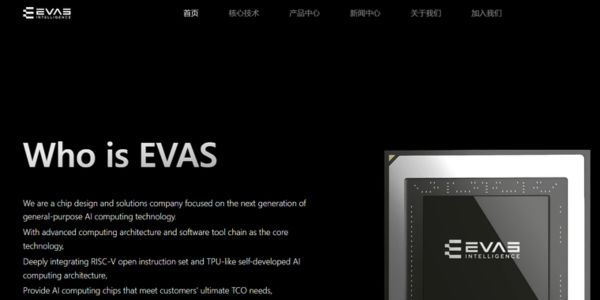
Founded in 2022, EVAS Intelligence develops full‑stack, self‑designed AI computing chips and platform solutions built on the open RISC-V architecture. The company targets high‑performance workloads such as large‑model training and deep learning, an area traditionally dominated by Nvidia and a handful of alternative GPU makers. Its bet: a customized architecture that blends TPU‑like design with RISC-V’s flexibility can offer more efficient and controllable infrastructure for domestic and global customers.

The startup has already reached mass production for its Epoch series AI chips, a milestone many semiconductor startups struggle to hit before capital runs out. With this round, EVAS is no longer just a promising design house; it is positioning itself as a systems‑level provider with silicon, boards, servers, and clusters.

Inside the 1.5 Billion Yuan Series B

The Series B was co‑led by several Beijing‑based industrial and technology funds, including the Beijing Economic‑Technological Development Area Industrial Upgrade Fund. Other backers include public and private capital from vehicles such as the Beijing High‑Precision Industrial Development Investment Fund, the Beijing Information Industry Development Investment Fund, and the Beijing AI Industry Investment Fund, alongside investors like Heli Capital and Boni Capital.

This mix of municipal industrial funds and market investors reflects how strategic Beijing considers AI compute. Rather than a pure financial bet, the round is structured to accelerate local supply of high‑end AI chips while supporting an export‑ready platform. For founders, it illustrates how aligning with regional industrial upgrade agendas can unlock large, nontraditional pools of capital.

What makes the Epoch series different?

EVAS’s Epoch series is built on a RISC-V and RVV (RISC-V Vector) foundation and combines a TPU‑style architecture with the open instruction set. The chips natively support FP8 quantization, which has become a key format for modern AI workloads because it can balance compute efficiency and model accuracy. According to the company, this design aims to optimize three variables at once: performance per watt, deployment flexibility, and precision for large models.

On top of the chips, EVAS offers PCIe accelerator cards, complete servers, and large‑scale intelligent computing clusters. This product matrix gives it more control over end‑to‑end performance and lets customers buy into a stack that ranges from single cards to full data center deployments. For buyers, that reduces integration risk; for EVAS, it increases average deal size and defensibility.

How the new capital will be used

The company plans to use the 1.5 billion yuan round to scale production and commercialization of the current Epoch chips, invest in its next flagship product, and deepen its software‑hardware ecosystem. That includes tooling, frameworks, and platform software needed to make RISC-V infrastructure feel as turnkey as incumbent solutions for developers and enterprise teams.

Another priority is international expansion. EVAS wants to grow beyond domestic deployments and push its RISC-V AI computing offerings into global markets, positioning itself as an alternative for customers seeking more geographic and architectural diversity in their AI supply chains. If successful, that could create new pressure on established GPU providers and raise the profile of Chinese RISC-V players in the worldwide semiconductor ecosystem.

Why this matters for the AI hardware race

EVAS’s Series B comes amid broader momentum for AI hardware startups and RISC-V‑based designs. As model sizes grow and inference volumes spike, demand for specialized, cost‑efficient compute is expanding faster than leading suppliers can serve it. For investors, EVAS is a case study in how regionally backed, vertically integrated AI chip startups are trying to fill that gap with differentiated architectures and strong local support.

For founders building in adjacent spaces—whether infrastructure software, model deployment platforms, or application‑layer AI—moves like this are also a reminder. The AI stack is fragmenting into multiple hardware options, and go‑to‑market strategies increasingly need to account for a world where “Nvidia only” is no longer the default assumption.

Elena Rossi is a Senior Staff Writer at futureTEKnow, covering AI, foundation models, autonomous agents, and the infrastructure powering the next wave of intelligent applications.

Elena Rossi is a Senior Staff Writer at futureTEKnow, covering AI, foundation models, autonomous agents, and the infrastructure powering the next wave of intelligent applications.

Discover the companies and startups shaping tomorrow — explore the future of technology today.

Join Our Newsletter

* indicates required

Intuit Mailchimp

Leave a Reply

Your email address will not be published. Required fields are marked *

Trending Companies

Latest Articles

futureTEKnow is focused on identifying and promoting creators, disruptors and innovators, and serving as a vital resource for those interested in the latest advancements in technology.

© 2026 All Rights Reserved.