
Startups & Business News
Factory.ai raises $150M Series C to build fully autonomous software engineering “factories”
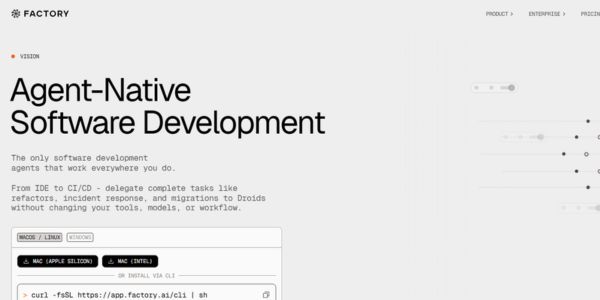
On a spring Thursday in April, Factory.ai quietly crossed a psychological threshold that startups in the “agentic” AI boom have been chasing for the past 18 months: a billion‑dollar valuation backed by tier‑one venture money, actual enterprise usage and month‑over‑month revenue growth that would make most SaaS founders wince.
The three‑year‑old company announced a $150 million Series C led by Khosla Ventures, with Sequoia Capital, Blackstone, Insight Partners, Evantic Capital, 20VC, NEA and Mantis VC all piling in, valuing Factory at $1.5 billion. The round is designed less as a lifeline and more as rocket fuel: the team says it will pour the cash into research, product and a global go‑to‑market push as it races to define what an “agent‑native” software development platform actually looks like in production.
Behind the number is a bet that autonomy in software engineering is not just a neat demo, but an inevitable shift in how code gets written, shipped and maintained inside big companies. Factory is pitching itself as the place where that shift happens first — and at scale.
What Factory actually builds
Factory started with a focused mission: bring autonomy to software engineering, not through another coding assistant, but via “Droids,” its branded autonomous agents that can plan, write, test and ship code across a software organization. Today, the company says hundreds of thousands of developers use these Droids inside enterprises like Nvidia, Adobe, EY, Palo Alto Networks and Adyen.
That usage matters because it hints at something beyond experimentation. These are organizations that already run critical workloads across complex regulatory and security regimes, and they don’t adopt new build tools lightly. Factory says enterprises are now using its platform to construct “fully autonomous software factories” that plug into any large language model, any interface and every stage of development, from feature specs to deployment and monitoring.
The company’s core abstraction is the Droid itself: an autonomous system that operates as the functional unit of work across multiple roles in a software business, rather than a point‑solution bot that only suggests lines of code. Factory claims its Droids sit at the top of independent benchmarks for software development agents, giving it technical bragging rights in a crowded space where every vendor says they are “best‑in‑class.”
From coding agents to long‑horizon “Missions”
The bigger shift inside Factory’s product is less about single agents and more about orchestration. The company recently introduced Missions, a layer that lets multiple Droids coordinate long‑horizon, multi‑step workflows that can represent “weeks’ worth of work.”
In practice, a Mission might be “re‑platform this legacy billing service,” “migrate this monolith to microservices,” or “implement region‑specific compliance changes,” each of which can span planning, code changes, tests, documentation and rollout. Instead of handing off these phases between teams via ticket queues and stand‑ups, Factory wants customers to describe the outcome and let missions route tasks to the right Droids, monitor progress and keep humans in the loop where needed.
The company also shipped Factory Desktop, a native app that runs on a developer’s machine with full system access and local context, essentially saying: if it can be done on a computer, a Droid should be able to do it. That moves the product from cloud‑only workflows into everyday developer environments, where latency, file access and security policies often make or break adoption.
A business model racing ahead of benchmarks
On the commercial side, Factory says it has doubled revenue for six consecutive months. That kind of curve suggests either tiny starting numbers or unusually fast enterprise expansion motion — likely both — but it also signals that customers are paying for more than just pilots.
Factory does not spell out its pricing on the Series C announcement page, but the broader positioning points to a classic enterprise model: platform licenses for the core agent infrastructure, add‑ons for advanced governance and observability, and usage‑based components tied to model calls and long‑running missions. For CIOs and CFOs, the pitch is straightforward: trade rising headcount and contractor costs for a platform that can parallelize work and route it to cheaper or more efficient models while maintaining security and compliance.
This is where the funding story meets unit economics. Factory’s next phase will focus on optimized model routing and cost control, always‑on agents, advanced enterprise‑grade governance and “real measurement of agent readiness and effectiveness at scale.” In other words: prove that Droids don’t just generate impressive demos but actually improve throughput, reduce incidents and keep cloud bills in check.
Why enterprises care now
If you talk to engineering leaders at large companies, the problem is rarely “not enough tools.” It’s fragmentation: scattered scripts, partial adoption of AI assistants by senior engineers, and a long tail of manual work in QA, documentation, triage and integrations that no one has time to touch.
Factory’s narrative taps into that frustration. By anchoring its platform in autonomy rather than autocomplete, it aims to give enterprises a way to standardize how AI agents are configured, monitored and audited across teams. Benchmarks might win headlines, but in regulated industries, buyers care at least as much about audit trails, RBAC (role‑based access control) and integration with existing DevSecOps pipelines.
The customer logos — Nvidia, Adobe, EY, Palo Alto Networks, Adyen — suggest Factory is already threading that needle between innovation and compliance. Each of those companies has strong internal opinions about security, and they tend to push vendors hard on topics like data residency, model choice and incident response.
Governance, safety and the politics of autonomy
Bringing “autonomy” to software engineering is as much a governance problem as it is a technical one. Factory is explicit that the next phase of its platform will prioritize advanced governance features and robust measurement of agent performance. That’s not just a nice‑to‑have; as soon as Droids can touch production systems, they sit at the intersection of risk, liability and internal politics.
City officials aren’t (yet) writing ordinances about AI agents committing bad refactors, but regulators are paying attention to how automated systems make decisions in finance, healthcare and critical infrastructure. For enterprises, that scrutiny shows up in requirements around explainability, change management and the ability to roll back or override agent‑driven changes.
Factory’s emphasis on “always‑on” agents raises a separate set of questions. Autonomous systems that operate continuously against production workloads need guardrails to prevent drift, cascading failures and quiet dependency on the underlying models’ behavior. That is precisely where investors will want to see credible roadmaps—and where internal platform teams may insist on tight integration with their own observability and incident tooling.
Competing with incumbents and internal tools
Factory is not the only company chasing this territory. Incumbent dev‑tool vendors are layering agent capabilities on top of existing IDEs and CI/CD systems, and some large enterprises are rolling their own orchestration layers on top of open‑source frameworks.
Factory’s argument is that a purpose‑built, agent‑native platform can move faster than retrofits and homegrown systems. Its team, which the company frames as a group of high‑velocity engineers, researchers and operators from top organizations, is leaning into that narrative: assemble a concentrated group of people who believe autonomy in software engineering is “inevitable and imminent,” then ship product aggressively. The new capital gives the company room to scale that hiring thesis.
For investors, the upside scenario is clear: if Factory becomes the default abstraction layer for how enterprises deploy and govern AI agents in software development, it can capture a meaningful slice of the spend currently flowing into both cloud infrastructure and traditional dev‑tooling. The downside is that incumbents with massive installed bases and existing procurement relationships may be able to mimic enough of the functionality to blunt Factory’s differentiation.
Can the model scale beyond early adopters?
The core open question is whether Factory’s approach scales beyond AI‑forward companies and tech‑heavy enterprises into the broader market of organizations with legacy stacks, mixed talent and tight regulatory constraints.
To win there, Factory will have to do more than ship features. It will need to prove, with data, that Droids and Missions consistently deliver measurable improvements in cycle time, defect rates and cost per feature, without triggering security incidents or developer backlash. It will also need to manage expectations from customers eager to believe that “anything that can be done on a computer can be done with a Droid” — a bold line from the company’s own messaging that sounds aspirational today.
What the Series C does buy is time and runway. The company can now invest heavily in optimized model routing to balance cost and performance, deepen its governance stack, and refine how always‑on agents behave in real‑world environments. It can also expand geographically, testing whether its current success with enterprises in sectors like semiconductors, media, consulting and fintech will translate into other verticals.
Factory closes its announcement with a recruitment pitch to people who are “unreasonably ambitious” and want to work on “the highest‑leverage technology of our time,” along with a simple sign‑off: “Long live developers.” If the company delivers on its roadmap, that optimism might be justified; if it stumbles, the next generation of software engineers may remember Droids as yet another wave of automation hype that never quite escaped the lab.

Jason Miller is a Staff Writer at futureTEKnow, focusing on AI infrastructure, MLOps, and the platforms that help teams run models reliably at scale.
Discover the companies and startups shaping tomorrow — explore the future of technology today.
Most Popular
Trending Companies
Latest Articles
futureTEKnow is focused on identifying and promoting creators, disruptors and innovators, and serving as a vital resource for those interested in the latest advancements in technology.
© 2026 All Rights Reserved.