
Startups & Business News
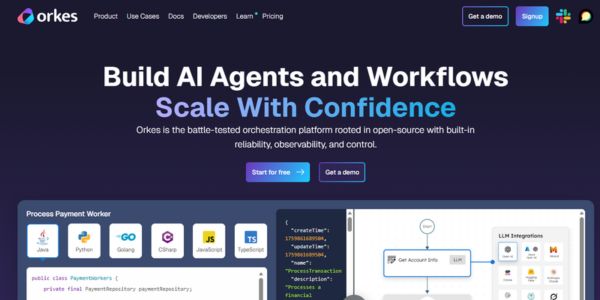
When Jeu George talks about AI in the enterprise, he does not start with model architectures or benchmarks. He talks about outages. In the past year, the Orkes co-founder says, too many companies have learned the hard way that a clever large language model demo does not translate into a reliable production system that can survive rate limits, flaky APIs, or a compliance audit. Orkes, the workflow and agent orchestration startup he leads, is betting that this reliability gap is where the real money in AI will be made—and its new 60 million dollar funding round suggests investors agree.
Inside Orkes’ $60 Million Bet
Orkes, based in Santa Clara and built by the original architects of Netflix’s microservices orchestration platform, has secured 60 million dollars in fresh capital led by AVP, with participation from Prosperity7 Ventures, Nexus Venture Partners, Battery Ventures, and Vertex Ventures US. The round, which includes 40 million dollars in Series B equity, brings Orkes’ total funding to roughly 90 million dollars and places it among the more heavily financed players going after enterprise AI orchestration.
Investors are effectively underwriting the idea that enterprises will not scale AI without a dedicated control plane. The company’s pitch is that Orkes gives developers a single execution layer to design, run, and monitor complex, AI‑infused workflows—everything from multi-step customer support agents to fraud pipelines that blend LLM reasoning, internal microservices, and human approvals.
From Netflix Conductor to Enterprise AI Backbone
Under the hood, Orkes builds on Conductor, the open‑source workflow engine first created at Netflix to manage sprawling microservices architectures. That lineage matters to risk‑averse CIOs: Conductor has already been battle‑tested at web scale, orchestrating millions of transactions across services that cannot afford downtime.
Orkes has repurposed that foundation for an AI-first world. The platform lets teams stitch together LLM calls, retrieval steps, deterministic services, and human tasks into durable workflows, with retry logic, timeouts, circuit breakers, versioning, and observability built in. If a model times out or an external API fails, the workflow can degrade gracefully rather than dropping a customer request or producing an untraceable hallucination.
Why Developers Are Reaching for Orchestration
For developers, the problem is not building a prototype chatbot; it is running a fleet of AI agents that interact with core systems without breaking SLAs or compliance rules. Orkes pitches itself as the execution layer that abstracts away the mess: it tracks state across long‑running processes, provides detailed logs and metrics, and exposes policy controls so security teams can see which agents can call which systems and under what conditions.
In practice, that means a fintech can design a credit underwriting agent that chains together a KYC service, an LLM for document parsing, a rules engine, and a human reviewer, with every step logged and auditable. A retailer could run a customer support agent that escalates to a human when confidence scores drop below a threshold, with dashboards showing latency, error rates, and model costs over time.
This is the layer many organizations realized they were missing in 2024 and 2025, when AI pilots worked in a sandbox but stalled before hitting real users. Orkes is explicitly going after that “stuck in pilot” segment: companies with budget and executive pressure to deploy AI, but without the tooling to make those systems robust enough for production.
Competitive Landscape: Cloud Giants vs. Specialists
Orkes is far from alone in chasing this opportunity. Cloud providers and AI platform vendors are racing to offer their own ways to chain LLM calls and tools, from managed workflow services to agent frameworks. The risk for a startup like Orkes is that enterprises may default to whatever their primary cloud vendor offers, even if it is less feature‑rich, simply to keep architecture simple.
Orkes is trying to differentiate by leaning into neutrality and depth. The platform is designed to span multiple models, data sources, and clouds, reflecting the reality that most large organizations will mix and match vendors. Its Netflix pedigree and focus on durable, long‑running workflows—rather than just short LLM chains—also set it apart from lighter‑weight “agent frameworks” that live closer to the developer tools layer than to enterprise operations.
Still, questions remain about how much of this functionality incumbents will absorb. Hyperscalers could bundle orchestration into broader AI platform pricing. Traditional BPM and integration vendors may try to rebrand their existing products as AI‑ready. Orkes will have to prove that its deeper, AI‑centric control plane is worth adopting alongside or instead of those tools.
Regulation, Governance, and the “Trust Layer”
The funding comes as regulators in the U.S., Europe, and elsewhere push companies to show they have real governance around AI systems, not just high‑level principles. Enterprise customers are already asking how to track which models were used for which decisions, how to prove humans were in the loop where required, and how to roll back or update workflows when policies change.
Orkes’ architecture gives it a natural role in that conversation: as the system that knows every step an agent took, every model it called, and every exception it triggered. For risk officers and auditors, that kind of unified execution log could be a way to bridge the gap between experimental AI projects and the documentation regulators increasingly expect to see.
But orchestration alone will not solve regulatory compliance. Companies still need strong data governance, model evaluation, and domain‑specific controls. Orkes is positioning itself as one layer in a broader AI governance stack, betting that as rules tighten, the demand for a configurable, observable execution fabric will grow rather than shrink.
What Comes Next for Orkes and Enterprise AI
With its new capital, Orkes plans to expand the platform and grow adoption across industries, reinforcing its role as a foundational layer for AI and agent deployments. Expect the company to invest in higher‑level tooling—templates for common industry workflows, stronger security integrations, and richer analytics to help customers understand where AI agents help and where they still fail.
For founders and operators building atop AI, the signal is clear: the frontier is shifting from model performance to system reliability. As more organizations move from proof‑of‑concepts to production, the question will not just be “what can this model do?” but “can we trust this workflow on a Tuesday afternoon when traffic spikes and a regulator calls?” Orkes is wagering that whoever can answer that second question convincingly will own a critical piece of the enterprise AI stack.

Emma Carter is a Staff Writer at futureTEKnow, covering applied AI, foundation models, and the startups turning research breakthroughs into real products.
Discover the companies and startups shaping tomorrow — explore the future of technology today.
Most Popular
Trending Companies
Latest Articles
futureTEKnow is focused on identifying and promoting creators, disruptors and innovators, and serving as a vital resource for those interested in the latest advancements in technology.
© 2026 All Rights Reserved.