
Startups & Business News
Cloneable’s agentic AI platform targets the infrastructure knowledge gap with $4.6M seed round
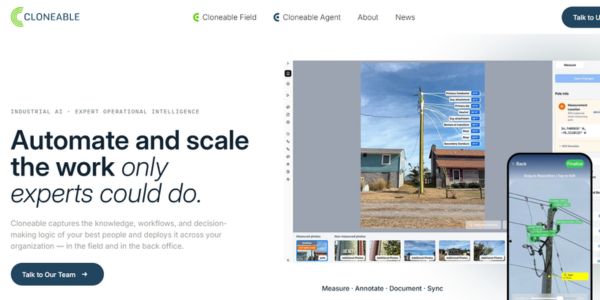
Cloneable’s new agentic AI platform is betting that the next big efficiency gain in artificial intelligence will not come from writing better prompts, but from capturing the tacit knowledge of field-hardened experts before it disappears from the infrastructure workforce. As utilities, telecoms, and construction firms scramble to modernize aging assets, the Raleigh-based startup is positioning itself as a bridge between retiring engineers and the software agents that could one day replace their most specialized workflows.
Why agentic AI is coming for infrastructure operations
Across the United States, critical infrastructure is aging faster than operators can maintain it, and the constraint is increasingly human rather than financial. Cloneable’s co-founder and CEO Lia Reich frames the problem bluntly: the engineers who understand grid hardening, telecom build-outs, and complex construction projects are retiring, and much of their expertise still lives only in their heads. The result is a widening knowledge gap that slows down modernization projects, increases risk, and leaves capital on the table.
Cloneable argues that recent advances in AI finally make it possible to preserve and scale that expertise in a way that traditional training, documentation, and point solutions have not. Rather than asking teams to clean data or adopt new interfaces, its platform shadows experts inside the desktop and web tools they already use, then turns those observed workflows into specialized agents that can execute similar tasks at scale.
What Cloneable Agent actually does
Cloneable Agent is described as a fully agentic platform that converts back-office workflows into AI agents capable of replicating expert work at “unlimited” scale. It observes how subject-matter experts perform tasks inside existing systems, captures their decisions and contextual cues, and then codifies this into software agents that can be deployed across an organization.
At launch, Cloneable is focusing on a specific vertical: energy. The company offers purpose-built templates for make-ready engineering, permitting, and joint use processes, and says customers are seeing time-to-value in as little as 24 hours. For founders and operators, that suggests a go-to-market motion built around highly opinionated, use-case-specific agents, rather than a horizontal toolkit that requires significant in-house configuration.
The platform complements Cloneable Field, a product the company unveiled in 2025 to streamline infrastructure inspections such as pole assessments. That earlier product is used by utility companies, internet service providers, engineering firms, and agribusinesses to improve safety, inspection speed, and data quality, while the new back-office agents extend automation from data capture in the field through to decision-making and execution.
Seed funding and expansion roadmap
To fuel this strategy, Cloneable closed a $4.6 million seed round led by Congruent Ventures, with participation from First In, Overline, St. Elmo Venture Capital, and Bull City Venture Partners. Crunchbase reporting indicates that this brings the company’s total funding since its 2023 founding to around $5.35 million. That capital is earmarked for expanding its agentic platform across infrastructure-intensive industries beyond the energy use cases it is launching with.
The roadmap includes public utilities, vegetation management, construction, rail, mining, agriculture, and manufacturing—markets the company characterizes as chronically underserved by generic automation and rigid point solutions. Cloneable’s pitch is that no one has yet combined in-field data collection with agent-based back-office automation at the scale these sectors require. Investors appear to see this combination of domain depth and technical leverage as a defensible wedge into what has historically been a slow-moving software market.
How customers might use Cloneable in practice
On the ground, Cloneable’s offering is meant to look less like a replacement for engineers and more like a force multiplier for overstretched teams. A utility might start by using Cloneable Field to automate inspections of hundreds of thousands of poles, capturing standardized images and structured data from crews in the field.
Cloneable Agent then steps in on the back end: it shadows senior engineers as they review inspection data, run structural calculations, and make go/no-go decisions using existing engineering tools. Over time, those interactions train agents to replicate key parts of the workflow, from drafting design documents to preparing permitting packages, so that humans can focus on edge cases and higher-level planning.
Tate Stricklin, CEO of Texas Area Telecom, captures the customer-side pain point in a quote cited by Cloneable: infrastructure is being asked to support a modern economy while still being managed with “fragmented tools and tribal knowledge.” He frames Cloneable’s end-to-end stack—from field capture through back-office execution—as a step toward the operational continuity that telecom and utility operators have long needed.
Competitive landscape and differentiation
The infrastructure automation market has seen waves of products that handle narrow slivers of the workflow, from inspection tools to asset management systems. Cloneable is explicitly positioning itself against hardcoded, single-use workflows, arguing that its customers can build and deploy new applications in hours, connecting data collection directly to actionable outcomes.
Unlike generic large language models that require clean datasets and often force teams into new interfaces, Cloneable’s approach leans heavily on “shadowing” experts and working across the desktop and web applications they already rely on. The company also emphasizes that its agents are vertical and rules-aware, tuned to industry-specific regulations and operational constraints rather than broad conversational tasks.
For founders and investors tracking the emerging ecosystem of agent platforms, Cloneable’s bet is that deep domain context and integrated field-to-back-office workflows will matter more than generic AI capabilities. If it can continue to prove time-to-value in days rather than months, the company could become a reference point for how agentic AI products penetrate conservative, safety-critical industries.
What’s next for infrastructure-focused AI agents
The launch of Cloneable Agent underscores a broader shift in enterprise AI from experimentation to embedded workflows. As infrastructure operators face workforce attrition and rising reliability expectations, tools that can preserve institutional knowledge while automating repetitive tasks are likely to move from “nice to have” to core systems.
Cloneable is already inviting prospects to schedule demos, sign up for developer updates, or even submit workflow ideas that the team will prototype with “no strings attached.” For an industry where pilots can drag on for years, this emphasis on rapid deployment and collaborative design may be as important as the underlying model architecture. Founders building adjacent products—and investors backing them—will be watching closely to see whether specialized agent platforms can scale beyond early lighthouse customers into the broader fabric of infrastructure operations.

Elena Rossi is a Senior Staff Writer at futureTEKnow, covering AI, foundation models, autonomous agents, and the infrastructure powering the next wave of intelligent applications.
Discover the companies and startups shaping tomorrow — explore the future of technology today.
Most Popular
Trending Companies
Latest Articles
futureTEKnow is focused on identifying and promoting creators, disruptors and innovators, and serving as a vital resource for those interested in the latest advancements in technology.
© 2026 All Rights Reserved.