
Startups & Business News
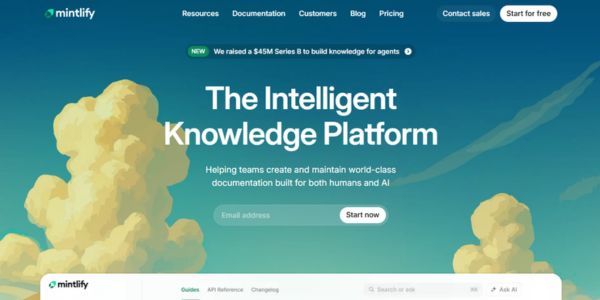
In a funding climate where many software startups are tightening their belts, Mintlify just closed a $45 million Series B round led by Andreessen Horowitz and Salesforce Ventures at a $500 million valuation, pushing its total funding to $67 million. On the surface, it is another big-number announcement in the AI-adjacent gold rush. Look closer, and it is a wager on something more prosaic but far harder to replicate than model weights: the unglamorous documentation and internal knowledge that AI systems quietly depend on.
That distinction matters because regulators, enterprises, and workers are starting to discover the same uncomfortable truth: AI fails in the wild less because of raw model capability and more because it sits on top of fragmented, stale, and inconsistent information. Mintlify’s pitch is that this “knowledge layer” is no longer a back-office concern; it is becoming core infrastructure for AI agents inside companies and across the web. As lawmakers in Washington, Brussels, and Beijing debate how to govern powerful models, the real leverage may lie further down the stack, in who controls and maintains the structured knowledge these systems read from and act on.
From developer docs to AI system of record
Mintlify started in 2022 with a familiar pain point: developers stuck at 2 a.m. trying to integrate an API using a stale README and a GitHub issue from three years ago. The founders, Hahnbee and Han Wang, went through Y Combinator’s W22 batch and built a documentation platform that now powers docs for more than 20,000 companies and reaches over 100 million people annually.
For a while, the story was straightforward: make documentation beautiful, fast, and actually useful for humans skimming for code snippets and quick answers. Then the traffic shifted. Mintlify says nearly half of documentation traffic now comes from AI agents and AI-assisted workflows, not humans in a browser tab. That is a profound change: documentation is no longer just a developer convenience; it is becoming the machine-readable interface to how products work.
In this new environment, marketing sites are largely irrelevant to AI agents. They are designed to trigger human emotion and brand recognition, not to explain rate limits, edge cases, or API behavior in the precise ways models need. When an AI agent wants to know what a product does and how to use it, it goes to the docs. If those docs are incomplete or poorly structured, the product may effectively vanish from the AI ecosystem—an emerging discoverability problem that looks a lot like the early days of mobile and search, only this time the “user” is software.
Documentation as knowledge infrastructure, not content
Mintlify’s central claim is blunt: documentation is no longer just content; it is infrastructure. That framing aligns with what large enterprises are discovering as they bolt AI assistants onto sprawling internal systems. If an AI support agent is built on scattered help center articles, outdated pricing pages, and conflicting playbooks, it will confidently deliver wrong answers at scale. The model gets blamed; the real failure sits in the knowledge layer underneath.
The company has watched this play out in customer deployments. One example they cite: a company tweaks its pricing but neglects to update the help center. Every AI-based support agent trained on that content starts misinforming customers. This is not a hallucination problem; it is a data governance problem. As more organizations rely on AI to interact with customers, regulators are likely to start asking how systematically that underlying knowledge is maintained and audited.
Mintlify is positioning itself as the structured, continuously updated backbone that makes both external docs and internal knowledge usable by AI agents. The logic is simple: in an AI-native world, companies that invest in this layer will enjoy compounding advantages as machine-to-machine workflows become default. The rest will be stuck in a reactive posture, patching systems after bad answers hit users, regulators, or both.
Inside Mintlify’s AI-era product stack
The company’s product line reveals how this knowledge-layer thesis translates into specific tools. Mintlify’s original public-facing documentation platform remains the front door. Increasingly, however, customers are bringing the platform inside the organization to power internal knowledge bases, engineering handbooks, design systems, and best-practice repositories. The same patterns that make external developer docs effective—clear structure, versioning, and ownership—are being repurposed for internal AI agents that answer questions for employees.
To keep this content accurate, Mintlify offers “Workflows,” an always-on automation layer that helps keep documentation up to date across codebases and tools. It integrates with existing systems like project management platforms and source code repositories so that changes in one place trigger content updates elsewhere. It also provides its own AI agent to draft and update content based on prompts, an acknowledgment that even documentation about AI will increasingly be written by AI.
For external connectivity, Mintlify supports the Model Context Protocol (MCP), allowing customers to connect their knowledge directly to outside agents. In practice, that means organizations can expose structured documentation and internal knowledge to third-party AI systems in a controlled way, instead of hoping general-purpose models infer the right behavior from a marketing site. It is a small but important step toward a more interoperable AI stack, one where documentation behaves almost like an API for knowledge.
Labor, compliance, and the politics of knowledge
If Mintlify is right that documentation is becoming infrastructure, the implications go beyond developer experience. There is a labor story here: the quiet work of maintaining accurate documentation has historically been under-resourced and often pushed onto developers or technical writers as an afterthought. As AI agents become more deeply embedded in sales, support, and operations, the stakes of that work rise.
For workers, this shift cuts both ways. On one hand, better documentation reduces the cognitive tax on engineers and operators who spend time chasing down institutional knowledge in chats and wikis. On the other, it could accelerate the automation of frontline roles—particularly in customer support and internal help desks—if those roles are increasingly mediated by agents that sit on top of a well-structured knowledge base. The question for management and policymakers is whether the gains from reduced friction and error get reinvested in upskilling and new roles, or simply flow to the bottom line.
On the compliance side, regulators in the US and EU are already circling around transparency, reliability, and auditability requirements for AI systems. While the headlines focus on models, enforcement is likely to hinge on questions that look suspiciously like documentation governance: Can a company show how the information its AI relied on was sourced, updated, and corrected over time? Who is accountable when an AI agent misleads a consumer based on outdated knowledge? A platform that tracks and structures this information offers a more defensible story to regulators than a collection of unmanaged wiki pages.
Capital, control, and AI’s middle layer
The investor roster for Mintlify’s Series B is a who’s who of the current AI capital stack: a16z and Salesforce Ventures leading the round, with participation from Bain Capital Ventures, Y Combinator, DST Global’s Rahul Mehta, MVP Ventures, Avra, HubSpot Ventures, and TwentyTwo Ventures. That mix of cloud, CRM, and traditional venture capital points to a broader pattern: strategic investors want a say in how the middle layers of the AI stack get built.
This is not just about financial returns. If documentation becomes the de facto system of record for how products work in an AI ecosystem, whoever standardizes and hosts that layer has outsized influence over interoperability, compliance norms, and even competitive dynamics. In a US–China race framed around chips and frontier models, it is easy to overlook the leverage embedded in such “boring” infrastructure. But history suggests control of middleware and standards often determines who captures durable value in a platform shift.
Mintlify is explicit that it wants to “define a new category at the center of the AI stack,” and is hiring aggressively across engineering, sales, and marketing from its fully in-person base in San Francisco. That ambition will put it into closer conversation—and potential tension—with both regulators and large enterprise buyers who are wary of new single points of failure in their AI supply chains. For policymakers, the open question is whether this kind of knowledge infrastructure remains plural and interoperable, or ossifies into a few privately controlled choke points.
What founders and operators should watch
For founders and operators building in AI or selling into AI-heavy customers, the Mintlify story is less about one company’s fundraise and more about where the bottlenecks are moving. As AI agents proliferate, reliable, structured knowledge is emerging as a prerequisite, not a nice-to-have. That suggests several practical questions:
Who owns the accuracy and governance of documentation and internal knowledge in your organization today?
Can you trace how pricing, policies, and product behavior changes propagate into the content your AI agents rely on?
If an AI system misleads a customer or employee, could you explain which underlying document failed—and who is responsible for fixing it?
The answers will shape not only technical roadmaps but also hiring plans, procurement strategy, and regulatory exposure. Mintlify’s latest round is a signal that investors believe there is real money to be made in solving these problems. For everyone else in the ecosystem, it is a reminder that in an AI-native world, the quiet work of documentation may be where power—and liability—ultimately resides.

Aiko Tan is a Staff Writer at futureTEKnow, covering AI research, multimodal models, and the fast‑moving AI startup scene across Asia‑Pacific.
Discover the companies and startups shaping tomorrow — explore the future of technology today.
Most Popular
Trending Companies
Latest Articles
futureTEKnow is focused on identifying and promoting creators, disruptors and innovators, and serving as a vital resource for those interested in the latest advancements in technology.
© 2026 All Rights Reserved.
One Response
Love how you framed Mintlify’s raise as a bet on “documentation as AI infrastructure” rather than just another devtool round. 🙂