A New Era in AI Hardware at WAIC Shanghai
Huawei has officially unveiled its CloudMatrix 384 AI computing system at the World Artificial Intelligence Conference (WAIC) in Shanghai, seizing global attention as China’s most assertive leap toward challenging Nvidia’s AI dominance. This system, powered by 384 Ascend 910C chips, demonstrates Huawei’s audacious strategy to bridge the technology gap left by US export restrictions and marks a pivotal moment in the ongoing race to command the future of artificial intelligence in China.
The Supernode Advantage: Cluster Power Over Chip Power
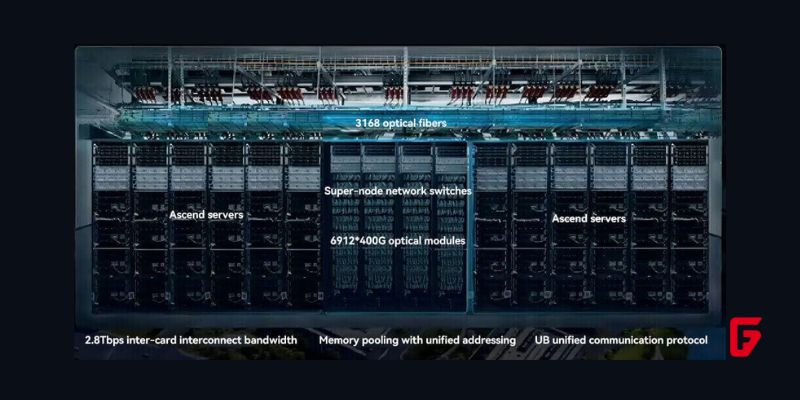
Unlike its rivals, Huawei’s design philosophy prioritizes “system-level innovation” over sheer chip performance. While each Ascend 910C chip trails Nvidia’s top silicon in raw computational power, CloudMatrix 384 compensates by clustering hundreds of these chips in a unified, high-bandwidth network. The result? An estimated 300 petaFLOPS of performance—almost double Nvidia’s current GB200 NVL72 system.
Key architectural highlights:
“Supernode” architecture: Every chip links using an ultra-fast, all-to-all optical interconnect, slashing latency and boosting aggregate compute power.
Optical links: Photonic connections replace conventional copper, delivering both high speed and reliability across 16 system racks.
Operational in Huawei Cloud: Not just theory—CloudMatrix 384 is already running in production for cloud users, confirming practical viability for China’s AI sector.
Why Now? U.S. Export Curbs & China’s AI Independence
The timing of this launch is no coincidence. Recent US bans on Nvidia’s most advanced AI chips, such as the H20, have opened a path for domestic Chinese players. Huawei has seized this vacuum, rapidly scaling Ascend chip production and pushing the CloudMatrix 384 into active deployment—even as debates continue over the future availability of Nvidia hardware in China.
Behind the scenes, Huawei pours roughly $25 billion annually into research and development. The company’s founder, Ren Zhengfei, openly acknowledges that Ascend chips “lag a generation behind” in physics but emphasizes “mathematics to complement physics” and the power of cluster computing over single-chip supremacy for real-world workloads.
Performance vs. Power: Not a Free Lunch
There’s a catch. This brute-force approach is power-hungry—an estimated 559kW per system—which is more than twice the energy draw of Nvidia’s closest rival. Yet, with lower electricity costs and a political imperative for tech independence, China appears ready to bear these inefficiencies for the sake of autonomy.
What It Means for the Global AI Landscape
The debut of CloudMatrix 384 doesn’t just represent a hardware achievement. It’s a clear statement: China now possesses an AI supercomputer able to rival Nvidia’s top-end tech by leveraging system integration and optical networking. Internationally, this escalates the tech rivalry as regulations tighten and Chinese firms build alliances to solidify a home-grown ecosystem.
This is a milestone, not just for Huawei, but for the entire Chinese AI sector. By embracing a strategy of massive chip clustering and next-generation interconnects, Huawei has redefined the battle lines in the global AI hardware race. While challenges remain—especially around power consumption and software maturity—Huawei’s architecture innovation offers a credible path for technological self-sufficiency amid mounting geopolitical headwinds.