

Startups & Business News
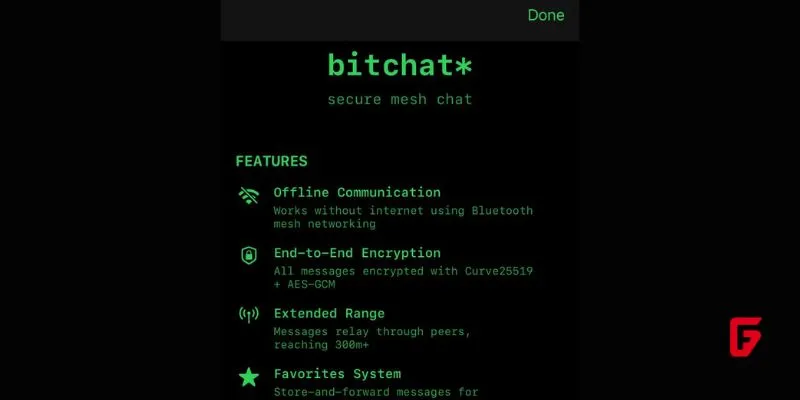
Jack Dorsey’s new app, Bitchat, is shaking up secure communication. Released on the Apple App Store, Bitchat is not your typical messaging platform. It’s designed for digital autonomy and connectivity in places where traditional networks fall short, from disaster zones to large events and censored regions.
At its core, Bitchat uses Bluetooth mesh networking powered by Bluetooth Low Energy (BLE). Instead of routing messages through centralized servers or relying on expensive cell towers, each device acts as both a client and a relay, passing messages to peers in proximity. As people move, their devices connect, forming clusters and extending the communication range up to 300 meters by hopping through overlapping users. All of this happens offline—no Wi-Fi, mobile data, or infrastructure required.
Unlike mainstream messaging apps, Bitchat breaks away from the need for account creation, phone numbers, or email addresses. When you launch the app, you’re assigned a random display name, and that’s all you need to start chatting. There’s no sign-in, no registration, and zero user tracking. For added peace of mind, a triple-tap panic feature instantly deletes all app data.
Bitchat employs robust end-to-end encryption using the Noise Protocol. Messages vanish after delivery unless purposely stored, and private or group chats can be protected by passwords. However, security researchers have pointed out that the app currently carries some vulnerabilities, especially regarding user impersonation.
Developers note that Bitchat should not be relied upon for critical or sensitive secrets until further independent security reviews are complete.
Several features make Bitchat practical beyond tech novelty:
Disaster/Emergency Zones: When cellular networks fail (such as during natural disasters), Bitchat’s mesh can keep local communities and rescuers connected.
Protests and Censorship: Activists and citizens can coordinate and communicate privately, even when internet access is cut or monitored.
Remote Areas: From field teams to rural families, Bitchat works where the internet doesn’t.
Previous mesh messaging efforts like FireChat proved helpful in similar scenarios, but Bitchat’s focus on encryption and privacy sets it apart.
Despite its promise, Bitchat comes with trade-offs:
Physical Proximity: For best performance, users need to be within Bluetooth range; the app’s effectiveness relies on enough nearby devices to form a network.
Compatibility: Full connectivity between iOS and Android is still being improved; current Android versions must be installed manually from GitHub.
Security: Users are advised to avoid sharing highly sensitive information via Bitchat for now.
Looking ahead, features like Wi-Fi Direct are planned to boost speed and range, with ongoing open-source development set to enhance Bitchat’s capabilities.
Bitchat emerges as a privacy-forward, infrastructure-independent messaging platform ideally suited for contexts where traditional connectivity is unreliable, censored, or risky. While the security model is still maturing, the app’s simple, anonymous access and resilient design signal a new direction for secure, decentralized communication

Editorial Team
futureTEKnow is a leading source for Technology, Startups, and Business News, spotlighting the most innovative companies and breakthrough trends in emerging tech sectors like Artificial Intelligence (AI), Robotics, and the Space Industry.
Discover the companies and startups shaping tomorrow — explore the future of technology today.

London startup Dwelly just landed $93M to snap up UK rental agencies and inject AI smarts. Founders from Uber and

Encord just landed $60M in Series C funding to supercharge data tools for physical AI. Founders Eric Landau and Ulrik

Foodforecast, a Cologne AI foodtech firm, just scored €8M in Series A funding led by SHIFT Invest. Their tools predict

In 2026, AI scales operational excellence fundamentals—clear ownership, disciplined execution, and continuous improvement—letting leaders focus on outcomes while systems handle

Munich-based VoiceLine has closed a €10M Series A round to grow its voice AI platform for frontline sales and service

AI is redefining logistics transformation—from network design to real-time execution. This article explores how data-driven insight, intelligent automation, and scalable

Shenzhen’s Hai Robotics, pioneer in ACR warehouse robots, files for HK IPO after raising over $500M in funding rounds led

Explore how AI transforms process engineering and continuous improvement into self-learning systems. This article explains how organizations can design operations

Ouster’s $35M StereoLabs acquisition fuses lidar and ZED cameras into end-to-end Physical AI sensing. Founders Cecile Schmollgruber and team drive

Bretton AI’s $75M Series B modernizes AML KYC compliance via AI agents, slashing staffing costs for banks and fintechs like

Axiom Space has locked in a fresh $350M raise to push its commercial space station and NASA lunar spacesuits toward

New York startup Santé secures $7.6M seed to build AI-powered POS for liquor stores, tackling regs & inventory woes after
futureTEKnow is focused on identifying and promoting creators, disruptors and innovators, and serving as a vital resource for those interested in the latest advancements in technology.
© 2026 All Rights Reserved.