Warehouse automation decisions shape distribution performance for years to come. Organizations that align automation investments with operating strategy consistently achieve stronger throughput, cost control, and long-term adaptability.
As case-pick and distribution environments grow more complex, automation has become a critical lever for scale and efficiency. Robotics, AS/RS, conveyors, and advanced software platforms are now common across modern distribution centers. What differentiates outcomes, however, is how these technologies are designed into the operating model.
Organizations that approach automation through a systems lens—integrating flow, intelligence, and flexibility—tend to realize compounding value over time.
Automation as an Operating Model Decision
Distribution centers today operate under increasing pressure from higher SKU counts, tighter service windows, labor constraints, and demand volatility. In this context, automation plays a central role in sustaining performance.
Leading organizations treat automation as part of an integrated operating strategy, where physical design, software intelligence, and future adaptability are engineered together. Data, analytics, and AI increasingly support these decisions by improving visibility, evaluating trade-offs, and reducing execution risk.
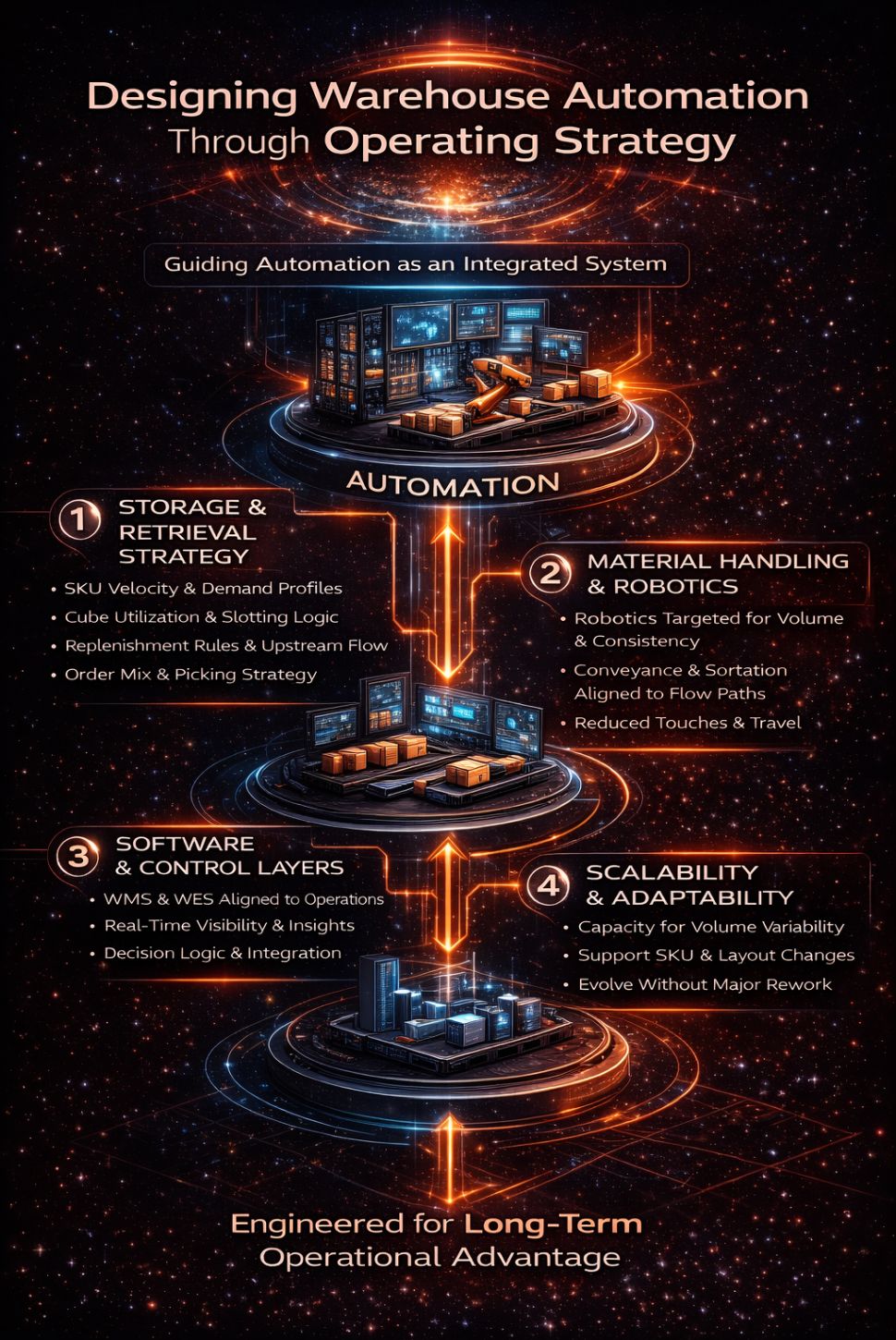
Four Design Principles Behind Effective Warehouse Automation
High-performing automation strategies consistently emphasize four interconnected design principles.
1️⃣ Storage & Retrieval Strategy
Storage design establishes the structural foundation of warehouse performance.
High-density storage solutions such as AS/RS deliver the most value when engineered around:
📦 SKU velocity and demand profiles
📐 Cube utilization and slotting logic
🔁 Replenishment rules and upstream flow
📊 Order mix and picking requirements
Advanced analytics and AI-supported modeling help teams evaluate SKU behavior, assess trade-offs, and align storage design with operational realities. When storage strategy is engineered with these inputs, automation supports flow rather than constraining it.
2️⃣ Material Handling & Robotics
Material handling and robotics influence how efficiently work moves through the facility.
Effective designs focus on:
🤖 Applying robotics where volume and repeatability support consistency
🔄 Aligning conveyance and sortation with true flow paths
🚶 Reducing unnecessary travel and handoffs
⚖️ Balancing automation with human adaptability
Simulation and AI-enabled flow analysis help validate that automation improves throughput across the system rather than shifting congestion between process steps.
3️⃣ Software & Control Layers
Automation performance depends heavily on the intelligence coordinating execution.
Modern distribution environments rely on software layers that include:
📊 WMS and WES platforms aligned to operational logic
👁 Real-time visibility across orders, labor, and equipment
🧠 Decision logic for prioritization, wave release, and exception handling
🔁 Integration between WMS, WCS, and automation controls
AI enhances these layers by supporting predictive insights, dynamic sequencing, and exception-based management—enabling operations to respond proactively to changing conditions.
4️⃣ Scalability & Adaptability
Sustained automation value depends on how well systems evolve over time.
High-performing designs support:
📈 Volume variability and peak demand
📦 SKU expansion and assortment changes
🧱 Layout evolution with minimal disruption
🔄 Incremental growth rather than full redesign
Digital modeling and AI-enabled scenario analysis increasingly inform these decisions, helping teams test future conditions and protect long-term flexibility.
Automation as a System, Not a Component
Modern distribution centers are designed as integrated systems that balance:
Throughput
Cost-to-serve
Operational resilience
When automation decisions are aligned with operating strategy—and informed by data, analytics, and AI—technology becomes a durable performance enabler rather than a fixed constraint.
Final Thoughts
Warehouse automation delivers the greatest value when it is designed as part of the operating model.
By focusing on storage strategy, flow efficiency, control intelligence, and adaptability, organizations create distribution environments that scale with demand, absorb variability, and sustain performance over time. AI-supported insights increasingly strengthen this approach by improving decision quality before execution risk materializes.
That is how automation supports long-term operational advantage.
Carlos Salazar is an Executive Supply Chain Leader with 20 years of experience spanning international business, engineering, and operations. Certified in PMP, Lean Six Sigma, and advanced artificial intelligence (AI) for supply chain leadership, Carlos combines disciplined execution with innovation to build resilient, end-to-end supply chain solutions.