
Startups & Business News
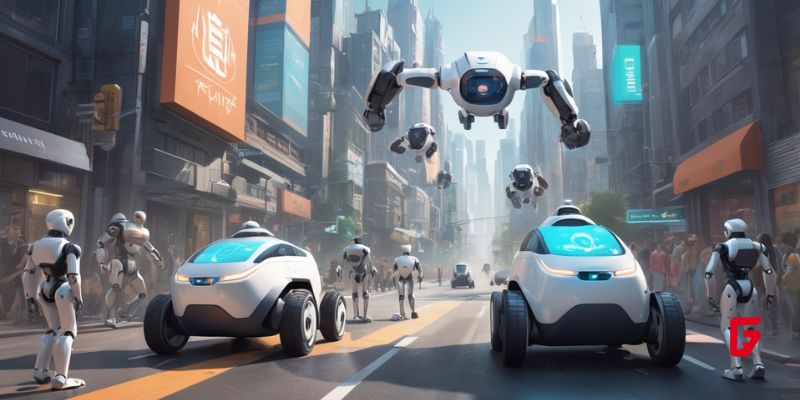
The integration of robotics and artificial intelligence is no longer a futuristic concept but a rapidly advancing reality, as global tech giants like Tesla, Amazon, and Intel make bold investments that forecast a seismic shift in automation. Morgan Stanley projects the robotics market to hit $5 trillion by 2050, signaling the arrival of a new era dominated by physical AI innovations.
Robots Transforming Urban Logistics and Daily Life
One of the most striking recent developments is the deployment of delivery robots commuting on subways in Shenzhen, China, autonomously navigating elevators, train doors, and aisles to restock 7-Eleven stores. These robots exemplify how urban logistics could soon be fully automated, shrinking delivery timelines and cutting operational costs while blending seamlessly into public infrastructure. This practical use case pushes robotics beyond lab experiments into everyday life.
Democratizing Robotics: Bringing Robot Training to Everyone
Moving beyond specialized factory settings, engineers at MIT have unveiled a handheld device allowing users to train robots without any coding. This innovation breaks down barriers, empowering individuals and small businesses without technical backgrounds to teach robots new tasks by physical demonstration. This inclusivity heralds a democratization of robotics, potentially accelerating adoption across industries and homes.
AI Agents That Think, Act, and Self-Correct
On the software side, OpenAI’s new ChatGPT Agent represents a leap forward in AI’s ability to blend reasoning and actions. This agent can handle complex, multi-step tasks such as analyzing wedding invitations, recommending outfits, planning gifts, and even booking vacations—all within one conversation. Impressively, it critiques and improves its own outputs, showcasing a level of autonomy akin to a personal digital assistant far ahead of current models. This evolution could redefine interactions with AI across productivity, entertainment, and lifestyle.
Breakthrough Funding and New AI Frontiers
The AI revolution is backed by massive funding, highlighted by former OpenAI CTO Mira Murati’s new startup raising $2 billion in a seed round for a multimodal AI program described as the most ambitious worldwide. The scope and scale of this funding underscore confidence in revolutionary advancements that could unlock capabilities beyond today’s AI models.
Beyond Voice Cloning: Capturing Personality and Communication
Emerging voice AI technology such as Hume’s EVI3 model goes beyond mere voice replication to capture the entire personality, speaking style, and vocabulary of individuals. This nuanced understanding of human communication points to AI that can not only talk like you but also think and respond like you, opening new horizons for personalized AI companions and virtual assistants.
Robotics in the Real World: Enhancing Workforce Efficiency
Real-world applications of robotics show promising impacts on labor-intensive industries. Korean Air’s use of robotic exoskeleton suits to reduce worker strain by up to 60% during aircraft maintenance illustrates how AI and robotics enhance worker safety and productivity. Similar exosuits are planned for construction, shipbuilding, and agriculture, proving these technologies are not just theoretical but effectively solving practical problems today.
AI and Robotics Market Dynamics
The industry faces intriguing shifts, such as Google and Nvidia resuming AI chip sales to China, affecting the balance of AI development and competition. Meanwhile, lesser-known players in China are releasing open-source large language models that challenge the dominance of GPT-4, signaling a rapidly evolving and competitive AI landscape.
In Summary
| Company | Key Focus / Specialization | Notable Technologies / Products | Industry / Use Case |
|---|---|---|---|
| Tesla | Physical AI, humanoid robots | Optimus Gen 2 humanoid robot | Robotics, AI-powered automation |
| Amazon | Autonomous delivery systems | Delivery robots for logistics and warehouse automation | Retail logistics, last-mile delivery |
| Intel | AI hardware and robotics components | AI chips powering autonomous robots | Robotics hardware and AI technology |
| MIT (Research) | No-code robot programming devices | Handheld robot trainers for non-programmers | Robotics democratization and training |
| OpenAI | Intelligent AI agents, multi-modal conversational AI | ChatGPT Agent for complex multi-step tasks | AI software agents, personal digital assistants |
| Hume | Voice AI personality models | EVI3 voice AI capturing style, personality | Advanced voice synthesis and communication |
| Korean Air | Robotic exoskeleton suits for workforce efficiency | Exoskeletons reducing strain in aircraft maintenance | Industrial robotics, worker support |
| Google / Nvidia | AI chip suppliers | AI chips, including sales and market competition | AI hardware enabling robotics |
Accelerating AI Capabilities and Democratizing Innovation
Data indicates AI models are doubling the complexity of tasks they can handle roughly every 4.5 months, accelerating innovation speed dramatically. Platforms like Replit harness this trend by enabling individuals to create powerful custom software affordably, exemplifying how AI is democratizing software creation and empowerment.
This convergence of robotics, autonomous AI agents, and accessible training tools marks a transformative inflection point in technology. As these innovations mature, we can expect the boundaries between digital intelligence and physical automation to blur, fundamentally reshaping industries, economies, and daily human experiences.

futureTEKnow
Editorial Team
Discover the companies and startups shaping tomorrow — explore the future of technology today.
Most Popular

Trending Companies
Latest Articles
futureTEKnow is focused on identifying and promoting creators, disruptors and innovators, and serving as a vital resource for those interested in the latest advancements in technology.
© 2026 All Rights Reserved.