
Startups & Business News

Microsoft $17.5B AI investment, Tesla Optimus, SpaceX defense launch

KEY POINTS

  • Microsoft’s multibillion-dollar AI investment signals a long-term bet on cloud, data centers, and enterprise AI.

  • Tesla’s Optimus robot push shows how humanoid robotics could transform labor and manufacturing.

  • SpaceX’s expanding defense launch portfolio highlights the militarization and securitization of space.

  • Together, these moves shape the next era of AI, robotics, and space competition across Big Tech and governments.

Microsoft’s $17.5B AI bet, Tesla’s Optimus robot push, and SpaceX’s latest defense launch reshape the AI and space race.

Why Microsoft’s AI investment matters now

When a company the size of Microsoft commits tens of billions of dollars into AI infrastructure, it is not experimenting – it is building the next computing layer. The latest Microsoft AI investment targets data centers, specialized chips, cloud platforms, and sovereign AI capabilities that let governments and large enterprises run critical workloads under tight privacy and security controls. This is all about owning the rails of the AI economy.

For builders and businesses, that means more GPU-rich cloud regionslow-latency AI services, and integrated tools that make it easier to deploy models directly into apps people already use every day. The more Microsoft doubles down here, the more Azure becomes the default home for AI-powered products, from copilots in productivity suites to custom vertical models in healthcare, finance, and industrial settings.

Inside Microsoft’s frontier tech strategy

This Microsoft AI investment is also a defensive and offensive move at the same time. On one side, it protects Microsoft’s position against other hyperscalers racing to build AI supercomputers and attract the biggest model developers. On the other, it creates leverage: whoever controls the infrastructure and tools controls much of the value in the AI and space news landscape that touches satellites, geospatial intelligence, and global connectivity.

Key layers of this frontier tech strategy include:

  • Building specialized data centers optimized for AI workloads, with high-bandwidth networking and energy-efficient cooling.

  • Tight integration between cloud, productivity software, and AI assistants, lowering friction for enterprise adoption.

  • Partnerships with governments and telcos to bring AI to sensitive sectors like defense, health, and national infrastructure.

In short, Microsoft is positioning itself as the backbone of the AI era, not just another vendor selling tools.

Tesla Optimus robot: from hype to factory floor

Shift to Tesla, and you get a very different but connected story: the Tesla Optimus robot. Unlike industrial robots that are bolted to the floor behind cages, Optimus aims to be a general-purpose humanoid that can move through spaces designed for humans – like factories, warehouses, and eventually even homes.

Tesla’s pitch is bold: use Optimus to handle repetitive, physically demanding, or low-margin tasks, freeing human workers for higher-value work. In a Tesla factory, that could mean Optimus units moving parts, performing quality checks, assisting with material handling, or working alongside people on the line. The long-term idea is to build a fleet of intelligent, updatable robots that scale like software – where you upgrade capabilities via code, not new hardware.

If Tesla can get reliability, safety, and cost per unit into the right range, humanoid robots go from sci‑fi curiosity to labor infrastructure. That would reshape everything from manufacturing cost structures to labor negotiations and regulation around robotics in the workplace.

Why the Tesla Optimus robot is a strategic play

The Tesla Optimus robot is not just a cool side project; it’s a strategic hedge. Tesla is heavily exposed to the auto sector, which is cyclical and brutally competitive. A scalable robotics platform could:

  • Create a new revenue stream beyond vehicles and energy.

  • Let Tesla “eat its own dog food” by deploying Optimus at scale inside its factories first, then selling to others.

  • Move Tesla deeper into the AI and robotics talent pool, competing directly with companies building humanoid and warehouse robots.

In a world where AI models are becoming more commoditized, the real edge is in embodiment – bringing intelligence into the physical world. Tesla clearly wants a front-row seat in that race.

SpaceX defense launch: space becomes a strategic battlefield

Now look up. The SpaceX defense launch story sits at the intersection of rockets, satellites, and geopolitics. SpaceX has already changed the economics of launch with reusable rockets, but its growing defense launch portfolio shows how space is becoming a core part of national security strategies.

Defense-oriented missions often involve surveillance satellites, secure communications, and early-warning systems that must be launched reliably, on time, and at a sustainable cost. SpaceX’s cadence and price point give governments something they did not have before: fast, relatively affordable access to orbit for sensitive payloads.

As more defense and intelligence agencies lean on SpaceX for launches, the company becomes a critical node in the security ecosystem. This is a powerful strategic position – technically, commercially, and politically.

How SpaceX defense launches shape frontier tech strategy

The SpaceX defense launch dimension also plugs directly into AI and space news more broadly. Satellites used for defense routinely generate massive streams of imagery and signals data, which then feed AI systems for detection, tracking, mapping, and decision support. Think of:

  • AI models spotting unusual activity in real time from orbit.

  • Secure satellite links powering resilient communications during crises.

  • Space-based infrastructure enabling global navigation, timing, and targeting for modern militaries.

Here’s where frontier tech strategy converges: the same foundational technologies – AI, robotics, launch systems, and satellite networks – are being woven together by big players like Microsoft, Tesla, and SpaceX, along with governments.

Connecting the dots: AI, robots, and rockets

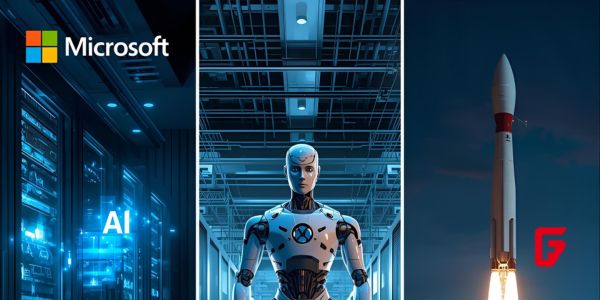
Seen together, Microsoft AI investmentTesla Optimus robot, and SpaceX defense launch moves are not isolated headlines. They are three pillars of the same shift:

  • Compute: Microsoft is racing to own the AI infrastructure layer, where models live, train, and run.

  • Embodiment: Tesla is trying to put intelligence into human-shaped robots, turning code into physical labor.

  • Orbit: SpaceX is taking critical systems into space, where satellites and launch capabilities underpin communications, security, and data.

Each company is building a piece of the future stack: from Earth-bound data centers and factories to orbital networks that wrap the planet. That stack will decide who controls the data, the hardware, and the strategic leverage in the decades ahead.

For investors, founders, and policymakers, tracking Microsoft AI investment, Tesla Optimus robot, SpaceX defense launch, AI and space news, and frontier tech strategy is less about any single announcement – and more about how these moves compound over time. Follow where the billions are going and you’ll see where the next wave of power and innovation is likely to concentrate.

futureTEKnow covers technology, startups, and business news, highlighting trends and updates across AI, Immersive Tech, Space, and robotics.

futureTEKnow

Editorial Team

futureTEKnow is a leading source for Technology, Startups, and Business News, spotlighting the most innovative companies and breakthrough trends in emerging tech sectors like Artificial Intelligence (AI), Robotics, and the Space Industry.

Discover the companies and startups shaping tomorrow — explore the future of technology today.

Join Our Newsletter

* indicates required

Intuit Mailchimp

Trending Companies

Latest Articles

futureTEKnow is focused on identifying and promoting creators, disruptors and innovators, and serving as a vital resource for those interested in the latest advancements in technology.

© 2026 All Rights Reserved.