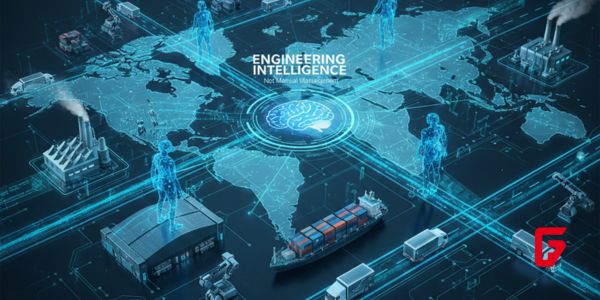
Design integrated, AI-enabled supply chain operating models that improve productivity, execution speed, and resilience by aligning people, processes, technology, and leadership as a unified system.
Sustained supply chain performance rarely comes from isolated tools or one-off initiatives. Instead, it is the result of how the operating model is designed—and how well strategy, execution, and technology reinforce one another over time.
As artificial intelligence, automation, and advanced analytics continue to mature, their greatest value emerges when they are embedded into the operating model itself. In this role, AI acts as an enabling intelligence layer—strengthening visibility, coordination, and decision-making across the end-to-end supply chain.
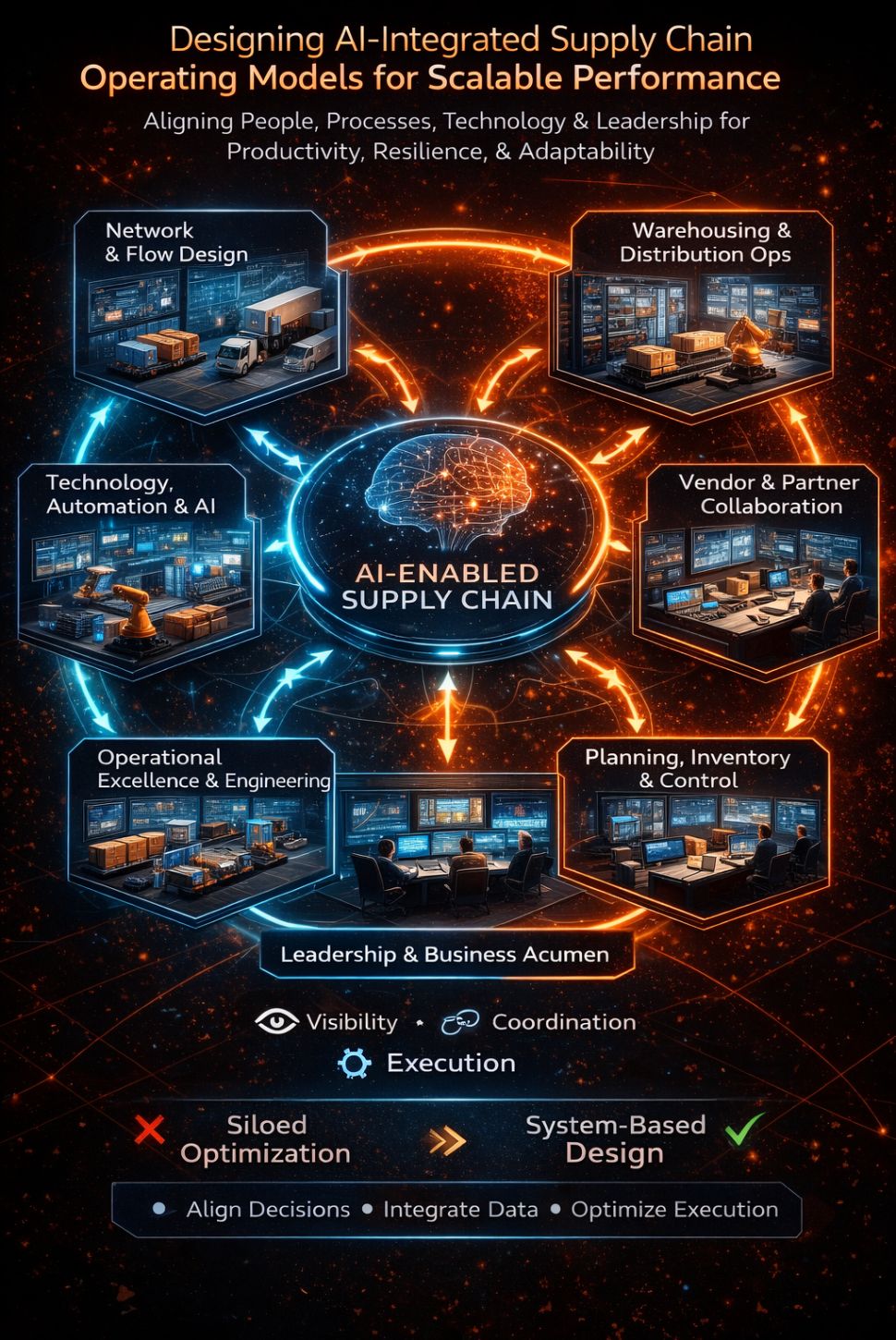
From Functional Excellence to System Design
Modern supply chains span multiple interconnected domains. When these areas operate independently, complexity increases and productivity erodes. High-performing organizations take a different approach: they engineer the supply chain as an integrated system.
AI supports this system-level design by helping organizations:
🔍 Detect patterns and variability across functions
📊 Improve real-time visibility and insight
🔁 Align planning and execution decisions
⚙️ Respond faster as conditions change
The result is a supply chain that performs consistently—even as scale and complexity grow.
1️⃣ Network & Flow Design
Network design establishes the foundation for cost, service, and resilience.
AI supports network and flow decisions by enabling organizations to:
🚚 Model logistics networks and evaluate trade-offs
🧭 Simulate routing and flow scenarios under changing conditions
📦 Align forward and reverse logistics strategies
📈 Balance cost, speed, and risk across the network
By integrating AI into network design, organizations move beyond static models and gain the ability to adapt flow decisions as demand and supply conditions evolve.
2️⃣ Warehousing & Distribution Operations
Distribution centers represent the intersection of planning and physical execution.
AI strengthens warehouse performance by enhancing:
📍 Slotting and layout optimization
👷 Labor planning and workload forecasting
🔄 Flow balancing across pick, pack, and ship
⏱ Early identification of congestion and bottlenecks
When AI is integrated with WMS and labor practices, execution becomes more predictable, scalable, and less dependent on manual firefighting.
3️⃣ Vendor & Partner Collaboration
Suppliers and logistics partners play a critical role in end-to-end performance.
AI-enabled analytics help organizations:
🤝 Monitor partner performance trends objectively
⚠️ Identify early signals of risk or variability
📊 Strengthen SLA governance and accountability
🔍 Focus collaboration where it creates the most value
This approach supports healthier, data-driven partnerships while improving reliability across the extended supply chain.
4️⃣ Planning, Inventory & Control
Planning functions must balance service, cost, and uncertainty—often under volatile conditions.
AI enhances planning and inventory control by enabling organizations to:
📉 Refine forecasts using real-time demand signals
📦 Dynamically adjust safety stock and buffers
🔁 Connect planning decisions to execution outcomes
🧠 Support scenario-based decision-making
When planning and execution are tightly connected, inventory becomes a strategic lever for flexibility rather than a source of excess cost.
5️⃣ Operational Excellence & Engineering
Operational excellence remains foundational to productivity and performance.
AI accelerates improvement efforts by enabling:
🔍 Faster identification of performance patterns
🧩 More effective root-cause analysis
🎯 Better prioritization of improvement initiatives
🔄 Sustained gains as conditions evolve
When AI supports Lean, Six Sigma, and engineering disciplines, continuous improvement becomes a durable capability rather than a periodic initiative.
6️⃣ Technology, Automation & AI as an Enabling Layer
Technology delivers the most value when it supports clear processes, decision rights, and operating discipline. Automation and AI are most effective when designed to augment human judgment, streamline execution, and surface actionable insights.
In high-performing supply chains, AI is not treated as a standalone solution. Instead, it functions as a connective intelligence layer across the operating model.
AI supports this role by helping organizations:
🤖 Augment decision-making rather than replace it
🔗 Integrate data across ERP, WMS, TMS, planning, and partner systems
🚨 Enable exception-based management instead of constant monitoring
📊 Surface insights teams can act on with confidence
⚙️ Align automation with real operational flow
When technology, automation, and AI are embedded this way, investments remain aligned with operational intent and long-term scalability.
7️⃣ Leadership & Business Acumen
Even the most well-designed operating model will underperform without strong leadership and business alignment. High-performing supply chains succeed because leaders connect strategy, execution, and financial outcomes into a single performance narrative.
Effective leadership in AI-integrated operating models is built on:
💼 Finance alignment
Ensuring operational decisions support cost-to-serve, margin, working capital, and ROI.
📊 Performance management
Translating insight into results through clear KPIs, governance rhythms, and accountability.
🚀 Innovation with purpose
Applying automation and AI where they solve real problems and improve outcomes—not for novelty.
🎯 Tactical execution tied to strategic outcomes
Ensuring day-to-day decisions directly support long-term goals for service, growth, and resilience.
AI strengthens leadership effectiveness by providing clearer trade-offs, faster feedback loops, and shared visibility across teams. When leadership and business acumen are present, operating models scale with discipline rather than heroics.
Siloed Optimization vs. System-Based Design
Organizations often face a critical design choice:
❌ Siloed optimization: Improving individual functions independently
✅ System-based design: Aligning decisions, data, and execution end-to-end
AI amplifies the system-based approach by connecting information, prioritizing actions, and supporting consistent execution across the enterprise.
Final Thoughts
Productivity, resilience, and scalability increasingly depend on how supply chain operating models are designed, not simply which technologies are deployed.
When AI is embedded thoughtfully into an integrated operating model, it strengthens:
👁 Visibility
🔗 Coordination
⚙️ Execution
Organizations that treat AI as an enabling layer—rather than a bolt-on solution—are better positioned to scale performance as complexity increases.
Carlos Salazar is an Executive Supply Chain Leader with 20 years of experience spanning international business, engineering, and operations. Certified in PMP, Lean Six Sigma, and advanced artificial intelligence (AI) for supply chain leadership, Carlos combines disciplined execution with innovation to build resilient, end-to-end supply chain solutions.


![Discover the top 10 AI agent companies driving innovation [3rd Edition]. Learn how they’re transforming industries with cutting-edge AI solutions.](https://futureteknow.com/wp-content/uploads/2025/02/Top-10-AI-Agent-Companies-Leading-Innovation-3rd-Edition-futureTEKnow.jpg)
![Discover the top 10 AI companies in England [2nd Edition], driving innovation and shaping the future with cutting-edge advancements in AI.](https://futureteknow.com/wp-content/uploads/2025/02/Top-10-AI-Companies-in-England-Leading-the-Tech-Revolution-futureTEKnow.jpg)
![Discover the top 10 AI companies in Germany [1st Edition], revolutionizing industries with cutting-edge technology and innovations.](https://futureteknow.com/wp-content/uploads/2025/02/Top-10-AI-Companies-in-Germany-Leading-the-Tech-Revolution-futureTEKnow.jpg)