

Startups & Business News
KEY POINTS
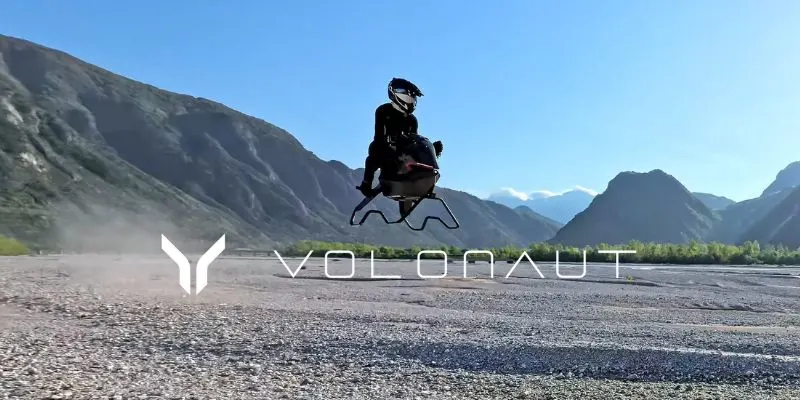
The Volonaut Airbike is a real, jet-powered flying motorcycle, going into limited production for personal use.
Built with carbon fiber and 3D printing, it weighs only 66lb (30kg), making it seven times lighter than a typical motorcycle.
The Airbike is designed for a maximum speed of 63mph (102km/h) to qualify as an ultralight, with up to 10 minutes of flight and a top payload of 209lb (95kg).
Advanced stabilization technology provides hands-free hovering, while automatic takeoff and landing make it accessible to trained enthusiasts—no pilot license required.
For generations, the dream of solo flight was reserved for science fiction, but the Volonaut Airbike is turning that fantasy into an exhilarating reality. Forget propellers and cockpits—this personal craft launches with pure jet power, aiming to become the ultimate ride for thrill-seekers and innovators alike.
The Volonaut Airbike tears up the traditional playbook for electric vertical takeoff and landing vehicles, or eVTOLs. No exposed rotors. No wings. Instead, it’s propelled by compact, powerful jet turbines mounted in its lightweight, open-frame chassis. If you picture yourself astride a motorcycle—minus the wheels and plus the power of aviation-grade engines—you’re on the right track.
What really sets the Airbike apart:
Featherweight engineering: Only 66lb (30kg), thanks to carbon fiber and 3D-printed components.
Unobstructed 360-degree views: The rider stands and leans forward to take off, just as you would with a terrestrial superbike, enjoying an unmatched open-air experience.
Advanced controls: Flight is stabilized by a triply redundant, fly-by-wire system, offering automatic hovering, takeoff, and landing for smooth, hands-free operation—think sci-fi simplicity meets real-world reliability.
Safety for a single-person jet-powered machine sounds daunting, but the Volonaut Airbike tackles it head-on. Its digital flight computer and stabilization systems do most of the heavy lifting, letting users hover stably and maneuver with intuitive controls. If partial system failure happens mid-air? Redundancy means you can still land safely.
Thanks to its ultralight status and straightforward controls, no pilot’s license is needed—just completion of Volonaut’s dedicated training program. This makes the Airbike accessible to a wider audience, at least among those who can afford the $880,000 price tag and crave airborne adventure.
Weight: 66lb (30kg).
Payload: Up to 209lb (95kg).
Speed: Commercial version capped at 63mph (102km/h) for ultralight compliance.
Flight time: Up to 10 minutes (varies by rider mass and environmental conditions).
Fuel options: Jet-A, kerosene, diesel, biodiesel—refuels in under a minute.
Creator: Tomasz Patan, already famed for co-developing the Jetson ONE.
Volonaut, the company behind the Airbike, draws expertise from engineers with serious cred in personal eVTOLs. Their minimalist, futuristic vision lets pilot and machine become “one,” prioritizing raw excitement, agility, and the freedom to fly almost anywhere open skies permit.
With its iconic design, viral videos, and mind-bending flying footage, the Volonaut Airbike has already turned skeptics into believers. While it’s unlikely you’ll see fleets of Airbikes zipping through crowded city centers soon (noise and price are big considerations), this project signals a paradigm shift for personal transportation.
We’re witnessing the first steps toward sci-fi-inspired urban mobility—no lanes, no pavement, just the sky and your imagination. The question is, are you ready to take flight?
The Volonaut Airbike truly marks the frontier where science fiction rides into our world, propelling us—quite literally—above and beyond conventional limits.

Editorial Team
futureTEKnow is a leading source for Technology, Startups, and Business News, spotlighting the most innovative companies and breakthrough trends in emerging tech sectors like Artificial Intelligence (AI), Robotics, and the Space Industry.
Discover the companies and startups shaping tomorrow — explore the future of technology today.

Aetherflux is betting that orbital data centers can power the next wave of AI, shifting from laser power beaming to

Harvey has raised $200M at an $11B valuation to scale more than 25,000 custom AI agents across law firms and

Mirage, the company behind the Captions app, has raised $75M from General Catalyst’s Customer Value Fund to build new AI

Amazon’s acquisition of Fauna Robotics brings the Sprout humanoid development platform into its Personal Robotics Group, highlighting a safety-first, developer-led

Interloom has raised $16.5M to build an enterprise memory layer that captures expert decisions and gives AI agents the context

Condor Software has raised $24M to expand an AI-powered financial intelligence platform for life sciences, connecting clinical, operational and financial

WhiteBridge AI has raised a $3M seed round to advance its AI-powered people search and research engine. The platform turns

Mind Robotics has raised a $500 million Series A to build an AI-driven industrial automation platform trained on Rivian’s production

Legora has raised a $550M Series D at a $5.55B valuation to expand its collaborative AI platform for lawyers across

Noetix Robotics, a Beijing-based humanoid robotics startup, has closed a near-$140M Series B round to ramp up mass production and

Delphyr, a Dutch healthtech startup, has secured €1.75M to grow its AI agents that automate clinical documentation and admin work

London startup Dwelly just landed $93M to snap up UK rental agencies and inject AI smarts. Founders from Uber and
futureTEKnow is focused on identifying and promoting creators, disruptors and innovators, and serving as a vital resource for those interested in the latest advancements in technology.
© 2026 All Rights Reserved.