
Startups & Business News
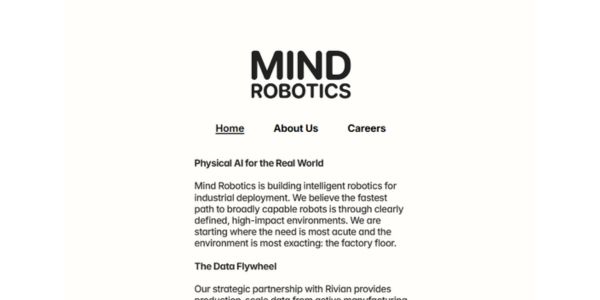
Mind Robotics’ latest funding round is another sign that “physical AI” is moving from slide decks into factory deployment roadmaps. The Rivian spinout has closed a $500 million Series A to build an AI-driven industrial automation platform trained on real production data, positioning itself as a full-stack alternative to today’s narrowly programmed robots.
Mind Robotics’ $500M bet on physical AI
Mind Robotics Inc. has raised $500 million in Series A financing to accelerate development of what it describes as “physical AI systems” for factory floors. The Palo Alto-based company is building an industrial robotics platform capable of dexterous, variable, and reasoning-intensive tasks that traditional automation still struggles to address.
The round, co-led by Accel and Andreessen Horowitz, reportedly values Mind Robotics at around $2 billion and follows a $115 million seed round led by Eclipse in November 2025. Taken together, the company has now raised roughly $615 million in less than a year, putting it among the largest early-stage financings in the history of industrial robotics.
Investors see a structural gap in today’s automation stack. Conventional industrial robots excel at repeatable tasks in dimensionally stable environments, but a large share of value-added factory work still requires human-like dexterity, adaptation, and physical reasoning.
A Rivian spinout built on production data
Mind Robotics formally spun out of Rivian in November 2025, with founder RJ Scaringe leading both companies. Rivian initially incubated the effort to “develop products and robotic solutions that allow us to run and operate our manufacturing plants more efficiently,” before deciding to launch Mind as a standalone venture.
At the core of the model is a tight strategic partnership with Rivian. Mind Robotics says it has access to production-scale data from active automotive manufacturing lines, creating what it calls a “robotics data flywheel” that lets the team iterate rapidly with a customer ready to deploy at scale.
That access to live factory data is a key differentiator. Rather than relying on simulations or limited pilot cells, Mind can train and evaluate systems in a production environment where tasks, parts, and workflows change over time, giving its models exposure to the kind of variability that has stalled legacy automation.
Building a full-stack industrial automation platform
Mind Robotics is not positioning itself as a point-solution vendor. The company describes its roadmap as a “full-stack” platform combining foundation models, purpose-built robots, and deployment infrastructure designed to generalize across core factory tasks and work alongside humans.
The technical stack includes:
AI models trained on production data to handle variable parts, changing fixtures, and unstructured tasks.
Custom hardware tailored for industrial environments rather than humanoid or consumer form factors.
Deployment infrastructure to manage fleet rollouts, monitoring, and continuous learning on live lines.
Mind stresses that its focus is on conventional industrial robot designs, not humanoids, even as automotive OEMs experiment with legged and humanoid systems from vendors such as Boston Dynamics, Apptronik, Figure, and Tesla. By keeping form factors familiar while upgrading intelligence and dexterity, the company is aiming at drop-in upgrades that fit existing safety, maintenance, and integration practices.
Talent bench spans autonomy and robotics leaders
To execute on that plan, Mind Robotics is assembling a team with experience spanning self-driving, robotics, and large-scale hardware manufacturing. The company says its founders and early staff come from Physical Intelligence, Waymo, Zoox, Google, and Rivian, combining robotics research depth with automotive production know-how.
The hiring plan underscores the ambition. Open roles range from research and modeling to machine-learning infrastructure, data engineering, robotics software, and hardware engineering, suggesting Mind is building out both the AI foundation and the mechanical and electrical systems needed to support deployments.
For investors and operators, that combination of full-stack engineering and production operations experience is one reason the round attracted Tier 1 automotive suppliers as backers alongside traditional venture firms. Accel partner Sameer Gandhi has joined the board, and a16z general partner Sarah Wang has highlighted Scaringe’s track record at Rivian in architecting vertically integrated hardware and software stacks as a template for building a “generational robotics company.”
How this fits into the automotive robotics arms race
Mind Robotics is entering an automotive robotics landscape where OEMs are actively testing humanoids and advanced automation platforms on factory floors. Hyundai has been working with Boston Dynamics’ Atlas, Mercedes-Benz has trialed Apptronik’s Apollo, BMW has tested Figure’s humanoids, and Tesla continues to develop its Optimus platform for in-house use.
Those programs are generating headlines, but most production lines are still dominated by conventional articulated arms and fixed automation. Mind’s bet is that upgrading those systems with AI-driven dexterity and generalization can unlock more near-term value than swapping them for entirely new humanoid platforms.
The Rivian partnership gives Mind a clear initial deployment beachhead in automotive assembly and component handling. If the company can demonstrate sustained productivity gains, lower reprogramming overhead, and robust safety performance at Rivian plants, it will have a strong case to expand into other automotive lines and adjacent industries like heavy equipment, consumer electronics, and general manufacturing.
What this means for integrators and end users
For system integrators, Mind Robotics’ approach could change where value resides in an automation project. If foundation models and data flywheels handle more of the perception and planning complexity, integrators may focus more on process design, cell architecture, and safety validation rather than hand-tuned programming of every task.
End users evaluating the platform will likely focus on several practical questions:
Which tasks benefit first from Mind’s dexterous robots, and how do they compare to current cells on throughput and uptime.
How the company handles safety certification, especially when robots adapt behaviors based on new data.
What the deployment model looks like, from pilot phases through full-scale rollouts inside brownfield plants.
Mind’s emphasis on working “alongside humans on the factory floor” implies collaborative usage scenarios, not fully fenced-off cells. That raises the importance of clear safety architectures, robust sensing, and compliance with industrial standards governing human-robot interaction.
Next steps and open questions
The size of the Series A round gives Mind Robotics a long runway, but also raises expectations. Public details on the company’s specific robot products, deployment timelines, and performance metrics are still limited, beyond commitments to use Rivian’s lines as a proving ground and to scale up pilots into production deployments.
Key milestones to watch over the next 12 to 24 months include:
First documented large-scale deployments inside Rivian factories, with quantified productivity or quality gains.
Expansion of customer pilots beyond Rivian into other automotive or industrial accounts.
Evidence that Mind’s foundation models can generalize across multiple tasks and lines without extensive per-cell retraining.
For founders, the Mind Robotics story highlights how tightly coupled data, full-stack engineering, and a strong anchor customer can be in today’s industrial robotics market. For operators and integrators, it is a reminder that the next wave of factory automation will likely be judged not only on motion specs, but on how quickly systems can be deployed, adapted, and trusted on real production lines.

David Lin is a Staff Writer at futureTEKnow, focusing on robotics software stacks, integration, and the systems that keep fleets running reliably.
Discover the companies and startups shaping tomorrow — explore the future of technology today.
Most Popular
Trending Companies
Latest Articles
futureTEKnow is focused on identifying and promoting creators, disruptors and innovators, and serving as a vital resource for those interested in the latest advancements in technology.
© 2026 All Rights Reserved.