
Startups & Business News
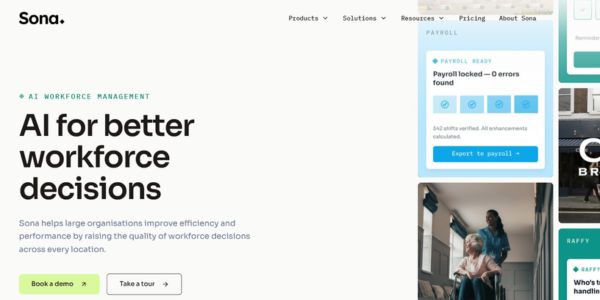
Sona’s latest funding round lands at a moment when frontline work is simultaneously over-instrumented and under-served. Enterprises in hospitality, retail, healthcare and logistics are drowning in shift calendars, compliance rules and volatile demand curves, yet much of the software coordinating all of that still looks like it shipped with Windows XP. Into that gap, London-based Sona has just raised a $45 million Series B to pitch itself as the AI-native operating system for what it calls the “frontline economy.” The company’s claim: with enough data, forecasting and agentic automation, workforce management can move from blunt time-and-attendance tools to a living model of how real-world operations actually run.
Inside Sona’s $45M bet
The new round is led by N47, with existing backers Felicis, Northzone, Gradient and Italian Founders Fund returning, bringing Sona’s total capital to more than $100 million. The company is splitting that money between an aggressive U.S. expansion and a fast-forwarded product roadmap that leadership says has been compressed from ten years to about one. Headquartered in London with a growing presence in New York, Sona is positioning itself not as another point solution but as the core infrastructure layer for frontline enterprises.
Co-founder and CEO Steffen Wulff Petersen frames the moment as an inflection between old and new software eras. In his telling, the previous generation of SaaS forced operators to conform to rigid workflows, while the next wave should provide infrastructure and an “agentic” layer that companies can build on top of. The funding is meant to underwrite that transition from application vendor to platform company, with all the expectations around breadth, reliability and ecosystem that status implies.
From scheduling app to AI-native system of record
Sona’s starting point is familiar: forecasting and scheduling for multi-site, hourly workforces in sectors like quick-service restaurants, nightclubs, hotels, care providers, retail chains and logistics. Customers such as Popeyes and Tao Group tap Sona to ensure not just the right number of people on each shift, but the “right” people, in theory matching skill sets and experience to demand spikes. That moves the product beyond simple coverage calculations into a sort of operational matchmaking engine.
Underneath that, Sona is building what amounts to a single system of record across scheduling, HR, payroll, compliance and business intelligence. Instead of stitching together separate vendors for each function, the platform sits in the middle of workforce infrastructure and ingests the operational exhaust: bookings, revenue, weather, historic shifts, even box office takings or local road closures where relevant. The promise is that once all of that data is centralized, AI models can move beyond descriptive dashboards into prescriptive recommendations about staffing, productivity and service quality.
The company is explicit about what it wants to kill off: traditional time-and-motion studies that involve consultants with clipboards trying to model how stores or wards actually run. Sona argues that a continuously updated, bottom-up model built from live data is both cheaper and more accurate, and early customers are touted as seeing multi-million-dollar labor savings alongside better customer experience.
That is an attractive pitch in a margin-pressed environment, but it also sets a high bar for measurable impact and rigorous baseline comparisons.
The labor AI engine and Forge
At the core of Sona’s differentiation story is what it calls a labor AI platform, essentially the forecasting and optimization engine trained on every shift, booking and revenue event it can ingest. The models are designed to evolve in real time as conditions change, continuously predicting not only demand but what “optimal” operations might look like based on historic productivity and business rules. For operators used to static templates and intuition-led scheduling, that is both a promise of efficiency and a potential cultural shift.
On top of that, Sona recently launched Forge, pitched as an enterprise AI application builder for frontline organizations. Because Sona already sits on the core HR, scheduling, payroll and reporting stack, Forge can generate and deploy custom applications that are automatically integrated with the company’s data and analytics layer. In practice, that might look like a tailored staffing assistant for a specific city, a compliance workflow tuned to a national labor law, or a micro-app for a single brand’s training process.
The strategic idea is straightforward: buy standard, commoditized capabilities from Sona off the shelf, then build bespoke software for the edge cases that define a business’s competitive advantage. If it works, that architecture could reduce the need for internally maintained custom tools and lower the overhead of experimenting with new workflows. The risk is that frontline operators may not have the internal product muscle to know what to build, forcing Sona into heavier solution-consulting mode than a pure platform story suggests.
Market timing: hot AI, cold margins
Sona is stepping into a global frontline workforce market that supports billions of workers and represents a multi‑billion‑dollar software opportunity. The timing is not accidental: wage inflation, staffing shortages, and growing compliance complexity are pushing employers to look for levers beyond simple cost cutting. Investors like N47 see a chance to swap out entrenched but outdated tools and reset how operations are run in the “real economy.”
The platform is already tuned to sectors where demand volatility is the norm—hospitality, hotels, care, retail and logistics—where getting scheduling wrong shows up immediately in wait times, service quality and staff churn. By binding forecasting, scheduling and labor optimization in one place, Sona is effectively trying to become the connective tissue between revenue and workforce cost. In a world where many incumbents still rely on disconnected HRIS, point scheduling tools and Excel, that alone is a meaningful integration story.
Yet the company also has to navigate a messy landscape of existing vendors, union agreements, and country-specific labor rules. Being the regulated workforce infrastructure of record means shouldering responsibility for compliance and data protection at scale—areas where regulators, workers and IT security teams tend to be less forgiving of “move fast” narratives. That tension between rapid iteration and operational stability will likely define how far and how quickly Sona can push its AI features into production environments.
Friction at the frontline
For frontline managers, software is not an abstract category; it is the tool that decides who gets overtime, who is sent home early and who can swap shifts without a phone call. Rolling out an AI-native platform in that context raises immediate questions of transparency and control: how are scheduling recommendations made, can managers override them, and how do workers contest decisions that affect their pay. Sona’s pitch centers on better experiences for both sides of the labor equation, but the proof will be in how these models are governed, explained and audited across different jurisdictions.
Investors, for their part, will be watching whether Sona can convert pilot wins into sticky, multi-country deployments. The company’s narrative of multi‑million‑dollar labor savings and improved customer experience sets expectations for strong ROI, which matters as software buyers scrutinize spend and push for outcome-based pricing. If Sona can demonstrate durable savings and lower churn versus legacy stacks, its position as an “operational foundation” could justify platform-level contracts rather than line-item tools.
That is the real test of whether Sona is building a feature, a product or an actual platform. A $45 million Series B buys time to figure that out, but in a crowded market for AI narratives, operators will care less about model architectures and more about whether the software shows up in the P&L as something more than a shiny scheduling upgrade.

Sofia Klein is a Staff Writer at futureTEKnow, writing about European AI ecosystems, safety research, and the regulatory frameworks shaping how AI gets deployed.
Discover the companies and startups shaping tomorrow — explore the future of technology today.
Most Popular
Trending Companies
Latest Articles
futureTEKnow is focused on identifying and promoting creators, disruptors and innovators, and serving as a vital resource for those interested in the latest advancements in technology.
© 2026 All Rights Reserved.