
Startups & Business News
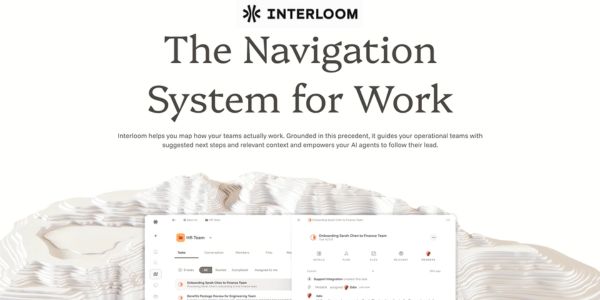
AI agents are finally making their way into real operations, but most still hit the same wall: they don’t know how work actually gets done inside a specific company. That gap between generic models and messy day‑to‑day reality is where Munich- and Berlin-based Interloom is positioning itself, and its new $16.5 million seed round suggests investors think that missing layer is starting to look like infrastructure.
The company, which describes itself as an enterprise operations platform that captures expert knowledge and turns it into permanent memory for AI agents, has raised a $16.5 million seed round led by DN Capital, with participation from Bek Ventures and existing investor Air Street Capital. Interloom already works with enterprises including Zurich Insurance, JLL and logistics group Fiege, processing millions of operational cases to bridge what it calls the “context gap.”
From documentation to “enterprise memory”
Most enterprises already have documentation, knowledge bases and playbooks, but much of the real decision-making lives elsewhere. According to Interloom, around 70% of operational decisions are never written down, instead sitting in emails, tickets, call transcripts and, crucially, in the heads of frontline experts who have “seen this movie before.”
That missing layer matters more as companies test AI agents on the front line, from customer operations to back‑office workflows. Without a reliable memory of how similar issues were resolved in the past, even sophisticated agents can struggle to go beyond generic answers or brittle scripts.
Interloom’s pitch is that it becomes the system of record for those resolutions. When complex issues escalate, operational experts resolve them alongside AI, and each resolution turns into a reusable asset that future employees and agents can draw on.
The Context Graph as a corporate map
At the core of the product is Interloom’s Context Graph, a continuously evolving model of operational decisions and how work actually flows across systems and teams. The company compares it to Google Maps: as more routes are taken, the system learns what works best under real conditions and can recommend better paths over time.
In practice, that means capturing the steps, stakeholders and trade‑offs that led to a successful resolution, not just the final outcome. Over time, this builds what amounts to a corporate memory layer that can ground automated workflows in real‑world experience rather than static manuals or one‑off playbooks.
For enterprises, the promise is twofold: agents that can handle more complex scenarios with less hand‑holding, and human experts whose work compounds instead of disappearing into individual inboxes. As AI projects move from pilots to production, that kind of institutional learning becomes a differentiator rather than a nice‑to‑have.
Investors: agents are only as good as their context
For DN Capital partner Guy Ward Thomas, the bet on Interloom is rooted in prior exposure to enterprise AI agent platforms like Cognigy, where context emerged as a hard constraint. “An agent is only as good as the specific knowledge it can rely on,” he notes, pointing out that corporate context is dynamic, poorly documented and often buried in the decisions of frontline workers.
Interloom’s approach — building a corporate context graph that continuously captures those decisions — stood out as a way to turn that messy reality into a structured asset. Instead of trying to rewrite how enterprises work, the platform observes and learns from existing flows, then feeds that back into both human and AI workflows.
That framing resonates in an environment where many enterprises have already experimented with large language models and basic copilots, but struggle to move into higher‑stakes automation without stronger guarantees about accuracy and governance. A dedicated memory layer offers a way to constrain and explain agent behavior using the company’s own history.
The “Great Retirement” as a forcing function
Timing is another part of the story. Interloom points to the “Great Retirement,” with around 10,000 baby boomers retiring every day in the U.S. alone, as a structural driver behind demand for better knowledge capture. As those employees leave, decades of operational expertise risk walking out the door just as AI is projected to automate roughly 30% of work hours by 2030.
That overlap creates a narrow window in which enterprises have to capture departing expertise and make it usable by both humans and machines. Interloom positions itself as the tool that can ingest that expertise from real cases and preserve it as a durable asset, rather than a scramble of last‑minute handover docs.
For sectors like insurance, real estate and logistics — where Interloom already has customers — this is not just about efficiency but continuity. Losing the people who know the edge cases of claims, leases or supply chains can create real operational risk, especially when AI‑powered automation is being layered into those workflows at the same time.
Positioning as an automation platform
Interloom describes itself as the next‑generation platform for business automation that learns from how operational work actually flows, not just how it is supposed to flow on paper. By analyzing cases across systems and teams, it builds a picture of the real paths work takes, where bottlenecks appear and how experts resolve them.
That vantage point can feed back into process design, tooling choices and how AI agents are deployed. Instead of scripting agents from scratch, enterprises can use the memory layer to prioritize workflows where there is already a critical mass of proven resolutions, then expand coverage as more cases are processed.
Interloom is currently processing millions of operational cases, a scale that should help refine its Context Graph and make the platform stickier for existing customers. As more enterprises look for ways to turn AI pilots into durable automation, having a growing corpus of encoded expertise could become a competitive advantage for both the vendor and its users.
What remains to be seen is how crowded this “enterprise memory” category becomes as incumbents and adjacent startups sharpen their own pitches around knowledge graphs, agent platforms and automation suites. For now, Interloom’s fresh capital and early enterprise references give it room to push the idea that, in the AI era, memory — not just models — will decide who can actually automate the hard stuff.

Elena Rossi is a Senior Staff Writer at futureTEKnow, covering AI, foundation models, autonomous agents, and the infrastructure powering the next wave of intelligent applications.
Discover the companies and startups shaping tomorrow — explore the future of technology today.
Most Popular
Trending Companies
Latest Articles
futureTEKnow is focused on identifying and promoting creators, disruptors and innovators, and serving as a vital resource for those interested in the latest advancements in technology.
© 2026 All Rights Reserved.