

Startups & Business News
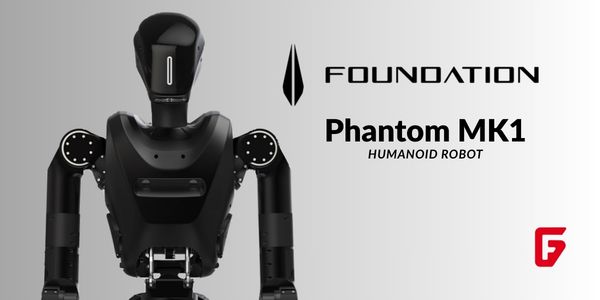
If you’ve been keeping an eye on the robotics world, you’ve probably heard whispers about humanoid robots taking over factories and even stepping into military roles. Today, we’re diving into Foundation’s Phantom MK1 – a real game-changer from the San Francisco startup at Foundation. This Foundation Phantom MK1 humanoid robot isn’t just another lab experiment; it’s already hitting factory floors and catching eyes for its bold plans in defense. Let’s break it down in simple terms.
The Phantom MK1 looks and moves like something out of a sci-fi movie, but it’s built for real-world grit. Standing about 5 feet 9 inches tall and weighing around 175 pounds, it’s sized just right to slip into human workspaces without a hitch. What powers this beast? Proprietary cycloidal actuators – think super-strong, efficient motors that pack hydraulic-level punch but run clean and quiet like electric ones. They’re back-drivable too, meaning the robot can yield to humans safely, which is huge for close-quarters work.
Foundation’s team calls it a “camera-first” design, ditching bulky LiDAR for smart vision systems fed by large language models (LLMs). High-level commands like “pick that up” turn into smooth actions on the fly. Speed? Up to 1.7 meters per second, with 19 degrees of freedom in the upper body for precise grabs and twists. These Phantom MK1 specs features scream reliability for tough jobs, from assembly lines to tricky inspections. No wonder factories are testing it out now.
|
Foundation Phantom MK1 Humanoid Robot Specifications
Factory-tested specs powering the 50,000-unit production goal |
|
|---|---|
| Height | 5 ft 9 in (175 cm) |
| Weight | 175 lbs (79 kg) |
| Top Speed | 1.7 m/s (6.1 km/h) |
| Upper Body Degrees of Freedom | 19 DOF |
| Actuators | Proprietary cycloidal actuators (hydraulic power, electric efficiency) |
| Vision System | "Camera-first" design with LLM-powered vision |
| Payload Capacity | Industrial-grade lifting (exact figures from factory pilots) |
| Operating Time | Near-24/7 operation in factory deployments |
| Control Method | Natural language commands + teleoperation |
| Production Goal | 50,000 units by 2027 |
| Current Status | Factory pilots live + first units shipped |
| Key Applications | Manufacturing, warehouse automation, military reconnaissance |
Foundation robot factory pilots are already underway, proving the Phantom MK1 can handle the daily grind. Early deployments focus on high-throughput manufacturing, where the robot swaps in for human shifts without missing a beat. Imagine it in auto plants or warehouses, running nearly 24/7 and cutting costs big time – one robot could replace multiple workers when you factor in downtime.
The company’s not rushing full automation in their own production line either. Led by ex-Tesla manufacturing pros, they’re scaling smart: starting with 40 units this year, ramping to 10,000 by next year. They’ve shipped the first ones already, and pilots show it’s adapting to messy, unstructured spots better than older bots.[ from prior] For tech fans like us, this is exciting – humanoids finally delivering on promises after years of hype.
Now for the edgier side: Foundation robotics military robots. CEO Sankaet Pathak sees the Phantom MK1 as the “first body in” for dangerous ops – think recon, bomb disposal, or risky ground missions. Picture it scouting ahead, carrying gear (maybe even weapons), while soldiers stay back safe. Fox Business highlighted this trend, calling humanoids the “future of warfare” as the US pushes AI into combat faster.[page:0 from prior]
It’s not a lone killer bot, though. Pathak stresses a human-in-the-loop setup, like today’s drones – robot moves, human decides on firepower. With its tough build and camera smarts, it thrives in chaos where other tech falters. Critics worry it might make wars too easy to start, but Foundation argues it could cut collateral damage with precise ground work over airstrikes. Either way, their push blends commercial and defense, setting them apart from pure factory players.
Here’s the jaw-dropper: Foundation 50,000 robots 2027. Yeah, you read that right – they aim to crank out 50,000 Phantoms by year’s end. Leasing model at about $100,000 per year per bot makes sense for businesses wanting uptime without huge upfront buys. Pathak admits it’s ambitious but gives it a “non-zero chance,” thanks to AI and actuator breakthroughs.
Team creds help: vets from Tesla, Boston Dynamics, and 1X bring battle-tested know-how. If they hit even half, it’ll flood markets with capable humanoids, shaking up labor from factories to front lines.
Foundation’s blending industrial muscle with military edge via the Phantom MK1 positions them as a top contender. Degrees of freedom, teleoperation, and end-effectors (check our glossary for these must-knows) are key to its dexterity – upper body alone has 19 DOF for human-like finesse. Early wins in factory pilots show it’s no vaporware.
Looking ahead, watch for more deployments. Will they nail 50k units? Only time tells, but Foundation’s moving fast in a crowded field. If you’re into AI-robotics mashups, this one’s bookmark-worthy. Drop a comment: factories or battlefields first?

Editorial Team
futureTEKnow is a leading source for Technology, Startups, and Business News, spotlighting the most innovative companies and breakthrough trends in emerging tech sectors like Artificial Intelligence (AI), Robotics, and the Space Industry.
Discover the companies and startups shaping tomorrow — explore the future of technology today.

Noetix Robotics, a Beijing-based humanoid robotics startup, has closed a near-$140M Series B round to ramp up mass production and

Delphyr, a Dutch healthtech startup, has secured €1.75M to grow its AI agents that automate clinical documentation and admin work

London startup Dwelly just landed $93M to snap up UK rental agencies and inject AI smarts. Founders from Uber and

Encord just landed $60M in Series C funding to supercharge data tools for physical AI. Founders Eric Landau and Ulrik

Foodforecast, a Cologne AI foodtech firm, just scored €8M in Series A funding led by SHIFT Invest. Their tools predict

In 2026, AI scales operational excellence fundamentals—clear ownership, disciplined execution, and continuous improvement—letting leaders focus on outcomes while systems handle

Munich-based VoiceLine has closed a €10M Series A round to grow its voice AI platform for frontline sales and service

AI is redefining logistics transformation—from network design to real-time execution. This article explores how data-driven insight, intelligent automation, and scalable
Shenzhen’s Hai Robotics, pioneer in ACR warehouse robots, files for HK IPO after raising over $500M in funding rounds led

Axiom Space has locked in a fresh $350M raise to push its commercial space station and NASA lunar spacesuits toward

New York startup Santé secures $7.6M seed to build AI-powered POS for liquor stores, tackling regs & inventory woes after

Lawhive has secured a $60M Series B round to scale its AI-native law firm model across the US, promising faster,
futureTEKnow is focused on identifying and promoting creators, disruptors and innovators, and serving as a vital resource for those interested in the latest advancements in technology.
© 2026 All Rights Reserved.