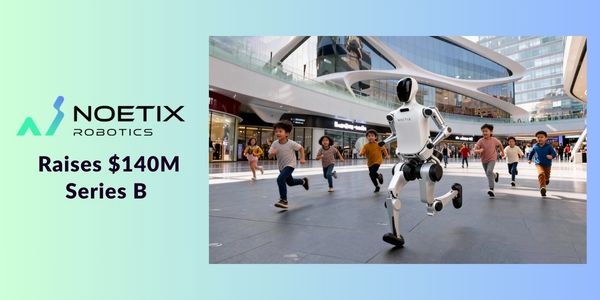
China’s humanoid robotics race just picked up speed. Noetix Robotics, a Beijing-based startup building humanoid robots for both industrial and consumer use, has closed a Series B funding round worth nearly 1 billion yuan, or about 140 million US dollars.
The fresh capital gives Noetix more firepower to move from eye-catching demos to large-scale production and real-world deployments.
The round is led by Chen Dao Capital, an investment platform under battery giant CATL, with participation from Guoke Investment, Jingguosheng Fund, and Jiuhe Venture Capital. The fresh capital gives Noetix more firepower to move from eye-catching demos to large-scale production and real-world deployments.
That lineup matters. It signals that serious industrial money now believes humanoid robots are moving from “someday” technology to a near-term market, especially in China’s manufacturing, logistics, and consumer sectors.
Noetix isn’t new to investors. According to local reports, this is already the company’s ninth financing round, following a 300 million yuan pre-Series B round completed in October 2025. That kind of cadence suggests a team that is shipping, iterating, and scaling fast, rather than sitting in a lab polishing a single prototype.
The company is betting on a dual-track product strategy: bipedal humanoid robots focused on mobility and general tasks, and bionic humanoid robots that emphasize expressive, human-like interaction. On the bionic side, Noetix has been pushing the envelope on realistic faces.
The team developed a bionic face architecture that combines platinum silicone with high polymer materials for a more natural feel and durability, while packing 32 drive motors into a compact head to power fine-grained expressions. It’s the kind of detail that matters when you want robots interacting with kids, shoppers, or elderly users without feeling uncanny or fragile.
If you watched China’s Spring Festival Gala this year, you might already have seen Noetix’s technology on stage. The company’s bionic humanoid robot appeared in a widely discussed skit, after a two-month sprint in which the team iterated three versions and overcame a series of technical hurdles to get the robot show-ready.
That national moment gave Noetix a branding boost and helped frame humanoid robots as something mainstream audiences could get excited about, not just engineers and investors.
But Noetix is not just chasing entertainment. The new funding is earmarked for scaling up mass production and expanding into household and educational scenarios, particularly through its lower-cost humanoid model “Little Bumi,” priced at roughly 10,000 yuan.
Positioned as an accessible entry point, Little Bumi is aimed at schools, community centers, and eventually homes, where it could be used for education, light assistance, and interactive experiences. If the company hits the right combination of price, durability, and useful applications, Little Bumi could become many people’s first direct experience with a humanoid robot.
On the industrial side, Noetix is also working on embodied robots for logistics and factory environments, building on a self-developed technology stack and more than 30 patents.
That stack underpins everything from motion control to perception and is a key part of their pitch: if you control your own core technology, you can optimize for cost, reliability, and rapid iteration instead of being locked into third-party components.
To support its global ambitions, Noetix has already set up a dedicated mass-production base and is building a flexible production and supply-chain system that integrates ERP and MES systems. The goal is to handle customized orders while still scaling manufacturing, and to back that up with localized after-sales service in key regions such as North America, Europe, the Middle East, Southeast Asia, Japan, and South Korea.
At CES 2026 in Las Vegas, the company showcased its production-grade humanoid “Little Rascal N2,” signaling that it is ready to move beyond concept videos and into actual overseas deliveries.
This broader strategy—“scenario first, replicate cases, deepen the brand,” as Noetix describes it—means the team plans to prove out specific use cases in each region, then replicate those wins instead of trying to be everywhere at once.
Think of a successful deployment in a chain of retail stores, a popular interactive exhibit in a theme park, or a standardized education program built around a robot companion. Once those lighthouse cases work in one market, they can be adapted and scaled to others. The timing of this funding round is also telling. Humanoid robotics is heating up globally, with players like Tesla and Figure drawing headlines, but Noetix shows how quickly Chinese startups are closing the gap and even pushing ahead in commercialization.
Backed by CATL-linked industrial capital and an aggressive roadmap, the company is racing to get humanoid robots out of the lab, into factories, and eventually into “thousands of households,” as its own branding puts it.
futureTEKnow is a leading source for Technology, Startups, and Business News, spotlighting the most innovative companies and breakthrough trends in emerging tech sectors like Artificial Intelligence (AI), Robotics, and the Space Industry.