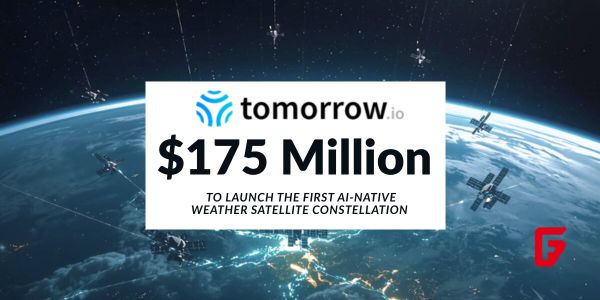
Tomorrow.io just raised a huge new round to take weather into a new era. The Boston-based company has secured a $175 million equity financing to deploy DeepSky, a new AI-native weather satellite constellation designed to make Earth’s atmosphere and oceans continuously observable in near real time. This is not just another funding headline; it is a signal that space-based climate intelligence is becoming core infrastructure for business, government, and everyday life.
The story of Tomorrow.io has always been about reshaping how we see weather. Co-founded by CEO Shimon Elkabetz and a team with deep experience in technology, defense, and meteorology, the company started by building a software-first weather intelligence platform used by airlines, logistics giants, and public agencies. Over the last few years, they have moved aggressively into space, launching their first constellation equipped with Ka-band radar and microwave sounders to close long-standing data gaps in global observation.
DeepSky is the next phase of that vision. It is described as the world’s first AI-native, space-based atmospheric and oceanic sensing network, deployed as a proliferated Low Earth Orbit (pLEO) constellation. Instead of a small number of large satellites, DeepSky focuses on many highly capable satellites, each carrying multiple proprietary sensing instruments. Operating at scale, this architecture is designed to dramatically increase global observation density and revisit rates compared to traditional government systems.
Why does that matter? Existing weather infrastructure relies heavily on aging GEO and LEO platforms that often leave big blind spots, especially over oceans, the Global South, and remote regions. With climate change driving more frequent and extreme events, those gaps translate into real-world risk: less lead time for storms, poorer flood modeling, and weaker planning for heat waves, drought, and wildfire. DeepSky is designed to complement, not replace, those government assets by adding higher cadence observations and new sensing modalities on top.
Each DeepSky satellite brings multimodal sensing across a wide portion of the electromagnetic spectrum, covering both atmospheric and oceanic signals. Combined with Tomorrow.io’s modeling stack, this data is meant to feed AI-driven forecasting systems that can refresh far more often than traditional models. The goal is faster updates for global and regional forecasts, with a focus on rapidly evolving and extreme events like fast-forming storms, flash floods, and severe convection.
The new $175 million round is all about getting this constellation into orbit at speed. The financing is led by Stonecourt Capital and HarbourVest, with participation from existing investors including Square Peg, Canaan, Activate, Pitango, ClearVision, and Fontinalis. It values Tomorrow.io at over $1 billion, putting the company firmly in unicorn territory. Goldman Sachs & Co. LLC acted as exclusive financial advisor on the deal, while Goodwin Procter LLP served as legal counsel.
For investors like Stonecourt, this is a doubling down on a thesis they started backing in 2021, when Tomorrow.io was still in the early days of its space strategy. Their view is that weather is not a niche vertical, but a foundational data layer for sectors like aviation, agriculture, energy, insurance, logistics, and national security. If you can change how the planet is observed, you can change how decisions are made from the boardroom to the field.
From a customer point of view, DeepSky is meant to show up not as raw satellite streams, but as actionable intelligence. Tomorrow.io already offers tools that translate forecasts into decisions: when to reroute aircraft, reschedule port calls, protect assets ahead of storms, or time field operations down to specific windows. With DeepSky data feeding those tools, the company aims to cut both uncertainty and cost for organizations that live and die by weather-sensitive operations.
There is also a broader resilience angle. Governments and international agencies are under pressure to modernize early warning systems and adapt to climate impacts, but many regions lack dense observation networks. A commercial constellation built for high revisit rates and global coverage can help close that gap, especially when paired with policy frameworks and open-data initiatives. Tomorrow.io positions DeepSky as a way to meet and exceed baseline observational requirements for these public sector customers while staying flexible enough to support new missions over time.
Zooming out, this funding round fits into a wider pattern: the convergence of space, AI, and climate tech into a single stack. Space companies are no longer just “selling pixels”; they are building full vertical systems from orbital hardware to cloud-native analytics and workflow tools. Tomorrow.io sits squarely in that camp, pitching itself as a global resilience platform powered by its own constellations and AI models.
For founders and builders, the takeaway is clear. The next wave of climate and infrastructure startups will not just be software or hardware; they will be both, tightly integrated. Tomorrow.io’s DeepSky push shows how owning the observation layer can unlock new products, new business models, and ultimately new ways to manage risk on a warming planet.