For more than three decades, Lean Six Sigma has been the backbone of process improvement across supply chain, logistics, manufacturing, healthcare, and service industries. The methodology still works — exceptionally well — but today’s operations move at a pace the original frameworks were never designed for. Variability is higher, customer expectations reset every quarter, and data flows faster than teams can manually analyze.
As processes expand across digital, physical, and hybrid environments, leaders everywhere are asking the same question:
How do we scale Lean Six Sigma in a world where data changes by the second?
The answer: AI doesn’t replace Lean Six Sigma — it upgrades it.
AI brings the speed, intelligence, and automation required to keep continuous improvement truly continuous.
Below is how top-performing organizations are combining Lean, Six Sigma, and AI to achieve breakthrough performance and create the next evolution of Operational Excellence.
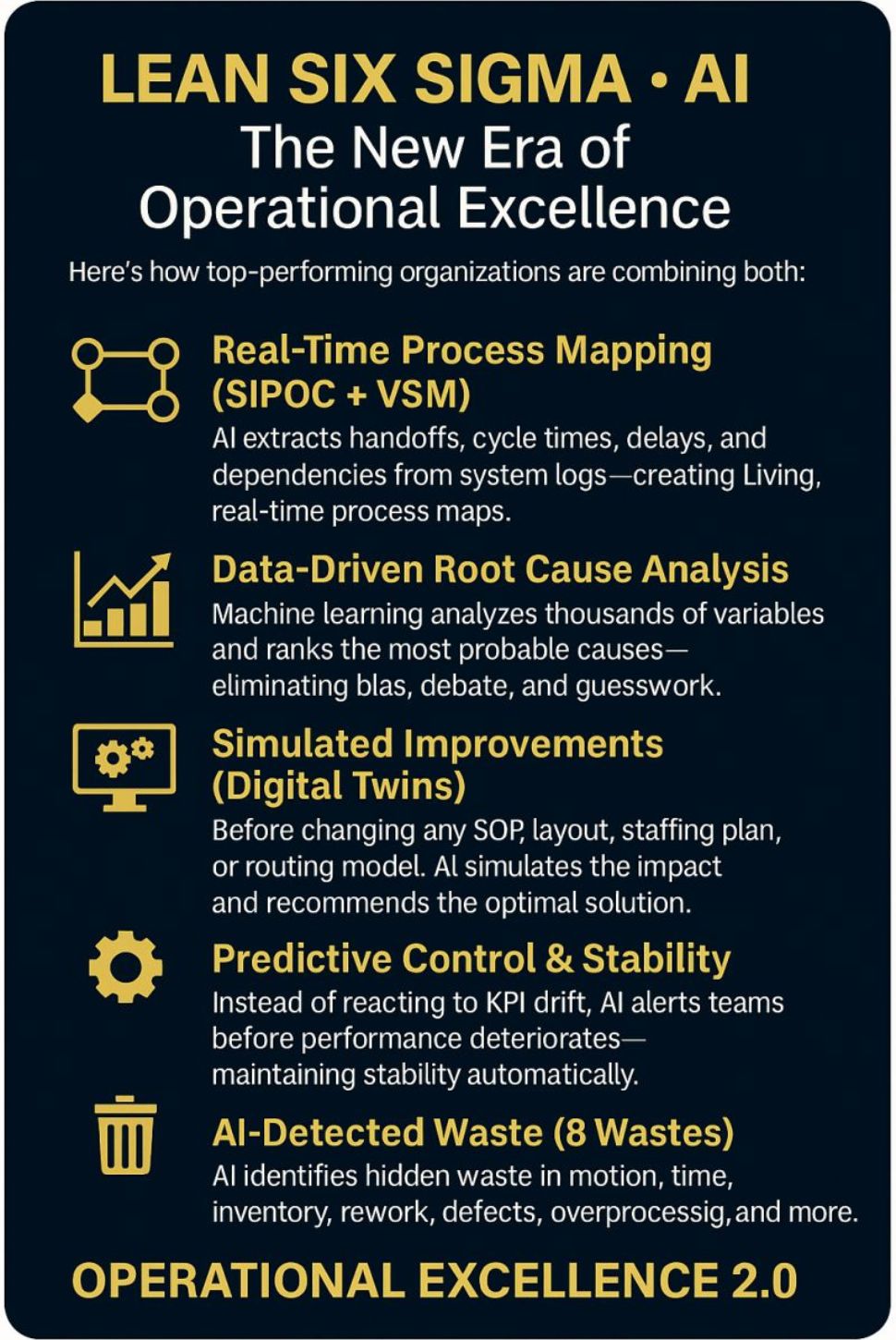
1. AI-Powered, Real-Time Process Mapping (VSM + SIPOC)
Traditional SIPOC and Value Stream Mapping rely on workshops, interviews, and physical observation. These exercises can take weeks, involve dozens of people, and by the time the map is complete, the operation may have already shifted. AI closes this gap by extracting process insights directly from digital footprints — WMS logs, TMS data, ERP events, scanner data, timestamps, telematics, and even user interactions.
AI systems now generate living process maps that update continuously as work happens. Instead of static PowerPoint slides, leaders can see real-time flow, bottlenecks, handoffs, and cycle times with pinpoint accuracy. For distribution and logistics, this means instantly visualizing where an inbound trailer is delayed or how long totes sit in buffer zones. In manufacturing, it highlights micro-stoppages, minor delays, and hidden rework loops.
The result: mapping efforts that once took weeks are reduced to minutes, giving teams a data-driven baseline that is always current.
2. Machine-Learning Root Cause Analysis
Root cause analysis has always depended on tools like fishbone diagrams, 5 Whys, and Pareto analysis. They’re effective — but slow, subjective, and limited by human perception. AI enhances this by analyzing thousands of variables simultaneously, identifying patterns no team could realistically detect on its own.
Machine-learning models sift through process data to automatically rank the highest-probability causes behind delays, defects, or cost spikes. Instead of debating in conference rooms, improvement teams receive statistically supported drivers of the issue — whether it’s a specific picking zone, shift, supplier, piece of equipment, or SKU.
This removes bias, accelerates decision-making, and allows organizations to focus their improvement resources where they generate the greatest impact. In many cases, AI points to causes that were previously invisible to humans.
3. Simulated Improvements with Digital Twins
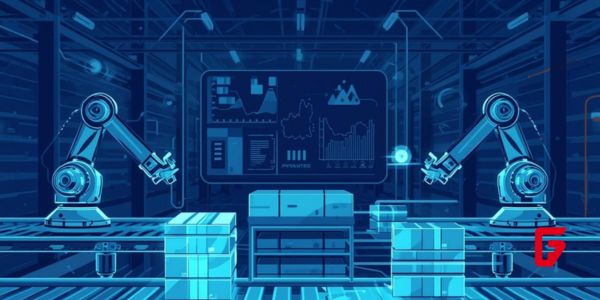
Before modifying an SOP, reconfiguring a warehouse, adjusting staffing levels, or redesigning a routing strategy, leading organizations now use AI-driven digital twins — virtual replicas of their operations. These simulations test the potential impact of changes without disrupting the real-world environment.
With AI, improvement teams can model different what-if scenarios:
– What if staffing is shifted from outbound to packing during peak?
– What if picking paths are reorganized by velocity instead of zone?
– What if automation is added to a bottleneck stage?
The digital twin calculates effects on flow, labor, cycle time, cost, and throughput instantly. This minimizes risk, avoids costly trial-and-error, and ensures decisions are data-backed. For global supply chains, digital twins create a laboratory where organizations can safely experiment with improvements at scale.
4. Predictive Process Control & Stability
Traditional Lean Six Sigma focuses heavily on control — SPC charts, control plans, audits, and KPI tracking. But most organizations still operate reactively, responding after they see metrics deteriorate. AI flips this model by predicting instability before it happens.
Using historical data, seasonality patterns, machine runtime, demand signals, staffing patterns, and environmental factors, AI systems detect early drift in KPIs. They trigger automatic alerts when a process is trending toward defects, delays, or cost overruns, even if the numbers still appear “in control.”
For example, AI may flag an increase in pick variance hours before it impacts order accuracy, or warn of a likely equipment failure days before a breakdown. This predictive control capability allows businesses to maintain stability proactively, not retroactively — the true spirit of continuous improvement.
5. AI Identification of the 8 Wastes
Eliminating waste is the foundation of Lean. But identifying waste has always relied on Gemba walks, floor observations, stopwatch timings, and operator interviews. AI accelerates and enhances this by analyzing millions of digital signals from scanners, sensors, telematics, RFID, video analytics, and workflow data.
AI uncovers wasted motion through travel-path heatmaps, reveals hidden waiting time in queues and buffers, highlights overprocessing through task variance, and detects systemic rework through error-pattern analysis. It also exposes underutilized talent by identifying skills mismatches and workload imbalances.
This leads to faster, more precise waste reduction and enables Lean teams to focus their time on solving problems — not hunting for them.
Lean + Six Sigma + AI = Operational Excellence 2.0
Lean accelerates flow.
Six Sigma reduces variation and improves quality.
AI adds intelligence, prediction, and scale.
Together, they form the blueprint for Operational Excellence 2.0 — a model where improvement is continuous, real-time, and system-driven rather than meeting-driven.
Organizations adopting AI-enabled Lean Six Sigma are seeing:
✔ Shorter cycle times
✔ Higher throughput
✔ Lower CPU
✔ Lower defects
✔ Smarter labor utilization
✔ And dramatically faster improvement loops
This isn’t theory — it’s becoming the new competitive advantage across supply chain, logistics, manufacturing, and distribution.
Those who embrace this evolution will outperform their peers. Those who don’t will be left operating with outdated, slow, and reactive methods.
Carlos Salazar is an Executive Supply Chain Leader with 20 years of experience spanning international business, engineering, and operations. Certified in PMP, Lean Six Sigma, and advanced artificial intelligence (AI) for supply chain leadership, Carlos combines disciplined execution with innovation to build resilient, end-to-end supply chain solutions.


![Discover the top 10 AI companies in Germany [1st Edition], revolutionizing industries with cutting-edge technology and innovations.](https://futureteknow.com/wp-content/uploads/2025/02/Top-10-AI-Companies-in-Germany-Leading-the-Tech-Revolution-futureTEKnow.jpg)