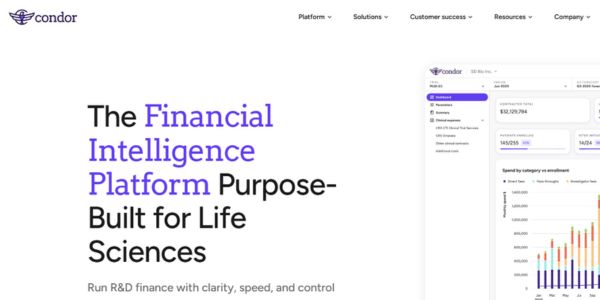
Life sciences companies are pouring hundreds of billions into research every year, but many still track that money with spreadsheets and scattered tools that make it hard to see what is really going on. A new wave of fintech startups is betting that this is no longer good enough when a delayed trial or blown budget can erase years of work, and Condor Software is the latest to draw serious backing for its answer.
The company has raised $24 million in Series A funding to build what it calls a financial intelligence platform tailored to life sciences. The round, which brings Condor’s total funding to about $36 million, is led by Insight Partners, with additional investors joining in a sign of confidence that a niche finance tool can become core infrastructure for biotech and pharma.
Condor’s pitch is that life sciences companies do not just need another accounting system; they need a way to connect clinical, operational and financial data so they can see, in close to real time, what they are spending and why. The company is going after a sector that invests around $300 billion annually in research and development but often relies on tools better suited to small businesses than to global drug programs.
A spreadsheet problem with billion‑dollar stakes
Many biotechs and pharma companies still rely on spreadsheets and a patchwork of software to keep track of trial budgets, vendor contracts and overall financial health. That can work when programs are small and simple, but it becomes risky as pipelines grow and more sites, vendors and regulators get involved.
Ventureburn’s report notes that the lack of up-to-date financial information can lead to delays and costly mistakes. In some cases, trials are paused or cut entirely, not because the underlying science failed, but because teams do not have a clear view of where money is going or how quickly costs are changing.
Condor is trying to address that by pulling together clinical, operational and financial data into a single system. The goal is to give teams a sharper view of their R&D spend so they can move faster on decisions, spot overruns early and avoid unnecessary surprises.
How Condor’s platform is structured
Condor describes its product as an AI‑powered financial intelligence platform that sits on top of the systems life sciences companies already use. It can ingest data from clinical trial platforms, accounting software and ERP systems, then organize it into a single view that financial and operational teams can work from.
Under the hood, Condor relies on proprietary frameworks that connect information from clinical research, vendor contracts and financial activity. Instead of treating those as separate worlds, the platform aims to show how decisions in one area ripple through the others.
The product is divided into three main components: Connect, Compass and Copilot. Connect is the data plumbing, pulling information from different sources so everyone is working from the same set of facts. Compass focuses on forecasting and scenario modeling, helping teams understand how changes might affect budgets and risk. Copilot automates repetitive work like reconciliations and monthly close tasks, freeing up staff to focus on analysis rather than manual data wrangling.
Taken together, the idea is to tighten forecasts, cut back on busywork and make finances more transparent across the organization. For a sector where a single trial can cost hundreds of millions of dollars, getting those basics right could make a meaningful difference.
Early traction in biopharma
Condor is already tracking more than $19 billion in R&D spending for a mix of younger biotech startups and larger pharmaceutical companies. Customers include Acadia Pharmaceuticals, BridgeBio Pharma and Madrigal Pharmaceuticals, which suggests the company is winning business at both ends of the market.
Users cited in the article report improvements that would be hard for finance teams to ignore. They say they are reaching more than 90% accuracy on forecasts, closing their books 70% faster at month‑end and trimming budgets by around 30% on average. Those numbers are likely to draw attention from other companies under pressure to do more with less in a tougher funding environment.
For investors, that kind of early performance can be a signal that the problem is real and the product is sticky once implemented. If customers rely on Condor to run their forecasts and close their books, switching away would not be trivial.
Why life sciences finance is getting its own tools
The funding round also speaks to a broader shift in how software is built for highly regulated, specialized industries. Horizontal finance tools are widely available, but they do not always capture the complexity of clinical trials, multi‑year research programs and the regulatory constraints that life sciences companies face.
By building specifically for this environment, Condor can bake sector‑specific assumptions into its models and workflows. That could make the platform more useful out of the box than generic tools that need heavy customization.
At the same time, the company is positioning itself at the intersection of two trends: the push to use AI to make sense of growing data sets, and mounting scrutiny over how money is spent in drug development. If Condor can help teams answer basic questions faster—what are we spending, where, and what could go wrong—it could become an attractive partner for both finance leaders and R&D heads.
What to watch next
With fresh capital, Condor plans to keep building out its platform and expand globally. That likely means adding integrations, refining its forecasting models and going after more customers in biotech and pharma hubs around the world.
The bigger question is how crowded this niche becomes. If life sciences finance is as under‑served as Condor and its backers believe, more competitors—both startups and incumbents—could push into similar territory.
For now, the company can point to concrete adoption, specific performance metrics and a set of brand‑name customers as it makes its case. For life sciences teams trying to keep ambitious pipelines on track with limited resources, tools that make the money easier to see and manage may be less a luxury than a necessity.
Emma Carter is a Staff Writer at futureTEKnow, covering applied AI, foundation models, and the startups turning research breakthroughs into real products.