
Startups & Business News
AI optics boom: how Yuanjie’s photonic chips became China’s quiet weapon in the data center arms race
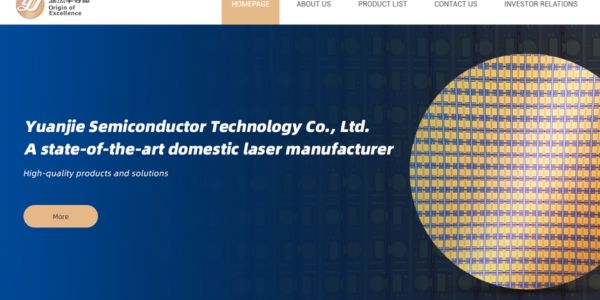
In early March, a little-known laser chip maker from Shaanxi quietly signaled how far the artificial intelligence infrastructure race has moved into the optical layer. Yuanjie Semiconductor Technology not only committed 1.3 billion yuan to a new production base in China’s Xixian New Area, it also moved ahead with plans for a secondary listing in Hong Kong — a bid to turn a runaway stock rally into hard manufacturing capacity for the next phase of the data center arms race.
That bet has already reshaped the fortunes of its founder, Zhang Xingang. Surging demand for photonic chips used in AI data centers has driven Yuanjie’s Shanghai-listed shares up roughly 780% over the past year, lifting Zhang’s stake to an estimated value of about 1.7 billion dollars and pushing the stock price above 1,100 yuan. Yuanjie’s market capitalization now hovers around 94.6 billion yuan, making it one of the most richly priced names on China’s tech-focused STAR Market and only the second company there, after AI chipmaker Cambricon, to cross the 1,000-yuan share-price threshold.
For policymakers and operators trying to understand who actually controls the chokepoints of AI infrastructure, Yuanjie’s rise is a useful case study. The company sits where national industrial policy, US–China tech friction, and the physics of light all intersect. It is backed by Huawei, leans on a founder trained in the United States, and builds components that determine how quickly — and how efficiently — AI workloads move inside data centers.
Inside the AI optics boom
At the core of Yuanjie’s business is a deceptively simple proposition: swap electrons for photons wherever the math makes sense. Its photonic and laser chips are the optical “heart” of high-speed data transmission, powering transceiver modules that convert electrical signals into pulses of light for AI data centers, 5G infrastructure, and fiber access networks.
The product mix reads like a catalog of strategic components for hyperscale compute: continuous-wave (CW) laser chips, electro-absorption modulated lasers (EML), and distributed feedback (DFB) lasers that support 400G/800G and next-generation optical interconnects. These chips enable high-bandwidth, low-latency links between servers and accelerators, a critical constraint as AI models scale and traditional copper-based interconnects hit power and performance ceilings.
Investors have taken the hint from bigger players. In early March, Nvidia said it would invest 2 billion dollars each in US optics groups Lumentum and Coherent as part of a multi‑year partnership to advance AI infrastructure products. The same week, Yuanjie’s stock jumped close to its 20% daily limit after those US peers rallied, underscoring how public markets now see optical communication as a central bottleneck in the global AI race rather than a back‑office component category.
From struggling telco supplier to AI data center linchpin
Yuanjie’s transformation has been fast by semiconductor standards. Founded in 2013 by Zhang — a Tsinghua graduate who later earned a master’s and PhD in materials science from the University of Southern California — the company spent its early years supplying China’s hyper‑competitive telecoms market. For several years after its 2022 IPO on Shanghai’s STAR Market, performance looked more like a commodity player than a future national champion.
The pivot came as AI infrastructure demand spiked. During the first nine months of 2025, Yuanjie’s sales jumped 115% year‑on‑year to 383.2 million yuan, and the company swung from a 550,131‑yuan loss to a net profit of 117 million yuan. Projections cited by S&P Global suggest sales may have more than doubled to 506 million yuan for full‑year 2025, with net profit climbing toward 138 million yuan — still modest at global scale, but a clear signal that AI data centers are displacing telco as the company’s profit engine.
By external sales revenue in 2025, Yuanjie had already become the sixth‑largest laser chip provider globally and the second‑largest supplier of laser chips for silicon‑photonics-based high‑speed optical interconnect products worldwide, according to consultancy data cited in its Hong Kong listing filing. For data center operators, that concentration means a single Shaanxi‑based vendor now sits near the top of a critical supply chain tier.
A Huawei‑backed optics play in a bifurcating world
The geopolitical context makes Yuanjie’s trajectory more than a feel‑good growth story. The company is backed by Huawei, one of the most powerful — and politically sensitive — technology brands in China, and one that remains under extensive US export controls. That backing offers obvious advantages at home, from integration into Huawei‑built data centers and networks to alignment with Beijing’s push for self‑reliance in advanced components.
But it also adds complexity as cross‑border capital and supply chains rewire around sanctions. Zhang himself is a US citizen who spent years working for Luminent and later Source Photonics in California before returning to China to found Yuanjie in 2013. Two years ago, Yuanjie announced a 50‑million‑dollar investment in the United States to expand its overseas presence, even as Washington tightened controls on advanced chips and manufacturing gear.
The planned Hong Kong listing underscores that tension. A second listing would give the company access to a deeper pool of global capital while keeping it under the umbrella of a Chinese jurisdiction that is increasingly contested but still central to mainland firms’ offshore financing plans. For international investors, the question is whether exposure to a Huawei‑backed optics supplier in a strategic sector is a calculated risk worth taking in a bifurcating financial system.
Who benefits from photonic bottlenecks?
For now, optics vendors are some of the clearest winners from the AI land grab. Yuanjie’s share price has risen nearly ninefold in a year, and its founder has joined a growing cohort of optics‑sector billionaires, including Liu Sheng of Zhongji Innolight, whose shares have climbed roughly 480% over the same period. Capital is rewarding whichever firms can promise higher‑throughput, lower‑power links to keep GPUs fed with data.
Downstream, cloud providers and hyperscalers could benefit from more efficient interconnects that lower overall data center power consumption and delay costly newbuilds. Mass‑produced, high‑performance laser chips can help mitigate some of the energy and thermal costs of running ever‑larger AI clusters, especially as regulators in Europe and parts of the US scrutinize data center water and electricity use more aggressively.
The picture is more mixed for workers and smaller customers. The expertise required to design and fabricate advanced photonic chips favors a handful of integrated device manufacturers in China, the US, and a few other hubs, concentrating both economic gains and supply‑chain risk. System integrators and contract manufacturers that depend on a limited set of laser suppliers are exposed if export controls, local industrial policy, or even a single factory outage constrict supply.
Policy, industrial strategy, and the shape of the optics stack
Optical communication might sound like an engineering problem, but the roadmap is being written in policy language as much as in nanometers. As one Beijing‑based investment banker put it, optical communication has become a bottleneck in the global AI arms race, and the players willing to spend the most on capacity could end up owning disproportionate market share.
China has made clear that AI infrastructure — from accelerators and servers to the photonic plumbing that connects them — is a strategic priority. Supporting companies like Yuanjie through domestic listings, favorable financing, and procurement channels fits neatly into that playbook. In parallel, US policy is simultaneously restricting high‑end chip exports to China while signaling long‑term support for domestic optics through high‑profile partnerships and investments. Nvidia’s 4‑billion‑dollar optics deal is as much a political hedge as it is an engineering decision.
Those choices will influence which standards win for next‑generation optical interconnects, how open or proprietary the ecosystem becomes, and how much bargaining power component suppliers retain against cloud platforms. If a small circle of optics firms ends up intertwined with national security narratives on both sides of the Pacific, they may gain pricing power — but also face heavier scrutiny, export licensing regimes, and pressure to align with state priorities.
What founders and investors should watch next
For founders building in AI infrastructure, Yuanjie’s trajectory is a reminder that value is accruing not just in GPUs and model layers, but in the connective tissue around them. Photonics, packaging, and power are where incremental gains in efficiency can unlock disproportionate returns, especially as hyperscalers hit practical limits on adding more compute without rethinking the interconnect.
Investors, meanwhile, need to separate hype from durability. Yuanjie’s revenue base, while growing rapidly, is still relatively small, and the company remains heavily exposed to a cyclical, capex‑driven sector where customers can delay or cancel orders in downturns. The planned Hong Kong offering and new Shaanxi production base could either cement its position as a core supplier to global AI data centers — or leave it with underutilized capacity if policy or demand shifts.
For regulators and policymakers, the lesson is that rules on paper are now directly shaping which layers of the AI stack become chokepoints. Export controls, listing approvals, and industrial subsidies are determining who builds the lasers that feed the GPUs that train the models that will, eventually, filter into everything from consumer search to military planning. If optical communication really is the next bottleneck, the question is not just who solves it — but on whose terms.

Aiko Tan is a Staff Writer at futureTEKnow, covering AI research, multimodal models, and the fast‑moving AI startup scene across Asia‑Pacific.
Discover the companies and startups shaping tomorrow — explore the future of technology today.
Most Popular
Trending Companies
Latest Articles
futureTEKnow is focused on identifying and promoting creators, disruptors and innovators, and serving as a vital resource for those interested in the latest advancements in technology.
© 2026 All Rights Reserved.
One Response
It is fascinating to see how the infrastructure behind AI, like these photonic chips, is becoming just as critical as the processors themselves. Thanks for the read!