
Startups & Business News
Nexthop AI Raises $500M to Rewire AI Data Center Networking for the $650B Compute Supercycle
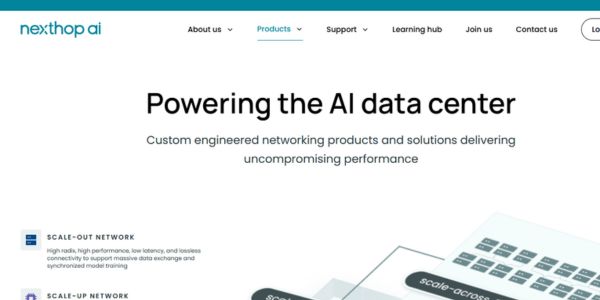
Nexthop AI’s latest $500 million raise at a $4.2 billion valuation is a clear signal that the bottleneck in AI is shifting from pure compute to the networks that move data between chips, racks, and data centers. As hyperscalers prepare to spend an estimated $650 billion on AI data centers and related infrastructure in 2026 alone, networking is emerging as a first-class design problem rather than an afterthought.
Against this backdrop, Nexthop is positioning itself as a specialist in low-latency, high-throughput networking systems purpose-built for AI workloads, not repurposed from legacy enterprise traffic patterns. The company is using its fresh capital to scale hardware, software, and manufacturing around a new family of switches that target one of the hardest problems in AI infrastructure: keeping massive clusters of accelerators fully utilized without drowning in congestion and energy costs.
Nexthop AI’s Core Bet: AI-Native Networking
At its core, Nexthop AI develops networking hardware and software specifically designed for AI data centers, where thousands of servers—and often tens of thousands of accelerators—must coordinate tightly during model training and inference. Unlike traditional data center networks optimized for many small, independent flows, AI clusters generate synchronized, bursty, and bandwidth-heavy traffic patterns that punish any inefficiency in the fabric.
Founded in 2024 by former Arista Networks chief operating officer Anshul Sadana, Nexthop leans heavily on hyperscaler co-design. The company codesigns its platforms with large data center operators so the resulting systems map directly to real-world topologies, scheduling policies, and service-level objectives rather than theoretical benchmarks.
The Technical Problem: Latency, Throughput, and Power
As frontier models scale to trillions of parameters, the cost and speed of moving data between chips increasingly defines overall system performance. Training runs spanning thousands of GPUs or custom accelerators depend on collective communication operations where stragglers and network hotspots can stall the entire job.
Nexthop’s technology is designed to tackle three intertwined constraints:
Latency: Reducing end-to-end message delay so synchronous gradient exchanges and parameter updates do not idle expensive accelerators.
Throughput: Increasing effective bandwidth across links and fabrics to keep utilization high even as model sizes and dataset volumes grow.
Energy efficiency: Cutting power per bit moved, a critical dimension as AI data center power budgets collide with grid, cooling, and sustainability limits.
The company’s networking systems aim to handle higher volumes of traffic while simultaneously reducing latency and energy consumption, a non-trivial combination in dense, thermally constrained racks. Although the underlying architectures are not fully disclosed, the emphasis on low-latency, low-power operation suggests aggressive use of specialized switching silicon, congestion-aware scheduling, and tightly integrated software control planes.
New Switches for AI Clusters
Alongside the funding news, Nexthop introduced three new networking switches aimed directly at AI data center communication paths. Switches are the core fabric elements that connect servers within a data center and tie multiple facilities together, effectively defining the topology and performance profile of an AI cluster.
In the AI context, these switches must:
Support extremely high port densities at advanced speeds to link large GPU or accelerator pods.
Provide predictable, low-jitter latency characteristics for collective communication operations.
Integrate with software stacks that can orchestrate flows, prioritize critical training jobs, and handle failures without destabilizing entire clusters.
While detailed product specs were not disclosed, the timing of the launch alongside the capital raise suggests Nexthop is transitioning from early deployments to a broader commercial push across multiple hyperscalers. This aligns with broader industry movement toward AI-optimized fabrics that differ meaningfully from standard cloud networking gear.
Funding Scale and Competitive Landscape
The $500 million raise, led by Lightspeed Venture Partners with participation from Andreessen Horowitz and existing investors Altimeter Capital and Kleiner Perkins, places Nexthop firmly in the top tier of AI infrastructure startups by capital raised. The valuation at $4.2 billion implies strong investor conviction that networking will capture a meaningful share of AI infrastructure economics, not just compute vendors and model providers.
Nexthop is not entering a greenfield market. The company is explicitly positioning itself against established infrastructure providers such as Cisco Systems, Arista Networks, and Hewlett-Packard Enterprise, all of which already provide data center networking solutions at hyperscale. The differentiation thesis is that AI-native traffic patterns, power envelopes, and reliability requirements justify specialized architectures that incumbents may be slow to prioritize.
For founders and investors, this round is another data point in a broader pattern: capital is flowing not just into model labs and chip startups, but into every layer that constrains AI scale—power, cooling, memory, and now, increasingly, the network fabric itself.
Scaling Plans: Headcount, Manufacturing, and Supply Chains
Nexthop currently employs more than 300 staff, with a majority focused on engineering roles spanning hardware, software, photonics, and network architecture. The company plans to use its new capital to continue hiring across these domains, reinforcing the view that modern networking platforms are deeply interdisciplinary.
Beyond headcount, Nexthop also manages manufacturing and supply chains for the switches it designs and intends to keep investing in that infrastructure. In the current environment of constrained chip supply and long lead times for advanced packaging and optical components, control over manufacturing and logistics is itself a strategic asset. Startups that can guarantee delivery of complex systems at scale earn meaningful leverage with hyperscalers whose build-out timelines are tight and non-negotiable.
Market Tailwinds—and Structural Risks
The funding round lands amid an unprecedented investment wave in AI capacity. Tech giants including Alphabet, Amazon, Meta Platforms, and Microsoft are expected to spend around $650 billion on AI data centers and related infrastructure in 2026. That spend encompasses accelerators, networking, storage, and power systems, with networking increasingly recognized as a key determinant of overall system performance.
At the same time, the sector faces real risks:
Overbuild risk: If AI demand normalizes or training efficiency improves faster than expected, capacity additions could overshoot near-term needs.
Physical constraints: Power shortages, grid interconnect delays, and memory supply limits could slow or redirect data center expansion plans.
Technology shifts: New interconnect paradigms, on-package networking, or alternative cluster architectures could alter the balance of value between standalone switches and integrated fabrics.
Anshul Sadana has acknowledged that AI spending will not accelerate indefinitely, even if the total market for AI infrastructure is likely to be significantly larger by the end of the decade. This perspective frames Nexthop’s strategy as building for a long-term structural shift toward AI-heavy workloads, not just a short-term capex spike.
Why This Matters for the AI Infrastructure Stack
For developers and enterprises building on large models, networking typically shows up indirectly—as job completion times, cloud pricing, and reliability SLAs. For operators and investors, however, the fabric is becoming a direct strategic concern. Poorly designed networks translate into underutilized accelerators and degraded economics; efficient fabrics effectively create more usable compute out of the same hardware footprint.
Nexthop sits squarely in this leverage point. If its switches and software can consistently deliver lower latency, higher throughput, and better energy profiles at scale, the company can influence how hyperscalers architect their next-generation clusters and, indirectly, how fast model capabilities can advance under real-world cost constraints. The new funding round and product launch indicate that the race to optimize AI networking is now fully underway, with significant capital backing the view that the network is as strategic as the chip.
For founders in adjacent domains—optical interconnects, cooling, power systems, and cluster orchestration—this is another strong signal: AI infrastructure is fragmenting into specialized, deep-tech verticals where focused teams can build multi-billion-dollar businesses by unblocking specific bottlenecks. Nexthop AI’s trajectory suggests that high-performance networking is likely to remain one of the most critical and investable bottlenecks in the AI compute stack for years to come.

Jason Miller is a Staff Writer at futureTEKnow, focusing on AI infrastructure, MLOps, and the platforms that help teams run models reliably at scale.
Discover the companies and startups shaping tomorrow — explore the future of technology today.
Most Popular
Trending Companies
Latest Articles
futureTEKnow is focused on identifying and promoting creators, disruptors and innovators, and serving as a vital resource for those interested in the latest advancements in technology.
© 2026 All Rights Reserved.