Startups & Business News

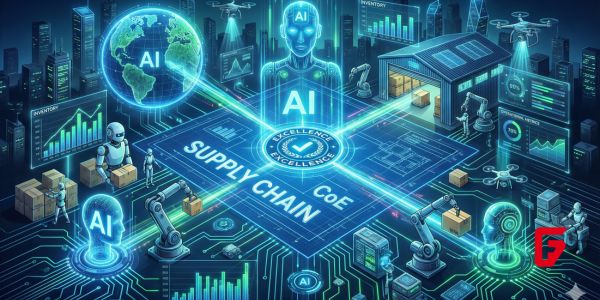
How to Build a High-Impact Supply Chain Center of Excellence (CoE):A Blueprint for Operational and Inventory Excellence in the Age of AI

Build a high-impact supply chain center of excellence using AI-driven strategies for operational and inventory excellence. Optimize your supply chain today.
In today’s volatile, fast-changing business landscape, establishing a Supply Chain Center of Excellence (CoE) has evolved from a “nice to have” into a strategic requirement. Organizations are dealing with unpredictable lead times, fluctuating demand, SKU proliferation, supplier risk, and global disruptions — far more complex than what legacy models were designed to handle.
 
A modern CoE must not only improve operational discipline and inventory performance — it must also integrate AI, automation, and real-time intelligence to drive resilience and scalability.
Below is a proven blueprint for designing a next-generation CoE that delivers measurable value and positions the supply chain for long-term success.

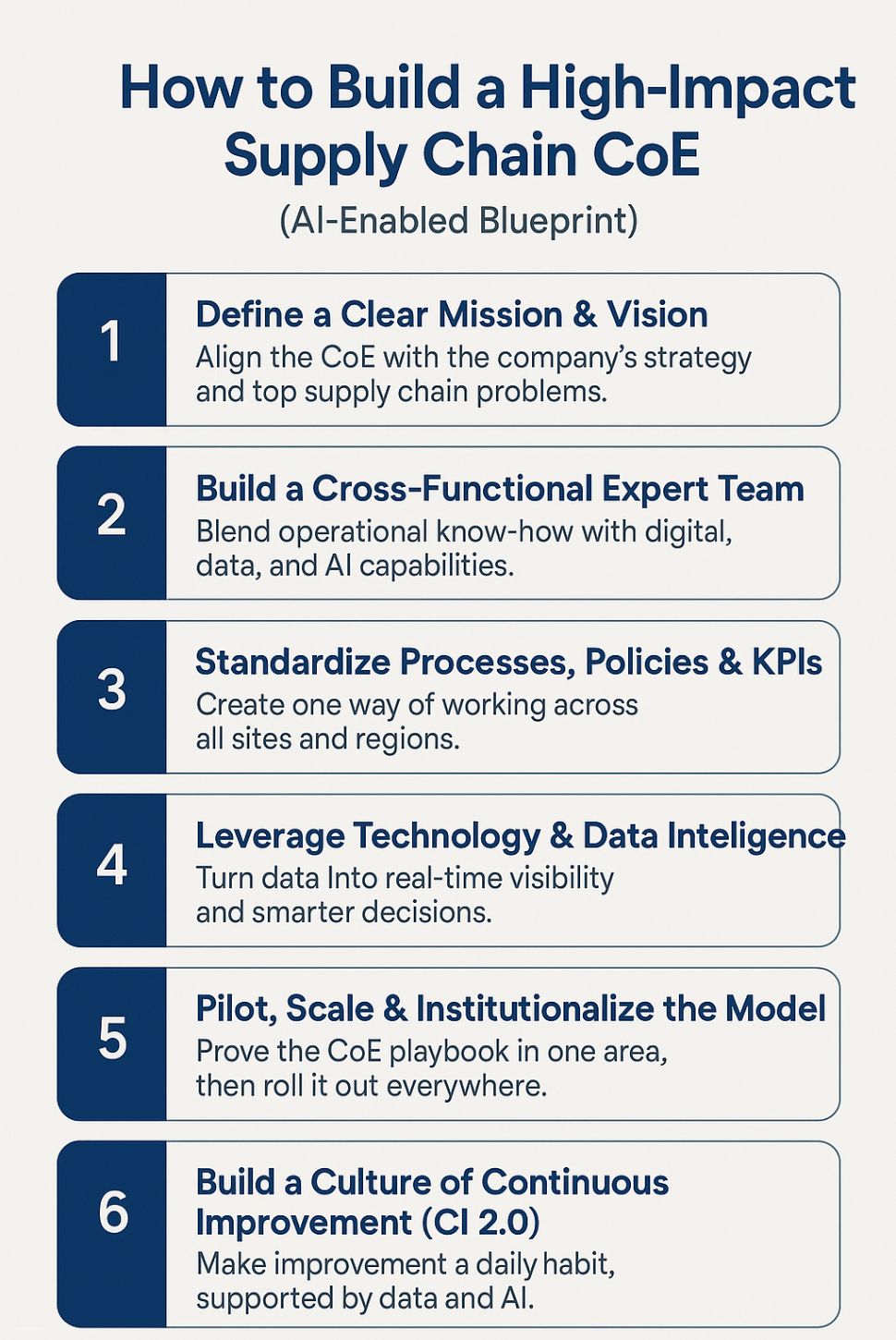
1. Define a Clear Mission and Vision

Every CoE begins with clarity of purpose. The mission should align directly with enterprise goals while targeting the key operational problems the organization must solve: improving inventory turnover, reducing stockouts, increasing OTIF performance, and elevating end-to-end visibility.
In an AI-enabled environment, defining the mission also means clearly identifying which decisions should be automated, which should be augmented, and which require human oversight. For example, a CoE vision may include deploying AI forecasting, predictive inventory monitoring, and automated replenishment rules tailored to demand patterns. A strong, well-defined mission ensures the CoE stays aligned with strategic priorities and delivers consistent, repeatable value.

2. Build a Cross-Functional Expert Team

A high-performing CoE requires a multidisciplinary team that spans operations, inventory, procurement, demand planning, data science, and supply chain analytics. This cross-functional mix ensures the CoE can diagnose systemic issues and execute solutions at scale.
The AI-enabled CoE elevates the team by integrating roles such as data engineersautomation architects, and AI model trainers. These experts translate operational challenges into data models and decision engines. Combined with subject-matter experts from DCs, transportation, and planning, this team becomes the engine for standardization, optimization, and technology-driven execution across the enterprise.

3. Standardize Processes, Policies, and KPIs

Strong process discipline is the backbone of any CoE. Standardizing inventory policies — min/max levels, safety stock rules, replenishment logic, cycle counting processes — allows the organization to operate with consistency across multiple locations. Harmonizing operational KPIs such as fill rate, lead time, throughput, order accuracy, and inventory accuracy ensures that every site operates against the same performance expectations.
AI amplifies this discipline. Once processes are standardized, AI models can monitor variation, predict KPI drift, and alert teams before performance deteriorates. For example, AI can identify where safety stock is misaligned with demand volatility or where a DC’s order accuracy is trending downward two weeks before it becomes a real problem. Consistency plus AI-driven oversight creates a powerful model for proactive operational control.

4. Leverage Technology and Data Intelligence

A modern CoE must operate as a digital command center. Tools like advanced forecasting engines, inventory optimization systems, and real-time dashboards provide visibility that traditional spreadsheets and siloed systems cannot match.
AI takes this further by enabling:
 
  • Predictive demand forecasting that adjusts to seasonality, promotions, macroeconomic shifts, and customer behavior patterns
  • Automated replenishment engines that recommend or trigger POs based on risk thresholds
  • Control tower platforms that unify transportation, warehousing, and supplier signals into one predictive decision layer
  • Exception-based workflows that remove manual monitoring and allow teams to focus on exceptions, not the noise
 
With AI at the core, the CoE becomes a nerve center for rapid, data-driven decision-making.

5. Pilot, Scale, and Institutionalize the CoE Model

The most successful CoEs begin with a focused pilot — one business unit, region, or DC that becomes the testing ground for the new playbooks, digital tools, and AI models. The pilot validates the operating model, highlights gaps, and builds credibility through measurable results.
Once refined, the CoE scales through a formal governance structure supported by AI-driven templates, standardized workflows, cross-site benchmarks, and automated KPI tracking. This ensures the improvements made in one location can be replicated across the enterprise with speed and precision. AI accelerates scaling by removing manual reporting, auto-adjusting rules for each site’s unique dynamics, and maintaining consistency as the organization expands.

6. Build a Culture of Continuous Improvement

A CoE is not a project — it is a permanent engine of operational excellence. Sustained impact requires a culture where teams are trained, KPIs are reviewed regularly, and cross-functional collaboration is embedded into the DNA of the organization. Lean, Six Sigma, and process optimization methods remain foundational.
AI strengthens continuous improvement by providing real-time insights, predictive alerts, automated anomaly detection, and rapid root-cause analysis. Instead of waiting for monthly metrics, teams can intervene hours or days earlier. This shifts the organization from reactive correction to proactive prevention — the essence of CI 2.0.
 
Organizations that activate a strong CI culture powered by AI outperform those that rely on static processes and historical reporting.

Conclusion

A well-designed Supply Chain Center of Excellence transforms operations, improves inventory performance, and builds resilience in a world defined by volatility and change. By aligning people, processes, technology, and governance — and leveraging AI as the force multiplier — organizations can create a scalable, intelligence-driven supply chain engine capable of supporting growth, innovation, and sustained competitive advantage.
 
This is the future of supply chain leadership: CoEs that are digital, predictive, autonomous, and continuously improving.
Carlos Salazar is an Executive Supply Chain Leader with more than 20 years of experience across international business, engineering, and operations.

Carlos Salazar

Senior Contributor

Carlos Salazar is an Executive Supply Chain Leader with 20 years of experience spanning international business, engineering, and operations.  Certified in PMP, Lean Six Sigma, and advanced artificial intelligence (AI) for supply chain leadership, Carlos combines disciplined execution with innovation to build resilient, end-to-end supply chain solutions.

Discover the companies and startups shaping tomorrow — explore the future of technology today.

Join Our Newsletter

* indicates required

Intuit Mailchimp

Trending Companies

Latest Articles

futureTEKnow is focused on identifying and promoting creators, disruptors and innovators, and serving as a vital resource for those interested in the latest advancements in technology.

© 2026 All Rights Reserved.