Top Supply Chain Challenges in 2025 — and How High-Performing Teams Use AI to Solve Them

Carlos Salazar | Senior Contributor

Discover top supply chain challenges in 2025, like risk management and demand forecasting, plus how AI-powered tools boost resilience, visibility, and OTIF through predictive analytics and control towers.
Modern supply chains are facing unprecedented volatility: unpredictable demand, supplier instability, labor constraints, rising freight costs, and growing pressure to make decisions in real time. The gap between high-performing supply chains and everyone else is widening — not because of luck, but because the best organizations are embedding AI-enabled, data-driven playbooks that accelerate decision speed and reduce operational risk.
These AI-enabled capabilities are no longer just operational enhancements — they have become essential components of modern Business Continuity Management (BCM) and supply chain resilience. Organizations that embed AI into planning, fulfillment, and execution recover faster and maintain service levels even during major disruptions.
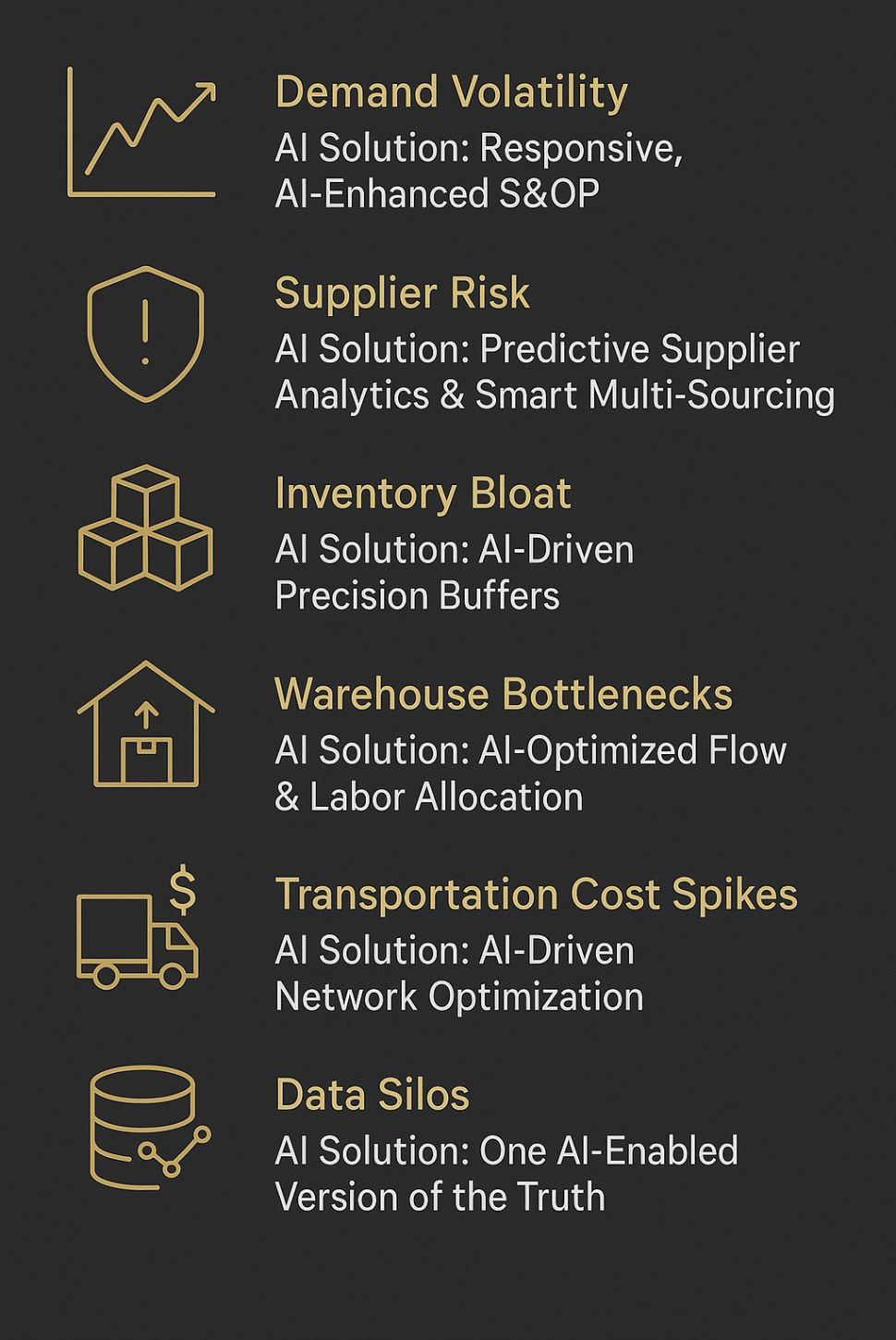
Below are the six biggest supply chain challenges and the AI-powered tactics leading companies use to solve them.

1. Demand Volatility → Responsive, AI-Enhanced S&OP

Demand in 2025 is more unpredictable than ever due to economic swings, rapid channel shifts, and fluctuating consumer behavior. Traditional forecasting struggles to interpret short-term signals with enough speed or reliability. High-performing supply chains are transforming their S&OP processes with AI-driven forecasting models that continuously learn and recalibrate.
AI enhances demand planning by identifying micro-trends, detecting anomalies, adjusting for promotions, and updating forecasts automatically. It also generates weekly 13-week rolling scenarios — best, worst, and base — giving leadership a constantly refreshed outlook. This reduces bias, strengthens cross-functional clarity, and dramatically accelerates S&OP decision cycles.

2. Supplier Risk → Multi-Sourcing Powered by Predictive Supplier Analytics

Geopolitical tension, transportation instability, and supplier failures have made the global supply base increasingly fragile. Instead of reacting to disruptions, leading companies now use AI-powered supplier analytics to assess risk in advance. AI monitors OTIF erosion, variability trends, lead-time drift, and external risk signals to generate predictive supplier risk scores.
These insights enable smarter sourcing strategies — identifying high-risk SKUs, prioritizing dual-source options, and building redundancy where it matters most. An AI-driven OTIF dashboard updates automatically and creates stronger accountability with suppliers. This shifts organizations from firefighting to proactive supplier risk prevention.

3. Inventory Bloat → AI-Driven Precision Buffers

Excess inventory has become a silent margin killer. Inflation, long lead times, and uncertainty cause teams to buy too much “just in case,” trapping capital and reducing agility. High-performing organizations combat this with AI-driven inventory optimization models that calculate safety stock based on real-time volatility.
AI reviews actual demand variance, supplier reliability, and lead-time fluctuation to generate precise, dynamic safety stock levels. It also recommends appropriate service levels for each segment (A: 98%, B: 95%, C: 90%) and uses anomaly detection to flag items drifting out of compliance. This creates inventory buffers that protect service without bloating carrying costs.

4. Warehouse Bottlenecks → AI-Optimized Flow & Labor Allocation

Distribution centers are under intense pressure from labor shortages, SKU expansion, and variable order waves. AI gives high-performing DCs a competitive edge by optimizing slotting, picking routes, dock flow, and labor allocation in real time. AI-driven slotting moves high-velocity SKUs closer to pick paths, reducing travel time. Route optimization algorithms generate more efficient cluster-picking sequences.
AI also predicts hourly workloads and recommends labor reallocations between receiving, picking, packing, and replenishment. For dock operations, computer vision or timestamp analytics detect congestion early and trigger alerts before backlogs occur. The result: smoother flow, higher UPH, and increased capacity using the same workforce.

5. Transportation Cost Spikes → AI-Driven Network Optimization

Transportation remains one of the highest sources of cost volatility in the supply chain. AI solves this by simulating thousands of network configurations and optimizing mode mix, carrier allocation, and lane strategy. High-performing organizations use AI-driven network optimization tools to rebalance freight in ways that reduce cost without compromising service.
Quick wins include rebidding high-impact lanes using dynamic benchmarking, consolidating low-volume shipments through AI load-combination logic, and using predictive tender-acceptance dashboards to identify potential carrier failures before they happen. This creates a transportation strategy that is cost-efficient, proactive, and resilient to market shifts.

6. Data Silos → One AI-Enabled Version of the Truth

Disconnected systems — ERP, WMS, TMS, supplier portals, carrier feeds — create blind spots and slow decision-making. High-performing supply chains eliminate these gaps with AI-enabled control towers that centralize all operational data into a single, real-time source of truth.
AI enhances this by generating intelligent exception alerts only when thresholds break, flagging risks across the end-to-end flow, and recommending corrective actions instead of merely reporting metrics. This unified visibility allows planners, buyers, operators, and logistics teams to act quickly and consistently, improving reliability and reducing surprise failures.

The AI-Enabled Playbook: Data → Design → Discipline

Winning organizations follow a simple but powerful framework:
Start with data clarity → design the right playbooks → enforce disciplined execution.
 
AI accelerates each step by turning complex signals into actionable recommendations.
 
A proven 30-day starter sprint focuses on:
 
3 KPIs: OTIF, CPU, Inventory Turns
3 Processes: S&OP, Inventory, Fulfillment
3 Teams: Operations, Supply Planning, Logistics
 
This approach delivers quick wins, builds momentum, and establishes the foundation for AI-enabled operational excellence.
As disruptions — from hurricanes to political tensions to supplier failures — continue to escalate, AI-driven playbooks become a critical pillar of Business Continuity Management. Organizations that combine BCM discipline with real-time, AI-enabled decision intelligence will outperform competitors and maintain resilience under any conditions.
 
Carlos Salazar is an Executive Supply Chain Leader with more than 20 years of experience across international business, engineering, and operations.

Carlos Salazar

Senior Contributor

Carlos Salazar is an Executive Supply Chain Leader with 20 years of experience spanning international business, engineering, and operations.  Certified in PMP, Lean Six Sigma, and advanced artificial intelligence (AI) for supply chain leadership, Carlos combines disciplined execution with innovation to build resilient, end-to-end supply chain solutions.

Discover the companies and startups shaping tomorrow — explore the future of technology today.

Join Our Newsletter

* indicates required

Intuit Mailchimp

Trending Companies

Latest Articles

Engineer intelligent, AI-driven supply chain operations. Discover what next-generation leaders must master to design resilient, data-driven, high-performing global networks.

The Future of Supply Chain Leadership: Why the Next Generation Will Engineer Intelligence, Not Just Manage It

Supply chain leadership is being redefined by AI, intelligent automation, and agentic decision-making, demanding leaders who can engineer end-to-end intelligence rather than simply manage workflows. This article explores how next-generation supply chain leaders will combine data, algorithms, and human judgment to build resilient, adaptive, and high-performing global operations.

Read More >
Medicare will pilot AI-driven prior authorization in 2026 across six states, targeting high-risk services while clinicians make final decisions.

AI-Powered Prior Authorization Comes to Traditional Medicare

Traditional Medicare will pilot AI-assisted prior authorization in 2026 across six states, focusing on high-risk outpatient services. Clinicians retain final say, but incentives and access concerns loom as CMS tests fraud reduction and “gold card” exemptions. Here’s what providers and patients should know.

Read More >