When Noon’s co-founders started talking to product designers at fast-growing software companies, they kept hearing the same story: design lived in one set of tools, code in another, and everything in between was a messy relay race of screenshots, tickets, and half-lost intent. Now the San Francisco-based startup is emerging from stealth with a $44 million seed round and a promise that feels almost heretical in 2026: a single “dual-canvas” where designers work directly on production code instead of static mockups.
What Noon is actually building
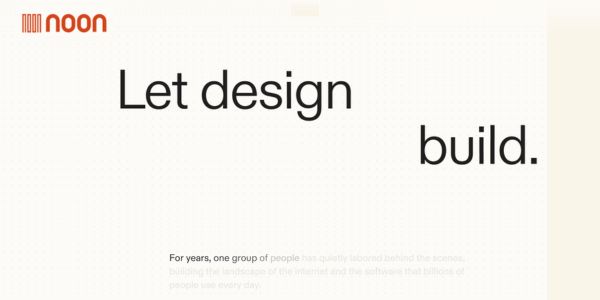
Noon describes itself as an AI-native product design platform that sits directly on top of a company’s product codebase. Instead of drawing screens that engineers later rebuild, designers manipulate functional components that behave like real software.
The company calls this a dual-canvas: one environment that understands both how a product looks and how it works. In practice, that means:
Designers operate on live components, not exported PNGs or static Figma frames.
The system reads the product’s design system and code, so generated variations match real-world constraints rather than abstract templates.
Changes designers make are meant to flow much closer to something shippable, rather than a spec document waiting to be reinterpreted by engineers.
Noon’s pitch is that by collapsing design and engineering into a shared source of truth, teams cut out entire stages of the handoff process that have quietly become a tax on modern software development. That ambition puts Noon in the middle of a broader shift: AI tools are no longer just helping designers brainstorm; they are starting to argue they should own more of the product pipeline.
The $44 million bet on AI-native design
For a company founded in October 2024, a $44 million seed round is a sizable show of confidence. The round was led by Chemistry, First Round Capital, Scribble Ventures, Elevation Capital and Afore Capital, with participation from SV Angel and a long list of prominent product and design leaders.
Those backers include partners and operators who have built products at Dropbox, Twitter, OpenAI, Meta, Google, and Adobe, along with heads of design from Stripe, OpenAI, Microsoft AI, Nubank, HubSpot, Perplexity and others. In an investor quote, Chemistry partner Mark Goldberg described his first demo of Noon as “one of those rare moments where you feel like you’re seeing the future,” the sort of line that raises expectations as much as it raises capital.
The startup’s founders, IIT Guwahati alumni Aditya Bandi and Kushagra Sinha, are positioning Noon as an AI-first architecture rather than a traditional canvas tool with AI bolted on. The platform is being built so that AI agents operate on production code and known design systems from the outset, promising speed “in seconds, not minutes” while still respecting the pixel-level precision designers expect.
Why the design–engineering gap is a target
The problem Noon is chasing is not new. For years, product teams have stitched together stacks of tools to move from idea to implementation: whiteboards or FigJam for early concepts, design tools for pixel-perfect screens, dev tools for tickets and handoff, and then an entirely different world of source control and code review.
Noon’s founders argue that even as AI has made it easier to generate both designs and code, most workflows still treat them as separate systems connected by translations, plug-ins, and prompts. Faster translation, they say, is still translation—and that is where intent gets lost, bugs creep in, and timelines slip.
Design leaders backing Noon have lived through this gap. Todd Jackson, a partner at First Round and former product and design leader at Dropbox and Twitter, is quoted as saying that when a design becomes the live product directly, entire stages of the development process can disappear. That’s an appealing promise for teams trying to ship quickly without sacrificing quality, particularly in markets where constant iteration is table stakes.
How Noon fits into the AI tooling wave
Noon arrives as AI-native tools are proliferating across software development, from code assistants embedded in IDEs to agents that propose product copy, layouts, and onboarding flows. Many of these tools still assume designers and engineers live in different worlds, offering exports and plug-ins rather than a unified workspace.
By working “entirely on your product code,” as the company describes it, Noon is betting that it can become home base for both disciplines. If that works, the implications for incumbents like Figma, Adobe, and a growing crop of AI prototyping tools are significant. A tool that controls the live representation of the product—rather than its documentation—can become the place where product decisions get made, not just visualized.
For investors, Noon’s positioning also aligns neatly with the current enthusiasm for AI infrastructure and agents: it is categorized as SaaS, AI infrastructure, and AI agents, suggesting potential hooks into automated testing, regression detection, or even AI co-pilots that operate on the same dual-canvas. That opens the door to adjacent products and workflows if the core design experience gains traction.
The stakes for teams adopting Noon
For founders and operators running product teams, the promise of a tool like Noon is straightforward:
Faster cycles from idea to shipped UI, by removing redundant translation steps.
Fewer inconsistencies between design and implementation, since they share the same code-backed canvas.
A more realistic design environment, where states, data, and behaviors reflect a live product rather than idealized screens.
But adopting this kind of platform is not trivial. Noon needs deep integration into a company’s codebase, which raises questions about onboarding cost, security, and how it will fit into existing engineering workflows. Development leaders will want to know how Noon interacts with version control, testing, and deployment pipelines, and whether changes initiated in a design session are tracked with the same rigor as traditional code changes.
There is also the question of how designers will respond. Noon is explicitly built “by product designers, for product designers,” and its narrative acknowledges that many felt sidelined when earlier AI tools took over parts of their work while stripping away precision and control. To win them over, Noon will have to show that AI is augmenting their craft rather than turning them into prompt jockeys for a black-box system.
Risks, unknowns, and the regulatory backdrop
As with any AI-native tool operating on production systems, Noon will face scrutiny on reliability and governance. If a designer can ship product changes more directly, companies will need clear policies around approvals, audits, and rollback mechanisms. That is especially sensitive in regulated industries, where even small interface changes can have compliance implications.
The broader policy environment for AI is also in flux. Regulators in the US and abroad are exploring rules around automated decision-making, transparency, and accountability for AI systems used in software development and user-facing experiences. A platform that lets AI act on live product code will likely draw questions about explainability and safeguards, even if its primary interface looks like a familiar design canvas.
Then there is the business-model question. Noon is entering a category dominated by well-entrenched incumbents that are themselves racing to add AI features. A $44 million seed round buys time and talent, but not guaranteed adoption. The company will need to prove that its dual-canvas approach delivers enough measurable impact—faster releases, fewer bugs, higher conversion—to justify swapping out or supplementing existing toolchains.
What to watch from here
Noon’s early access program will be an important test of how far teams are willing to go to collapse design and code into a single environment. Founders and investors will be watching a few key signals:
Whether early customers move core workflows into Noon, or treat it as an experimental side tool.
How engineering leaders integrate Noon into CI/CD, security, and review processes.
Whether designers feel more empowered or constrained when working directly on code-backed canvases.
If Noon can turn its dual-canvas concept into a daily habit for both designers and engineers, it could reshape expectations for what a “design tool” is supposed to do in an AI-native product organization. If not, it may end up as another ambitious experiment in a market that is already crowded with tools promising to fix the handoff. For now, the size of the seed round and the roster of backers signal that many of the people who have built the last generation of software are betting Noon could help define the next one.
Emma Carter is a Staff Writer at futureTEKnow, covering applied AI, foundation models, and the startups turning research breakthroughs into real products.