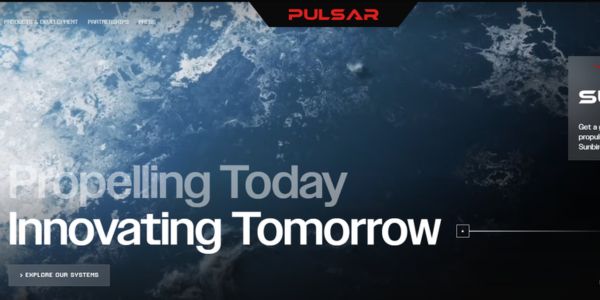
Pulsar Fusion has joined the small club of companies turning fusion from whiteboard physics into hardware, this time with a rocket exhaust that actually lit up on command. At its UK facility in Bletchley, the startup recently achieved “first plasma” in its Sunbird nuclear fusion rocket exhaust test system and beamed the moment live to Amazon’s invite-only MARS Conference in Ojai, California. For an industry used to PowerPoint concepts and artist’s impressions, seeing a fusion space tug spit out confined plasma is a tangible shift.
The milestone matters because Sunbird is not pitched as yet another experimental thruster, but as the backbone of a future deep-space logistics layer. Pulsar Fusion’s goal is to cut Mars transit times from roughly 10 months with chemical propulsion to under six months, while hauling on the order of 1,000 to 2,000 kilograms of payload per trip. If the technology scales, it could change how agencies, defence customers, and commercial operators think about mission cadence, risk windows, and the economics of going beyond low Earth orbit.
What “first plasma” actually proves
In fusion research, “first plasma” is the moment a system generates and confines a hot, ionized gas—proof that magnets, geometry, and power systems are working well enough to create the conditions fusion devices need. In Sunbird’s case, engineers drove plasma through an exhaust test system that represents the back end of the rocket, validating the architecture of its Dual Direct Fusion Drive (DDFD) engine.
The company says the DDFD is designed for a specific impulse on the order of 10,000 to 15,000 seconds and about 2 megawatts of total power output, combining propulsion and onboard electricity. That is an order of magnitude beyond chemical engines and places Sunbird conceptually closer to high-end electric propulsion, but with far higher thrust. The recent test did not produce fusion power at that scale; what it showed is that the exhaust hardware can generate and confine plasma in a way consistent with the planned engine design.
For operators and policymakers, this distinction matters. The demonstration validates the exhaust system and plasma handling, not a fully integrated, power-positive fusion core. It is a necessary, but not sufficient, step on the road to a flight-ready fusion tug.
How Sunbird’s fusion space tug is supposed to work
Sunbird is conceived as an orbital workhorse rather than a ground-launched booster. Instead of riding to space atop its own stack, each fusion tug would be stored at large docking stations in low Earth orbit and beyond. Chemical or reusable launchers would deliver satellites, crewed vehicles, or cargo ships to those depots, where a Sunbird would dock, fire up its fusion engine, and push the stack on a continuous-thrust trajectory to its destination.
Concept animations shared by the company show Sunbird using eight thrusters to latch onto a larger spacecraft before departing orbit—essentially a reusable, high-energy “jet pack” for orbital infrastructure. With a target payload range of roughly 2,200 to 4,400 pounds (1,000–2,000 kilograms), the system is aimed at exploration missions, high-value cargo, and eventually human transport rather than bulk constellations.
If Pulsar Fusion reaches its performance goals, Sunbird could enable:
Mars missions that arrive within a six‑month window, reducing radiation exposure and life-support requirements.
Higher‑energy transfers to outer-planet targets like Europa or Titan, with shorter cruise phases.
Reusable deep-space logistics, where a small fleet of tugs shuttles assets between waypoints instead of one-off heavy‑lift launches.
From a systems perspective, that implies not just fusion engines, but orbital depots, standardized docking interfaces, navigation autonomy, and dependable ground segments—each an investment decision for agencies and investors.
Where this fits in the fusion and propulsion landscape
The Sunbird test lands in a broader wave of fusion optimism, from terrestrial power plant efforts to compact fusion concepts for space. On the energy side, private and public stakeholders are funnelling billions into devices that still sit years away from grid connection, despite improving confinement times and new diagnostic tools. On the propulsion side, nuclear thermal and nuclear electric systems are already part of NASA and defence roadmaps, with fusion traditionally seen as a post‑2035 or even post‑2050 technology.
Pulsar Fusion’s move pulls that timeline forward, at least on the demonstration side. By showing live plasma confinement in an engine-scale exhaust system and tying it explicitly to a spaceflight product, the company signals that fusion propulsion may not wait for fully commercial fusion power plants. The architecture is closer to a high‑performance electric thruster that uses a fusion source for heating and power, rather than a pure power plant bolted to a spacecraft.
For founders and investors, the message is twofold:
Fusion propulsion is no longer purely speculative slides; hardware is being tested under realistic conditions.
The path to revenue likely runs through intermediary services—demonstration missions, government partnerships, and tech licensing—long before fully operational Mars tugs fly.
Engineering hurdles and regulatory unknowns
Sunbird’s core components are slated for an in‑orbit demonstration in 2027, which would test hardware performance in vacuum and microgravity. To make the full architecture work, Pulsar Fusion must also:
Mature its fusion core beyond plasma exhaust tests into sustained, controllable operation at megawatt‑class power.
Prove long‑duration reliability of high‑temperature materials, magnets, and plasma-facing components under repeated firing cycles.
Integrate guidance, navigation, and control systems suitable for continuous-thrust interplanetary trajectories.
Overlaying that engineering roadmap is a regulatory layer that does not yet fully exist for operational fusion tugs. Even if fuel choices minimize proliferation risk, policymakers will need to address in‑orbit safety, failure modes, and end‑of‑life disposal for fusion hardware. The same national security concerns that surround nuclear thermal concepts will surface here, especially if Sunbird becomes attractive for defence logistics or rapid repositioning of strategic assets.
Debris and congestion considerations also apply. A network of orbital docking stations and tugs introduces new large objects across multiple orbital shells; each adds collision cross-section and potential cascading risk if not managed within existing and forthcoming space-traffic frameworks.
Timelines, signals, and what to watch next
Pulsar Fusion’s messaging positions the March 2026 “first plasma” as a world first for fusion rockets, but the more useful way to treat it is as one datapoint on a longer curve. For decision-makers tracking this space, a few practical milestones stand out:
Successful in‑orbit demonstration of Sunbird core components in or around 2027, including verifiable performance data.
Evidence of government or agency partnerships that treat Sunbird as more than a demo—study contracts, mission concepts, or co-funded infrastructure.
Clear technical disclosures on duty cycles, achievable thrust levels, and specific impulse in integrated tests rather than extrapolated figures.
Progress on orbital docking and servicing standards that would allow multi-vendor spacecraft to interface with tugs.
For now, the Sunbird exhaust firing is an early but noteworthy indicator: fusion propulsion is leaving the realm of purely theoretical diagrams and entering experimental hardware with visible, measurable behaviour. The gap between this and a fully operational Mars tug is measured in years and multiple technology risk‑reduction steps, but the signal to founders and investors is clear. Deep‑space logistics is on track to become a distinct market segment, and fusion‑based systems like Sunbird aim to compete not on launch costs, but on time, energy, and flexibility.
Maya Johnson is a Staff Writer at futureTEKnow, covering commercial spaceflight, mega‑constellations, and the companies racing to scale orbital infrastructure.