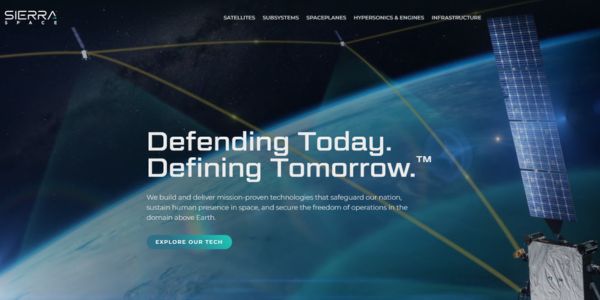
On a clear March morning in Colorado, long before any rocket engines roar, the real ignition happens on a spreadsheet. A single line item—“$550,000,000 Series C equity”—quietly signals a major shift in how space, defense, and capital now orbit one another. With this new round, Sierra Space’s valuation climbs to $8 billion, and a once “newspace” hopeful steps more fully into its emerging role as a defense-tech heavyweight.
For founders, operators, and investors watching national security and commercial space converge, this is more than another big check. It is a case study in where the next decade of orbital infrastructure, dual-use technology, and government–startup alliances may be headed.
What Sierra Space just raised—and why it matters
Sierra Space has closed a $550 million Series C equity round led by LuminArx Capital Management, a global alternative investment manager, with participation from existing backers. The financing sets the company’s post-money valuation at $8 billion and brings its total capital raised since 2021 into the multi‑billion dollar range.
The company describes itself as an industry-leading defense-tech space player focused on solutions for critical national missions, including satellites, space station technologies, and its reusable Dream Chaser spaceplane. This fresh capital is earmarked to expand production capacity and deepen offerings for defense and intelligence customers as geopolitical tension and demand for resilient space infrastructure keep rising.
From commercial “newspace” to defense-tech main character
Sierra Space’s story mirrors a broader gravitational pull in the sector. Over the last several years, leadership has steered the company through a strategic transformation, shifting from a primarily commercial newspace profile toward a tightly focused national security posture. That transformation now has the funding to match.
The company plans to use the Series C to:
Scale production for satellites and spacecraft that serve classified and unclassified missions.
Advance technologies designed for contested or degraded space environments.
Pursue new growth opportunities beyond its current mission programs, building out infrastructure that can support future defense and commercial needs.
For investors who once viewed space primarily through launch economics and tourism narratives, the center of gravity has shifted. Space is increasingly framed as a domain of intelligence, deterrence, cyber resilience, and rapid sensing—areas where well-capitalized, hardware-savvy players like Sierra Space can become core partners to governments.
Inside the tech stack: Dream Chaser, stations, and satellites
Behind the funding headline is a suite of hardware that aims to make orbit more useful, more secure, and more reconfigurable.
Dream Chaser: the spaceplane with multiple lives
At the center of Sierra Space’s brand identity sits Dream Chaser, a reusable lifting-body spaceplane that looks like a piece of concept art from early 2000s sci‑fi that actually made it into the cleanroom. Originally conceived as a crewed vehicle, Dream Chaser is being developed in a cargo configuration to fly resupply missions to low Earth orbit with a runway landing, promising gentler return profiles for sensitive payloads.
Under NASA’s Commercial Resupply Services-2 (CRS-2) contract, Sierra Space committed to using Dream Chaser and its companion Shooting Star cargo module to support the International Space Station. In 2025, NASA and Sierra Space agreed to modify that contract, opting for a free-flight demonstration targeted for late 2026—a step designed to mature the vehicle through an uncrewed test before expanding operational roles. For defense customers, a vehicle that can bring critical hardware back to a runway, rather than splashing down, opens interesting possibilities in rapid return of sensors, materials, or classified experiments.
Orbital infrastructure: from ISS to private stations
Sierra Space is also one of the anchor partners on Orbital Reef, a commercial low Earth orbit space station led by Blue Origin. The concept positions Orbital Reef as a “mixed-use business park in space,” combining research, manufacturing, and tourism with government and defense operations in a modular, privately operated platform.
Blue Origin is slated to provide the core modules and power systems, while Sierra Space contributes key station technologies alongside other partners such as Boeing, Redwire Space, Genesis Engineering, and Arizona State University. For investors, Orbital Reef is a glimpse of what comes after the International Space Station: a patchwork of commercial outposts where science, industry, and security interests literally share the same corridors.
Satellites and national security payloads
Beyond headline projects, Sierra Space manufactures satellites and components for spacecraft that support both civil and defense missions. With this round, management has highlighted plans to boost production capacity and deepen capabilities for national security and intelligence use cases, reflecting a wider industry trend where smallsat constellations, responsive launch, and agile integration are no longer “nice-to-have” but core to strategic planning.
Why capital is flowing into defense-focused space
A $550 million equity round in 2026 does not happen in a vacuum. Sierra Space’s raise fits into a pattern: investors doubling down on companies that sit at the intersection of orbital infrastructure, dual-use tech, and government demand.
Three forces stand out:
Geopolitics and contested orbits. Governments are signaling—through budgets and strategy documents—that space-based sensing, communications, and rapid response will define the next era of deterrence.
Commercial resilience as national infrastructure. Space companies that can offer responsive capabilities, from persistent imaging to secure connectivity, are increasingly treated as part of critical infrastructure rather than niche tech bets.
Maturing hardware and talent. Vehicles like Dream Chaser and modular stations like Orbital Reef ride on decades of incremental R&D, giving investors more confidence that the physics and engineering can close, even as business models continue to evolve.
In this environment, an $8 billion valuation is less about speculative hype and more about how much orbital leverage a company can provide to governments and enterprises that now see space as a daily operational domain.
The human and ethical dimension of defense-tech space
Amid the funding numbers and spacecraft renders, a quieter question grows louder: who gets to build this future, and on whose terms? Sierra Space’s defense-tech positioning places it inside a historically opaque ecosystem where communities closest to conflict, surveillance, and environmental disruption often have the least voice in how space infrastructure is used.
As more capital flows into companies that blend commercial innovation with national security missions, founders and investors across the sector face practical choices:
Which customers and mission profiles align with their ethics and long-term vision.
How to balance classified work with transparency, accountability, and public oversight.
How to bring in diverse technical and policy voices—including from historically underrepresented communities—to shape how new orbital capabilities are deployed.
These conversations increasingly involve not just engineers and military planners, but climate scientists, civil liberties advocates, and local communities affected by launch sites and tracking infrastructure. The same hardware that enables disaster monitoring and connectivity for underserved regions can also support more pervasive surveillance if governance lags behind capability.
What this means for founders and investors in frontier tech
For operators building in adjacent domains—AI for Earth observation, in-space manufacturing, climate risk modeling, autonomy for on‑orbit servicing—Sierra Space’s Series C offers a few practical signals.
First, capital is available at scale for companies that can convincingly straddle commercial and national security markets, provided they show disciplined alignment with government needs and credible paths to production. Second, hardware is no longer the neglected stepchild in tech portfolios; the stack from sensors to spacecraft is now a central arena for competition and collaboration.
Third, and most importantly, the cultural story of space is changing. The dream of orbit is no longer only about tourists gazing back at Earth through cupola windows. It is about who controls the data flows, supply chains, and platforms that will underpin everything from climate adaptation to conflict prevention. In that story, Sierra Space’s $550 million raise is not an ending, but a launch window: one of many openings where the next generation of founders, researchers, and investors will decide what kind of orbital economy they are willing to build.
Rachel Monroe is a Staff Writer at futureTEKnow, covering commercial launch, human spaceflight, and the politics and economics behind space programs.