
Startups & Business News
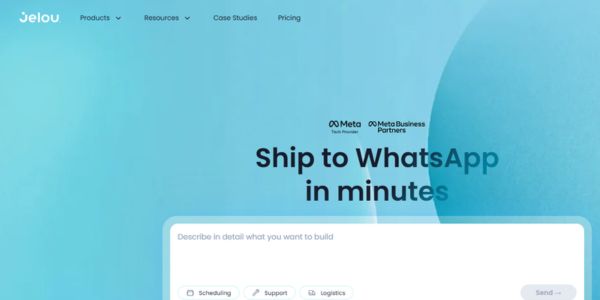
When most people in Latin America open their phones, they do not tap on a banking app first. They open WhatsApp. For years, that habit has been a challenge for financial institutions trying to move users into their own digital channels. Now, Guayaquil-born Jelou AI is betting that the future of finance in the region will not be about moving people away from chat—but about moving real money directly inside it.
In January 2026, Jelou announced a 10 million dollar Series A round led by Wellington Access Ventures, with participation from Krealo, Credicorp’s corporate venture arm, and Collide Capital. With this new capital, the company wants to turn WhatsApp into a transactional operating system for businesses, enabling AI agents that can open bank accounts, execute payments, handle credit applications, and manage identity verification in a single conversation. For founders and operators across Latin America, Jelou’s playbook is a glimpse into how agentic AI, fintech rails, and messaging culture are converging into a new product category.
What Jelou actually does on WhatsApp
Jelou is not just another chatbot builder. It has built Brain OS, a platform that lets organizations create AI agents directly integrated with internal systems such as banking cores, payment processors, KYC providers, ERPs, CRMs, and inventory tools. Instead of answering FAQs and then redirecting the user to a website or app, these agents are designed to complete the entire workflow inside the chat window.
That “no context switching” approach matters. In the markets where Jelou operates, over 30% of transactions are abandoned when users are forced to leave the conversational interface and jump into a browser or native app. By keeping every step—from identity verification to payment confirmation—inside WhatsApp, Jelou claims that its customers see higher conversion and completion rates. The result is a new kind of AI agent: one that is not only conversational, but also natively transactional.
For a bank, that can mean an agent that helps a user open an account, signs documents, and issues a debit card without the user ever seeing a traditional onboarding form. For a retailer, it can look like a virtual seller that checks inventory, calculates shipping, and processes payment inside a single thread. Jelou positions Brain OS as the “Replit for WhatsApp AI apps,” giving teams a way to go from prompt to production agent that sits on top of their existing infrastructure.
From Ecuador to a 13-country footprint
Jelou’s story starts in Ecuador, where founders Luis Loaiza and Alberto Vera first saw how much of daily life was already coordinated through messaging groups: neighborhood commerce, informal loans, and family budgets. The gap between those conversations and the formal financial system was obvious. People might talk about savings goals on WhatsApp, but fulfilling those goals required a jump into branches, web portals, or complex apps that many users abandoned.
The company’s early work focused on highly regulated financial institutions, proving that conversational agents could execute sensitive workflows while staying compliant with banking and KYC rules. Over time, Jelou expanded to serve more than 500 companies across 13 countries, working with banks, retailers, consumer goods companies, and large enterprises such as Arca Continental, Banco de Crédito del Perú, AB InBev, and Falabella Colombia. Along the way, its platform processed more than 100 million dollars in financial transactions through WhatsApp-based AI agents.
This path—starting with regulated players, then branching into broader SMB and enterprise use cases—is instructive for founders. By designing for the hardest compliance and security constraints first, Jelou built a credibility moat that now makes it easier to sell into less regulated verticals and even expand into the United States SMB market.
Why transactional AI on messaging is taking off
Jelou rides a structural shift: in many emerging markets, messaging apps are the default interface for commerce, coordination, and basic services. Instead of trying to drag users into web 2.0-era portals, platforms like Jelou are compressing entire financial journeys into the conversational layer. As Wellington Access Ventures’ Jackson Cummings put it, the future of AI will be centered around communication channels embedded in everyday workflows, combining chat, voice, payments, and identity in a single application layer.
In Latin America, this is not just a user experience preference—it is also a matter of trust and distribution. Many consumers already rely on WhatsApp groups to buy groceries, coordinate deliveries, and settle debts informally. When a bank or retailer appears in that same interface with a responsive, transactional AI agent, the friction to try a new service is much lower. On the supply side, businesses avoid the cost of training customers on new apps and instead plug into a platform most employees already know how to use.
If the last decade was about “mobile-first,” Jelou represents a “messaging-native” mindset. For founders and investors, it raises a question: how many workflows currently stuck in forms, PDFs, and call centers could migrate into chat, mediated by AI agents that are deeply wired into core systems?
Inside Brain OS: building agents that really move money
Under the hood, Brain OS is designed to abstract away the complexity of connecting to multiple fintech vendors, identity providers, and enterprise systems. An AI agent built on Jelou can trigger workflows such as initiating a wire transfer, checking a user’s credit score, requesting a digital signature, or launching a credit origination process, all from a single conversation.
Instead of a patchwork of separate bots per use case, Brain OS supports multiple agents orchestrated through one assistant layer, which Jelou pitches to both large enterprises and micro‑SaaS creators. Developers can build niche solutions—say, an agent that handles invoice financing for small distributors—without reinventing the messaging, payments, and identity stack every time.
Security and compliance are central. Because the platform plugs directly into regulated systems, it must handle authentication, audit trails, and data privacy at the level banks expect. For operators, the advantage is that they can experiment with new conversational journeys knowing that the underlying execution still flows through their trusted infrastructure.
Funding, strategy, and what comes next
With the 10 million dollar Series A, Jelou’s total funding reaches 13 million dollars, adding to a prior 3 million dollar seed round led by Act One Ventures and Arca Continental Ventures. The fresh capital is earmarked for accelerating Brain OS adoption and deepening integrations with transactional rails, identity verification providers, and business tools.
Jelou also plans to make it easier for developers and non-technical teams to deploy production WhatsApp applications from just a prompt, turning Brain into a full system for building, shipping, and managing chat-native apps. At the same time, the company is expanding beyond Latin America, bringing its transactional AI agents to U.S. SMBs that already use WhatsApp to manage customers but lack formal tools for payments and workflows.
Strategically, Jelou is positioning itself as the infrastructure layer for what it calls “transactional AI on messaging.” If that category solidifies, the company could become a default choice for any startup or enterprise that wants to execute real operations—not just support tickets—inside chat. For investors, this is less about another AI feature and more about owning the rails for a new interface to financial and operational systems.
Lessons for founders building in conversational AI and fintech
Jelou’s trajectory offers several practical lessons for teams working at the intersection of AI, fintech, and messaging in emerging markets:
Start where trust and regulation are hardest. By proving its model with banks and large enterprises, Jelou created a reputational shield and a defensible technical stack that now translates into other industries.
Design for the channel people actually use. Building for WhatsApp, instead of forcing users into proprietary apps, aligned Jelou with existing behavior across Latin America and reduced activation friction.
Make agents truly transactional, not just conversational. By wiring AI agents directly into cores, payment processors, and KYC systems, Jelou ensures that a chat can end in a completed transaction, not a hand-off.
Measure and attack abandonment. The insight that 30% or more of transactions are lost when users leave the chat became a north star for product design, pushing the team to keep workflows fully contained in messaging.
Build a platform other builders can stand on. By supporting micro‑SaaS creators and third‑party developers, Brain OS extends Jelou’s reach far beyond its direct sales motion, while reinforcing its position as infrastructure.
For founders across Latin America and other underserved regions, Jelou shows that innovation does not have to copy Silicon Valley’s app‑centric patterns. It can start with a simple question: where do people already spend their digital time, and what would it take for AI agents in that space to move from conversation to execution? The answer, at least for WhatsApp, is beginning to take shape in Guayaquil.

Diego Alvarez is a Staff Writer at futureTEKnow, covering AI startups and ecosystems across Latin America, with a focus on real‑world deployments and local markets.
Discover the companies and startups shaping tomorrow — explore the future of technology today.
Most Popular
Trending Companies
Latest Articles
futureTEKnow is focused on identifying and promoting creators, disruptors and innovators, and serving as a vital resource for those interested in the latest advancements in technology.
© 2026 All Rights Reserved.