
By futureTEKnow | Editorial Team
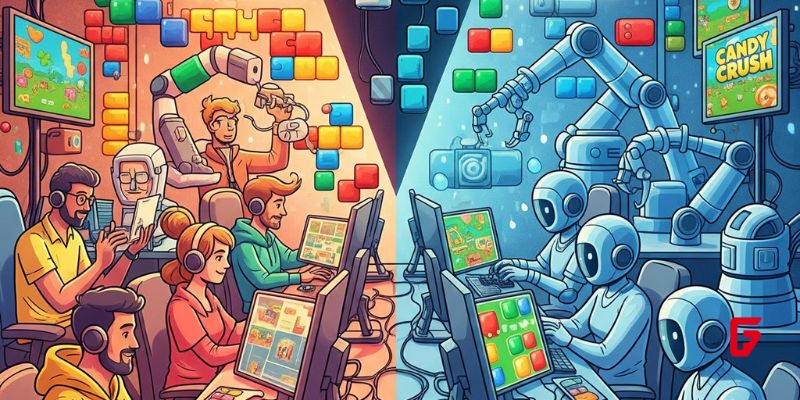
It’s a scenario out of a modern tech thriller: game developers who helped design AI tools found themselves out of work, with those same AI systems replacing their roles. This is the reality reportedly facing staff at King, the studio behind Candy Crush Saga—and it’s sparking intense debate about the future of the games industry.
In early 2024, King’s parent company, Activision Blizzard, initiated layoffs affecting hundreds of employees, including those at Candy Crush’s development studio. What’s particularly controversial is that some of these staff had actively contributed to the AI-powered tools that are now being used in their stead.
The very AI tools built for optimizing level design, play-testing, and player engagement are now performing critical jobs previously done by humans. According to reports, the company is leaning hard into automation for tasks like content creation and quality assurance. Think machine-generated levels and automated bug detection—all at a much faster pace than any human team could keep up with.
This case at King is more than a single incident; it’s a signal of broader shifts across the gaming sector. As game studios invest in more advanced AI and automation, concerns mount about job security, the future of creative work, and the human role in digital entertainment.
Developers’ skills and experience are being leveraged not just to build games, but also systems that can replace people.
AI-generated content can potentially lead to faster game updates, personalized user experiences, and cost savings for studios.
The tradeoff: possible loss of creative diversity and the unique touch that only human designers bring to celebrated franchises like Candy Crush.
There’s no denying the efficiency gains brought by automation, but this transition stirs up some serious questions:
Are we sacrificing creativity for speed?
Can an algorithm understand player fun as well as a team of designers?
Will other studios follow this model, risking similar fates for their teams?
What’s certain is that this trend is unlikely to stop. The digital games industry is looking for ways to balance AI-powered productivity with the value of human creativity.
The move by King’s parent company highlights the complex intersection of innovative technology and workforce disruption. For professionals in gaming, it’s a stark reminder: adapting to the age of AI may well mean building the very systems that could one day reshape, or even eliminate, your own job

AWS frontier agents introduce a new era of autonomous AI coders that can build, secure, and run applications for days at a time, acting like virtual teammates across dev, security, and DevOps while engineers retain final control over production changes.

Explore the cutting-edge ways AI is enhancing Lean Six Sigma, from real-time process insights to predictive controls, ushering in a new era of operational excellence and efficiency.

Facing supply chain challenges in 2025? High-performing teams leverage AI for risk management, demand forecasting, supplier analytics, and end-to-end visibility to ensure business continuity and resilience.

Craft an AI-powered supply chain Center of Excellence that unifies control tower visibility, analytics, and inventory optimization into one strategic hub. Explore this blueprint to learn how a modern supply chain CoE drives resilience, smarter decisions, and operational excellence in the age of AI.

Supply chain leadership is being redefined by AI, intelligent automation, and agentic decision-making, demanding leaders who can engineer end-to-end intelligence rather than simply manage workflows. This article explores how next-generation supply chain leaders will combine data, algorithms, and human judgment to build resilient, adaptive, and high-performing global operations.

Bridgit Mendler’s Northwood Space is pioneering mass-produced ground stations, enabling scalable, high-speed connectivity for the new era of satellite networks and megaconstellations.

SpaceX aims to nearly double launches from Vandenberg in 2025, facing support from federal agencies but strong objections from the state and local communities.

Traditional Medicare will pilot AI-assisted prior authorization in 2026 across six states, focusing on high-risk outpatient services. Clinicians retain final say, but incentives and access concerns loom as CMS tests fraud reduction and “gold card” exemptions. Here’s what providers and patients should know.

OpenArt’s new “one-click story” compresses scripting, visuals, and edits into ready-to-post short videos—fueling viral growth and a fresh IP debate. We break down how it works, adoption signals, what’s next (multi-character, mobile), and practical guardrails creators and brands should follow to stay original and compliant.

OpenAI’s o3 swept the Kaggle AI chess tournament, defeating xAI’s Grok 4–0. The victory fueled the intense rivalry between Altman and Musk, reshaping AI benchmarks.

NASA and Google’s AI-powered Crew Medical Officer Digital Assistant enables autonomous diagnoses for astronauts on Mars missions, redefining remote healthcare for space and Earth.

Pinterest’s CEO confirms that fully agentic AI shopping is years away, as the platform invests in AI-powered tools to enhance discovery, inspiration, and personalized shopping experiences for millions.
To provide the best experiences, we use technologies like cookies to store and/or access device information. Consenting to these technologies will allow us to process data such as browsing behavior or unique IDs on this site. Thanks for visiting futureTEKnow.