
Startups & Business News
China’s Lanyue Lander Test Puts Moon Ambitions into Overdrive
KEY POINTS
China completed its first full test of the Lanyue lunar lander, aiming for a crewed moon landing before 2030.
The test used a specialized facility simulating lunar terrain, marking a leap in China’s advanced space engineering.
The lander features redundant safety systems and life-support functions for astronauts.
China’s moon mission advances its rivalry with NASA’s Artemis program, intensifying the human space race.
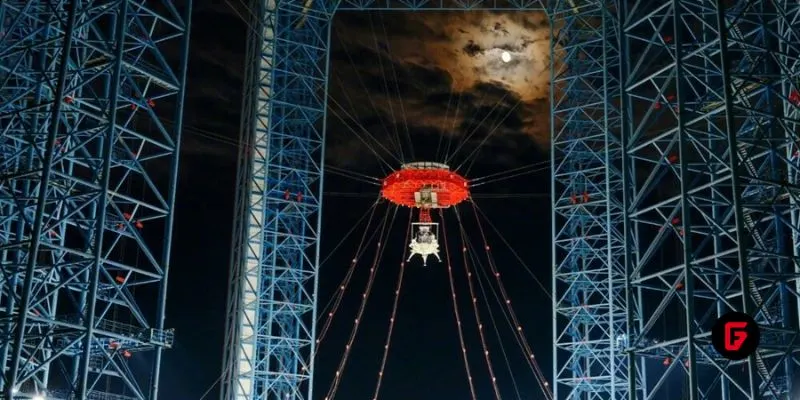
What Makes China’s Lunar Lander Test So Important?
How Does the Lanyue Lander Work, and Why Is It a Game-Changer?
Key engineering highlights include:
Redundant safety systems: The lander is equipped with multiple backup engines, ensuring the crew’s safety even if one set fails—a must for risk-prone lunar missions.
Landing stability: Four robust legs cushion and anchor the vehicle, while built-in systems are optimized for the moon’s uneven, unpredictable terrain.
Scientific capability: The lander can carry a lunar rover plus sophisticated science payloads, giving astronauts tools to explore and study the lunar surface in real time.
As Wang Xiaolei, a senior engineer at the China Academy of Space Technology, noted, crewed lander engineering is a quantum leap beyond robotics, with much greater size, mass, and life-support demands.
Why Is China’s Moon Program Accelerating Now?
Alongside the Lanyue lander, China is developing a full lunar transportation ecosystem:
Long March 10 rocket: Next-generation heavy lifter for lunar missions.
Mengzhou crew capsule: Designed for deep-space trips.
Wangyu lunar suit: Advanced extravehicular gear for surface activity.
Tansuo lunar rover: Robotic vehicle for scientific and support tasks.
New infrastructure is springing up at the Wenchang Space Launch Center, supporting both testing and future launches. These advances are a direct signal of China’s commitment to join, and possibly outpace, NASA in the coming “moonshot” era.
What Technologies Set China’s Mission Apart from Past Lunar Efforts?
Full-scenario simulation: Specialized test grounds enable rigorous “fail fast, fix fast” engineering before humans ever reach lunar orbit.
Human-robot teamwork: China’s plans emphasize robotic and crewed synergy, laying groundwork for future lunar bases.
Rapid prototyping: All mission hardware—from rockets to space suits—is progressing in parallel, reflecting a Silicon Valley–style “iterative engineering” rarely seen in national space programs.
As China throws down the lunar gauntlet, the world watches a new era of moon exploration unfold—where engineering ingenuity, national rivalry, and the dreams of interplanetary pioneers intersect.

futureTEKnow
Editorial Team
Discover the companies and startups shaping tomorrow — explore the future of technology today.



Trending Companies
Latest Articles
futureTEKnow is focused on identifying and promoting creators, disruptors and innovators, and serving as a vital resource for those interested in the latest advancements in technology.
© 2026 All Rights Reserved.