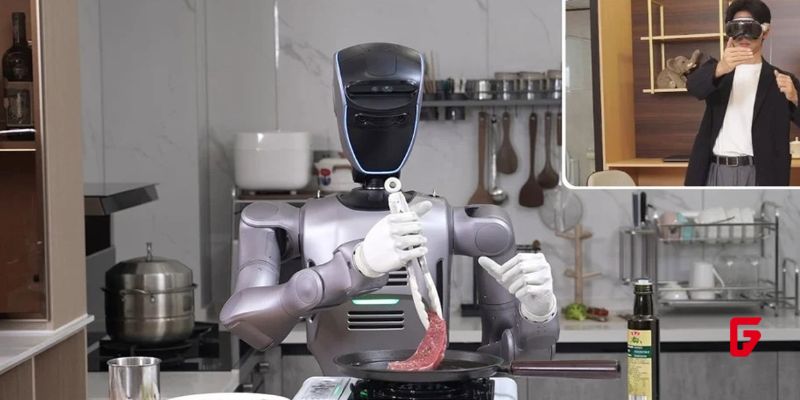
A Chinese humanoid robot recently demonstrated its ability to cook a steak by being remotely operated from 1,800 kilometers away using virtual reality (VR)—a spectacle that pushes the boundaries of both robotics and telepresence control. Developed by Shenzhen-based Dobot Robotics, the Atom model stands out not only for its dexterity and precision but also as a signpost for the future of remote labor and assistance.
How It Worked
In a captivating four-minute video, a Dobot engineer in Guangdong donned a VR headset and controlled Atom, stationed far away in Shandong province. The robot precisely mirrored the operator’s hand gestures in real time, carrying out a range of delicate culinary tasks:
Dabbing the steak with a paper towel
Pouring oil
Flipping the steak
Sprinkling salt with five-fingered hands, replicating human-like dexterity.
Atom’s control system boasts an accuracy of 0.05 millimeters, allowing for fine motor control that’s essential for tasks like cooking, surgery, or other situations where a soft touch is crucial. Currently, only Atom’s upper body is fully controllable via VR, but its developers suggest broader autonomy—including a human-like walking gait—could be coming next.
Why This Matters
This feat isn’t just a flashy tech demo—it signals potential breakthroughs in remote work, hazardous environment operations, and even medical procedures. The combo of high-accuracy robotics and VR teleoperation opens doors for human expertise to be delivered anywhere, anytime, not just in the kitchen but in:
Surgical theaters
Nuclear plant inspections
Space exploration (NASA has been developing similar technologies for controlling robots at a distance).
Robot Features and Specs
Launched: March 2025
Degrees of Freedom: 28, enhancing flexibility and lifelike movements
Hands: Five-fingered, capable of subtle, coordinated actions
Tasks Demoed: Steak cooking, breakfast preparation (placing toast, lettuce, fruit, pouring milk), walking.
The Atom robot is priced at around $27,500, marking it as one of the more accessible advanced robotics platforms for enterprises looking to explore teleoperation. Mass production and global delivery began recently, with Japan among the first international recipients.
What Sets This Apart
Unlike previous industrial robots or clunky remote-controlled machines, Dobot’s Atom blends AI-driven precision with intuitive, human-guided control—in other words, instead of programming each movement or relying on automation alone, the robot responds to live human decisions made thousands of miles away.
Implications and the Road Ahead
Remote-controlled humanoid robots like Atom could revolutionize labor, making high-skill expertise and assistance instantly available across geographies and industries:
Healthcare: Surgeons could operate in remote or isolated areas without leaving their home base
Disaster Response: Humans could perform hazardous tasks—such as bomb disposal or firefighting—from a safe distance
Luxury and Home Services: Remote personal chefs or cleaners could become a reality wherever high-speed networks allow.
As VR hardware continues to improve and AI-driven robots get even smarter, the line between physical and virtual labor will keep blurring. Dobot’s Atom marks an important step on that journey: a machine that brings the hands—and skills—of a human directly to where they’re needed most, no matter the distance.