






















Startups & Business News
KEY POINTS
Manus AI Wide Research unleashes 100+ parallel agents for large-scale, high-speed research and analysis.
Every agent is fully capable—no predefined roles—enabling flexible workflows and massive scale.
Built on dedicated cloud infrastructure, ensuring robust performance for demanding workloads.
Initially for Pro ($199/month) users; Plus and Basic tier rollout planned.
Big news is shaking up the world of artificial intelligence: Manus AI has just launched Wide Research, a breakthrough multi-agent system that runs over 100 AI agents in parallel. This release puts Manus at the forefront of automating complex, high-volume research tasks, challenging the traditional single-agent, step-by-step approach of competitors like OpenAI and Google.
Deep Research—the old standard for AI-powered investigation—relies on a single AI agent diving deep, sequentially handling sources, notes, and synthesis. It’s thorough, but dreadfully linear and slow for big jobs.
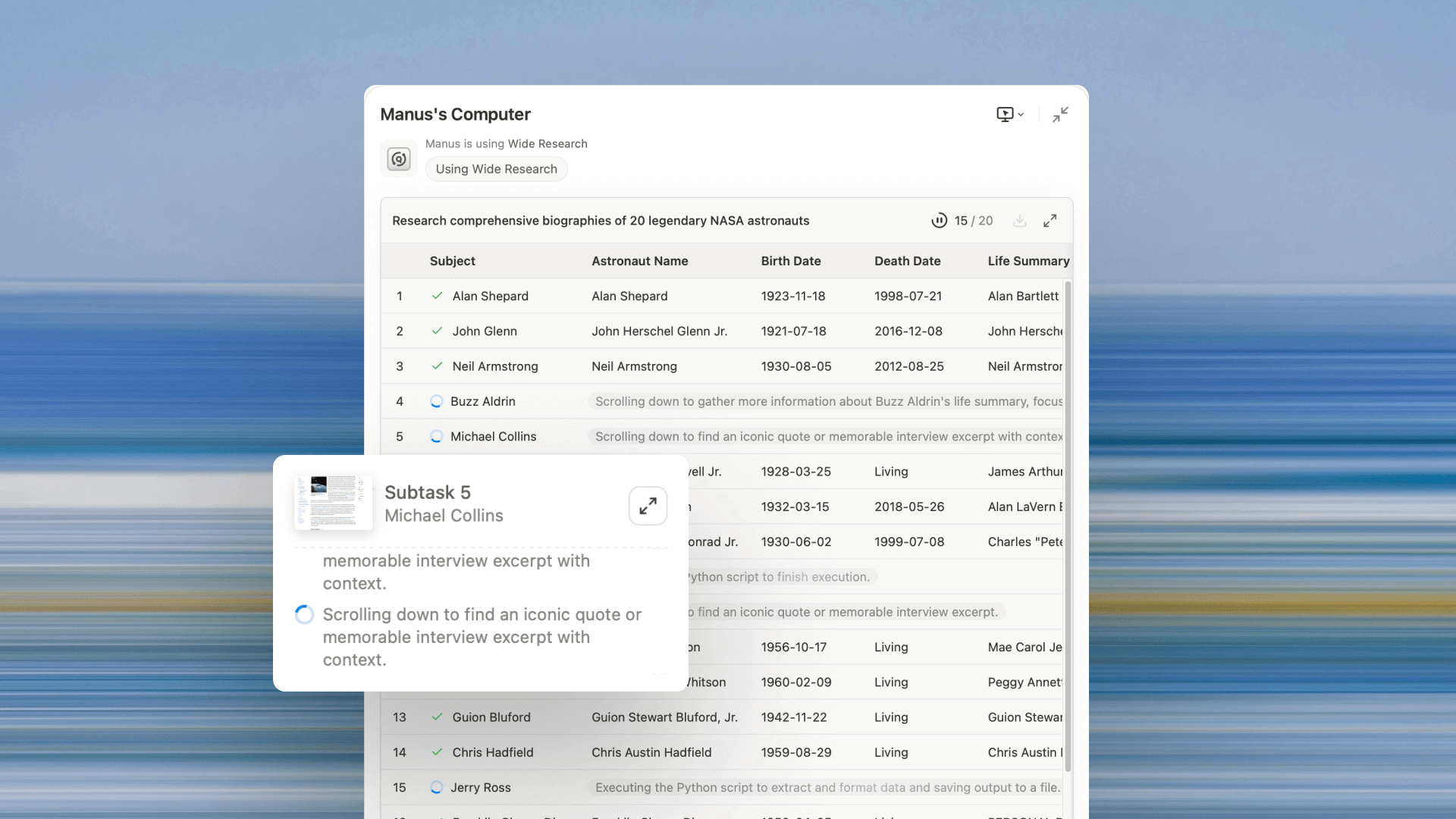
Wide Research flips this script. Instead of asking one agent to shoulder everything, Manus launches a swarm of up to 100 (or more) independent AI agents at the same time. Each one picks up a chunk of the problem—like profiling a company, comparing a product, or summarizing a document. When you need to analyze, say, one hundred sneaker models or compile social profiles for a list of Fortune 500 companies, Wide Research turns days of manual labor into results delivered in minutes.
Every agent in Wide Research isn’t just a dumb bot—it’s a fully general-purpose AI instance. This means every “subagent” has the power to research, synthesize, analyze, and create, totally free from pre-assigned narrow roles. They all communicate through a proprietary collaboration protocol, sharing findings and coordinating in real time. Behind the scenes, everything runs on dedicated virtual machines in the cloud, meaning massive compute firepower is always at your fingertips.
Practical uses span a wild spectrum:
Comparative research: Evaluate 100+ products or organizations in parallel.
Profiling: Rapidly pull public data for sales, recruiting, or sourcing targets.
Bulk analysis: Batch process images, text summaries, market reports, and more.
Creative work: Simultaneously generate dozens of design variations, content ideas, or marketing assets.
To make this happen, Manus invested in a large-scale virtualization backend. Forget the usual agent-manager hierarchy—Wide Research assigns each subagent as a full Manus instance on a private virtual machine. The result: robust scaling, greater stability, and flexible workflows that adapt to almost any imaginable task.
The agent cluster collaboration mechanism ensures agents split, tackle, and recombine their assigned tasks without getting in each other’s way. This isn’t just brute force—it’s smart parallel processing, with each agent adjusting its tactics as results come in.
Right now, Wide Research is available for Pro subscribers ($199/month), the same tier as advanced offerings from OpenAI. Gradual rollout is planned for Plus ($39/month) and Basic users, with no finalized date announced. Pricing reflects the sheer computational horsepower involved: running 100+ cloud agents simultaneously isn’t cheap, but the time savings for heavy-duty research are undeniable.
Compared to OpenAI’s and Google’s “deep research” tools, which tackle one thread at a time, Manus Wide Research shines in scenarios where breadth and speed matter. If you want one cohesive, super-detailed deep dive, single-agent systems are still strong. If you need to compare, fetch, or analyze many things at once, Wide Research is simply in another league.
Manus’s Wide Research isn’t just another AI tool—it’s a paradigm shift in how we handle research, data processing, and bulk creative tasks. For anyone who feels slowed down by traditional, step-by-step artificial intelligence (AI) tools, Wide Research signals a bold future: massive collaboration, done all at once, and available to every user—not just Silicon Valley giants.
Discover the companies and startups shaping tomorrow — explore the future of technology today.

Anvil Robotics is building a physical AI modular robotics platform that replaces fragmented, bespoke stacks with composable hardware, software, and

London-based Sona has raised a $45M Series B to turn its AI-native workforce platform into core infrastructure for frontline enterprises,

San Francisco-based Noon has raised $44M to build an AI-native product design platform that sits directly on live code, promising

Copenhagen-based Financial News Systems has raised €1.5M to build a fully AI-driven financial newsroom with no journalists in the loop.

Yuanjie Semiconductor’s photonic chips have gone from niche components to strategic assets in the AI data center race. This feature

Nvidia-backed Reflection AI is seeking a $2.5B round at a $25B valuation to build open-weight coding models as a U.S.

Pulsar Fusion’s Sunbird fusion rocket has achieved first plasma, validating its exhaust architecture and edging a reusable “space tug” concept

Aetherflux is betting that orbital data centers can power the next wave of AI, shifting from laser power beaming to

Harvey has raised $200M at an $11B valuation to scale more than 25,000 custom AI agents across law firms and

Mirage, the company behind the Captions app, has raised $75M from General Catalyst’s Customer Value Fund to build new AI

Amazon’s acquisition of Fauna Robotics brings the Sprout humanoid development platform into its Personal Robotics Group, highlighting a safety-first, developer-led

Interloom has raised $16.5M to build an enterprise memory layer that captures expert decisions and gives AI agents the context
futureTEKnow is focused on identifying and promoting creators, disruptors and innovators, and serving as a vital resource for those interested in the latest advancements in technology.
© 2026 All Rights Reserved.