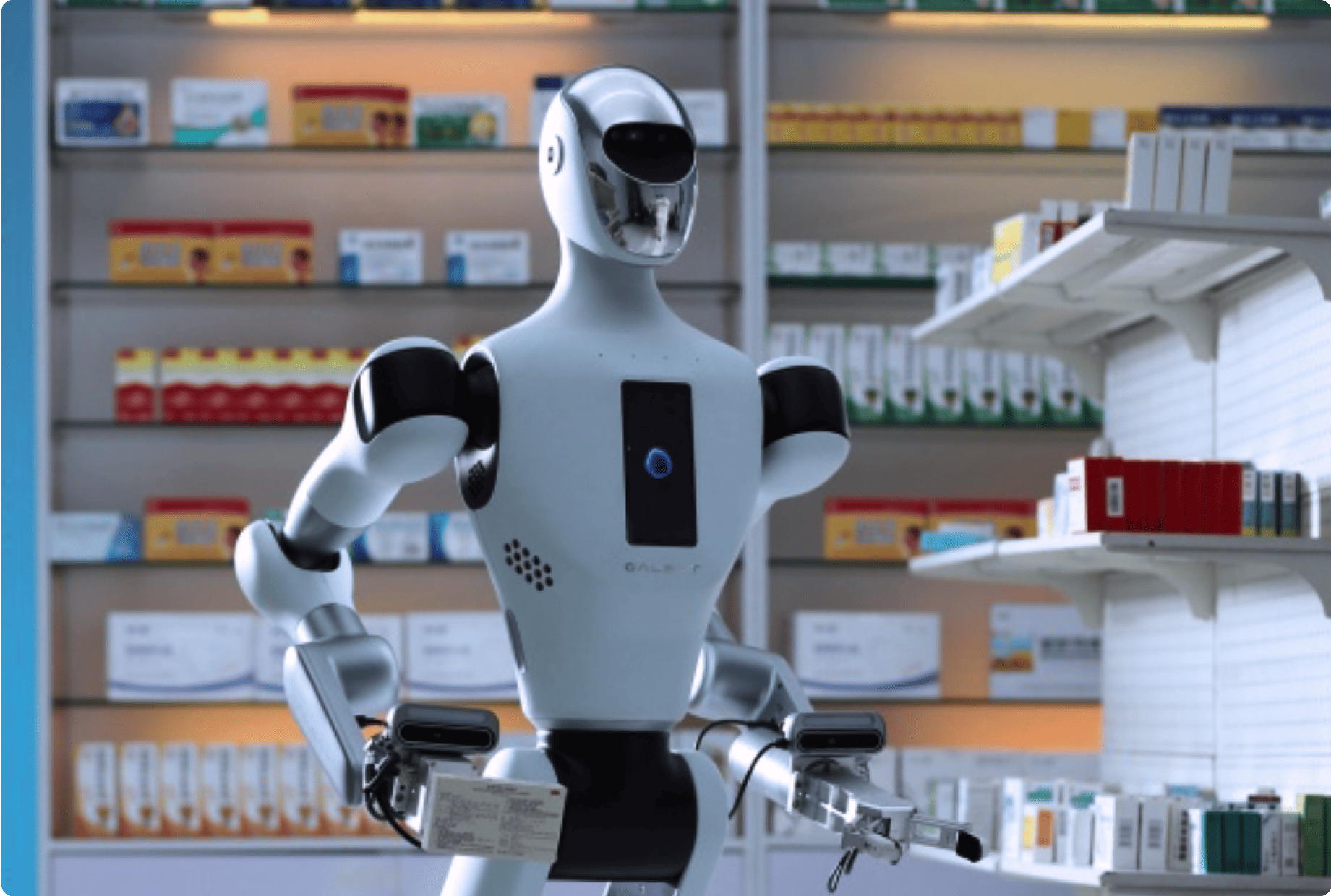
Humanoid robots have long captured the world’s imagination, but until now, scaling their real-world deployment has been slowed by the enormous cost and difficulty of gathering the real-world data needed to train them. Beijing-based Galbot has turned this obstacle into a stepping stone, pioneering a radical simulation-to-reality (Sim2Real) approach that is changing the rules of the game.
At the heart of Galbot’s breakthrough is a new strategy: massive pre-training of robots with high-quality synthetic data—scenarios generated virtually—followed by surgical fine-tuning with a minimal set of real-world examples. This dramatically reduces the need for expensive, laborious data-collection in real warehouses and factories, empowering robots to quickly and efficiently adapt from simulation to messy, unpredictable reality.
As Galbot’s co-founder Zhang Zhizheng sums up, skills learned in simulation now “seamlessly transfer into novel real-world contexts with minimal semantic relabeling.” This is not just a technical milestone—it is a true paradigm shift for the industry.
From Start-Up to Industry Player: Galbot Scales Up
Founded in 2023, Galbot’s growth has been nothing short of meteoric. The company raised over 2.4 billion yuan (about $335 million), with major backers like battery giant CATL. Galbot humanoid robots are already performing sophisticated logistics tasks—retrieving medicines, navigating crowds, and delivering orders—inside more than 10 pharmacies in Beijing, moving towards a vision of 100 robot-run stores by year’s end. Their strength lies in autonomy: these robots perform all tasks without human intervention—a goal that once seemed distant for robotics.
Industry Partnerships and High-Stakes Tests
To fast-track industrial adoption, Galbot has teamed up with Bosch, launching a joint venture focused on embodied AI for factory manufacturing. In high-precision environments, where a single error can cascade into huge costs, Galbot robots aim for accuracy rates between 99.9% and 99.99%—a level of reliability only possible through vast, diverse training data. Galbot’s custom Vision-Language-Action models, trained on over 10 billion robotic actions, highlight their proprietary edge.
The partnership leverages Bosch’s industrial know-how—and the result is not just theoretical. At the 2025 World AI Conference in Shanghai, Galbot’s robots stole the spotlight by live-demonstrating their skills: grasping both soft snacks and rigid bottles from tangled supermarket shelves, handling unpredictable items with poise and precision. This wasn’t programmed choreography but rather evidence of a system that generalizes from training to anything the real-world can throw at it.
Humanoid Robotics: The Next Growth Engine
China’s humanoid robot sector is rocketing forward. Projections from the China Academy of Information and Communications Technology estimate the market will reach more than 100 billion yuan ($13.6 billion) by 2030, up from just 2.76 billion yuan in 2024—mirroring the optimism of global forecasts, with Goldman Sachs envisioning a $154 billion global market for humanoid robots by 2035. Central and local governments in China are turbo-charging development with specialized pilot zones and manufacturing innovation centers.
The future is not confined to logistics: factory automation, retail, healthcare, and public services are all set to benefit from embodied AI systems like Galbot’s. As the world faces demographic shifts and labor shortages, the timing could not be better.
Practical Autonomy in Action
It’s easy to get swept up in the technological promise, but the real test of a robot’s value is on the shop floor or pharmacy counter. Galbot’s success isn’t about flashy demonstration—it’s the robot’s ability to consistently execute, adapt, and problem-solve across environments, bringing real productivity where it matters most. That’s why industry giants and investors are betting big on Sim2Real models—the foundation to unlock true autonomy in robotics for the decade ahead.