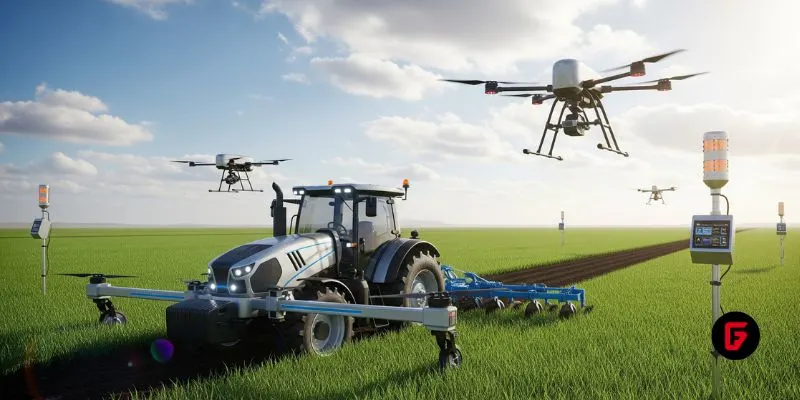
The global agricultural robot market will reach over $18.2 billion by 2025, boosted by precision farming and a pressing need for labor-saving solutions.
Robots perform myriad farm tasks, including planting, weeding, harvesting, and crop health monitoring, dramatically improving yield and efficiency.
The rise of drones and autonomous tractors enables real-time field insights and consistent, resource-saving farm management.
Challenges remain, including high upfront costs and the need for tech-savvy operators, but the sector grows thanks to innovation, government support, and sustainability mandates.

The agricultural robot market is riding a wave of momentum as demand accelerates for more productive, efficient, and sustainable farming solutions. Major drivers include:
Labor shortages: With populations shifting and declining interest in manual farm work, robots are stepping in where humans are harder to find.
Global food demand: The UN estimates the world’s population will surpass 8.6 billion by 2030, increasing pressure on farms to produce more with less waste.
Precision agriculture: Robotic systems offer pinpoint accuracy for tasks like weeding and fertilizing, dramatically reducing pesticide and resource wastage.
Environmental stewardship: Robots can target applications, helping conserve water, minimize chemicals, and improve sustainability.
| Statistic | Value / Detail |
|---|---|
| Global Market Size (2024) | USD 16.6 billion |
| Projected Market Size (2029) | USD 51.0 billion |
| Projected CAGR (2024–2029) | 25.2% |
| Estimated Market Size (2025) | USD 18.2 billion |
| Longer-term Market Projection (2030) | USD 48.06 billion |
| Longer-term Market Projection (2034) | USD 92.4 billion |
| CAGR (2023–2028) | 24.3% |
| U.S. Market Size (2024) | USD 3.1 billion |
| U.S. Market Forecast (2033) | USD 8.6 billion |
| U.S. Market CAGR (2025–2033) | 11.43% |
| Global Market Size (2024, alternate estimate) | USD 7.34 billion |
| Global Market Forecast (2032) | USD 26.35 billion |
| Projected CAGR (2025–2032) | 18.3% |
| Agricultural Robots and Drones Market Size (2025) | USD 7.43 billion |
| Agricultural Robots and Drones Market Forecast (2034) | USD 24.26 billion |
| Market Growth Drivers | Labor shortage, food demand rise, precision agriculture, sustainability mandates |
| Market Challenges | High upfront costs for small farms, technical complexity |
| Leading Regions | North America (dominant), Asia Pacific (fastest growing) |
| Emerging Trends | AI integration, autonomous tractors, crop-specific robots, electrification, modular designs |
The benefits of robotic farming are already reshaping agriculture in profound ways:
24/7 operation: Robots don’t tire, allowing farms to extend planting and harvesting windows around the clock.
Real-time monitoring: High-tech sensors and AI-powered algorithms deliver instant feedback on crop health and soil conditions, letting farmers catch issues early.
Reduced labor costs: Automating repetitive, labor-intensive tasks means farms operate with fewer workers, minimizing payroll and streamlining operations.
Better yields: From precision planting to drone-based field surveying, every facet of robot-assisted farming aims to boost overall productivity and crop quality.
Sustainability: Robots enable site-specific management, using resources only where needed and supporting eco-friendly farming practices.
Agricultural robots aren’t just limited to autonomous tractors. Watch for these standout innovations in 2025 and beyond:
Collaborative robots (“Cobots”): Designed to work alongside humans—especially for delicate tasks like fruit picking—reducing physical strain and increasing output.
Indoor & vertical farming robots: As urban food production grows, specialized robots manage crops in greenhouses and indoor farms, guaranteeing year-round quality.
Livestock management robots: Automated milking systems, feeding bots, and health monitors are revolutionizing animal agriculture.
Modular and customizable robotics: Farmers can tailor robots for specific needs, maximizing efficiency for unique crops and environments.
Despite their advantages, agricultural robots aren’t without hurdles:
High upfront investment: Robotics installation can be costly, especially for small and family-run farms.
Skill requirements: Operating and maintaining these advanced systems often demands technical expertise that rural teams may lack.
Environmental challenges: Tough terrain and extreme weather can sometimes slow robot adoption or performance.
Awareness gap: Not all farmers are fully aware of the benefits or possibilities that robotics brings, though this is changing through outreach and government support.

Editorial Team
futureTEKnow is a leading source for Technology, Startups, and Business News, spotlighting the most innovative companies and breakthrough trends in emerging tech sectors like Artificial Intelligence (AI), Robotics, and the Space Industry.
Discover the companies and startups shaping tomorrow — explore the future of technology today.

This article explores 10 AI-driven supply chain optimization companies to watch in 2026, highlighting how their platforms improve forecasting, logistics,

AWS frontier agents introduce a new era of autonomous AI coders that can build, secure, and run applications for days

Explore the cutting-edge ways AI is enhancing Lean Six Sigma, from real-time process insights to predictive controls, ushering in a

Facing supply chain challenges in 2025? High-performing teams leverage AI for risk management, demand forecasting, supplier analytics, and end-to-end visibility

Craft an AI-powered supply chain Center of Excellence that unifies control tower visibility, analytics, and inventory optimization into one strategic

Supply chain leadership is being redefined by AI, intelligent automation, and agentic decision-making, demanding leaders who can engineer end-to-end intelligence

WisdomAI has closed a $50M Series A led by Kleiner Perkins and Nvidia’s NVentures to turn fragmented enterprise data into

Bridgit Mendler’s Northwood Space is pioneering mass-produced ground stations, enabling scalable, high-speed connectivity for the new era of satellite networks

SpaceX aims to nearly double launches from Vandenberg in 2025, facing support from federal agencies but strong objections from the

Traditional Medicare will pilot AI-assisted prior authorization in 2026 across six states, focusing on high-risk outpatient services. Clinicians retain final

OpenArt’s new “one-click story” compresses scripting, visuals, and edits into ready-to-post short videos—fueling viral growth and a fresh IP debate.

OpenAI’s o3 swept the Kaggle AI chess tournament, defeating xAI’s Grok 4–0. The victory fueled the intense rivalry between Altman
To provide the best experiences, we use technologies like cookies to store and/or access device information. Consenting to these technologies will allow us to process data such as browsing behavior or unique IDs on this site. Thanks for visiting futureTEKnow.