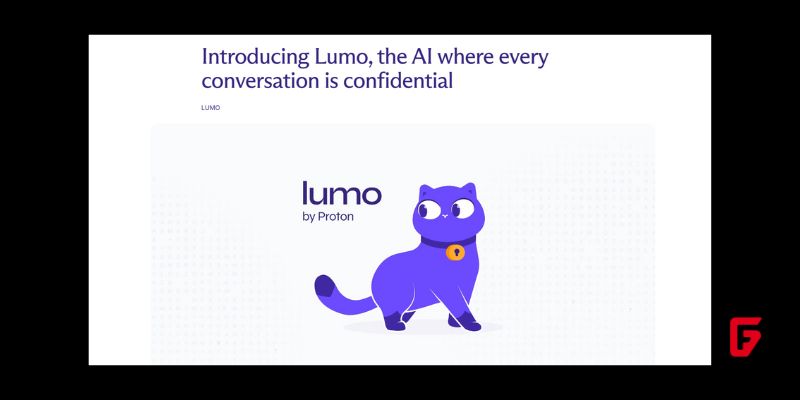
Proton, the renowned privacy-focused company behind Proton Mail and Proton VPN, has launched Lumo, an innovative AI assistant designed specifically to prioritize user privacy and security above all else. Unlike popular AI chatbots such as ChatGPT, Google Gemini, and Anthropic’s Claude, Lumo protects conversations with end-to-end encryption and zero-access storage, ensuring that user data remains completely confidential.
Privacy-Centric Features Setting Lumo Apart
Lumo’s key strength lies in its privacy-first architecture. All conversations are encrypted and decrypted only on the user’s device, preventing Proton—even as the service operator—from accessing or using the chat data for AI training or any other purpose. This represents a stark contrast to other AI services, which typically retain user inputs on servers for days or weeks and may use them to refine their models.
Additional privacy-boosting features include:
Ghost Mode: Chats vanish permanently as soon as they are closed, offering a temporary session without saving history.
Selective Web Searches: Web search in Lumo is disabled by default to maximize privacy but can be enabled to use privacy-focused search engines.
File Uploads: Users can securely upload and analyze files without Proton retaining any of that data.
Integration with Proton Drive: Allows direct interaction with encrypted cloud documents without compromising confidentiality.
These design choices make Lumo especially appealing for users dealing with sensitive information such as legal documents, health data, or confidential emails.
How Lumo Operates: Open-Source Models & European Data Centers
Lumo runs on open-source language models like Mistral’s Nemo and Nvidia’s OpenHands 32B. Unlike AI services hosted in the United States that fall under more lenient data regulations, Proton operates Lumo from European Union data centers, subject to stringent privacy protections. This geographic and regulatory positioning better safeguards user data from governmental surveillance and third-party demands.
User Experience and Access Options
Lumo is available for free use in guest mode with limited queries and a free tier for Proton users. For heavy users or professionals needing enhanced capabilities such as unlimited chats, file uploads, and extended history, the Lumo Plus subscription is priced competitively at $12.99/month, undercutting rival premium AI services.
Users can access Lumo easily through web browsers or via dedicated mobile apps for iOS and Android, integrating smoothly with Proton’s wider ecosystem to provide encrypted productivity tools.
Why Lumo Matters in the AI Landscape
As AI chatbots become ubiquitous, concern over privacy erosion and surveillance capitalism grows. Proton’s CEO Andy Yen emphasized that Lumo is designed to “create AI that prioritizes people over profit.” This marks a significant step in addressing growing user demand for AI services that do not undermine personal data rights.
In a climate where major AI companies often rely on vast user data collection for model training, Lumo’s commitment to transparent, encrypted, and user-controlled AI interaction introduces a new paradigm for trust in generative AI technology.